I haven’t been a Johnny Cash fan for very long. I’m ashamed to admit it, really, because his catalog has always been one of those holes in my CD collection that I know is there but have no idea where to start filling it in. His career began in an era where “records” were singles, not “albums,” so there are so many different collections of his work, it was too overwhelming to go out and pick one. So I only have “American III,” “American IV,” and “Live at San Quentin”—and, of course, I love them.
But after seeing “Walk the Line,” I must have much, much more, because this movie is so stunning, it must be considered one of the greatest movies about rock and roll of all time.
It all starts with Joaquin Phoenix, who spent a year and a half in vocal training to sing like Johnny Cash. Yes, he does all his own vocals and the results are unbelievable. Phoenix disappears into the character, not only through Cash’s throaty inflections in both singing and speaking voices, but also the way he holds the guitar and attacks the microphone onstage. He commandeers the same commanding presence that only a person dubbed the “Man in Black” could manage. There are times in this movie—much like Val Kilmer’s portrayal of Jim Morrison in 1991’s “The Doors”—that just listening to the music, it’s hard to tell whether or not that’s actually Cash. It’s a shame that Jamie Foxx won an Oscar last year for a similar role (albeit an inferior performance, compared to Phoenix), because I doubt the Academy would give back-to-back awards for a music biopic, no matter how deserving.
But as good as Phoenix is, the emotional center of “Walk the Line” is actually found in Reese Witherspoon’s June Carter, the woman who would eventually become not only the love of Cash’s life, but his path to salvation, as well. Witherspoon also does all her own singing and is equally as fabulous in this role, unarguably the best of her career. When she and Phoenix take the stage for the first time, the screen crackles with energy that sustains the rest of the way.
Everyone knows Johnny and June went on to get married and spent the second half of their lives essentially inseparable. “Walk the Line,” directed by James Mangold (“Girl, Interrupted”) and with a script approved by Cash himself, shows us how they got there.
It opens with John as a young boy who can’t tear himself away from the radio, much to his father’s chagrin. When tragedy strikes the family, John takes the brunt of his father’s drunken, abusive anger (played well by Robert Patrick). From there we jump ahead to John’s early adulthood, as he struggles to make ends meet with a wife (Vivian, played by Ginnifer Goodwin) and children. The first great scene in the movie comes when Johnny and his two buddies audition for label-owner Sam Phillips (Dallas Roberts), who helps Cash find his real voice and starts him on the road to superstardom.
(On a side note, "Walk the Line" also highlights pop music in its infancy, when the unbelievable lineup of Cash, Elvis, Jerry Lee Lewis, Roy Orbison, and many more all toured on the same bill, traveling from hall to hall in a caravan of cars. In an era when you have to choose sides between "sellouts" or indie "cred," it's so refreshing to look back on an era when music was just about talented artists wanting to put their work in front of the public and entertain them. Where did it all go wrong?)
Trouble finds Johnny early and often on the road, as childhood guilt and access to fame, fortune, women, and, most importantly, drugs lead him on a self-abusive path to near-destruction. Life on tour shreds his marriage and his career, leaving June—who no matter how many times she was hurt never quit seeing the good in him—to pick up the pieces. The film’s climax is Cash’s legendary performance at Folsom Prison, which is filmed so well, you’d swear it was a documentary. This film is meant to be turned up loud.
People’s real lives don’t lend themselves to making great movies, because nobody’s story ever has an actual dramatic arc to it—especially one that can be boiled down into a couple hours. That’s why biopics are so hard to pull off—inevitably they become just a series of scenes, rather than a seamless whole (see last year’s “Ray” or “The Aviator” for proof).
But that challenge is what makes Mangold’s work here such a triumph. John and June’s story is so transcendent and the performances so brilliant, you don’t have to be a Johnny Cash fan to love this film. It’s the best thing I’ve seen this year.
Grade: A
Monday, November 21, 2005


ZooTV 2005: It just keeps going, and going, and going …
Wednesday marks the one-year anniversary of U2’s “How to Dismantle an Atomic Bomb,” and what a calendar it’s been. Over the past 363 days, the band has sold several million copies of its latest near-masterpiece, played 97 concerts (all sellouts, with two more tonight and tomorrow at MSG) to rabid fans in Europe and North America (and soon the world), released a DVD to commemorate the Vertigo//2005 experience, pushed Apple’s iPod into uncharted territory, and been featured on television too many times to count.
It’s the latter that has me all worked up this morning. U2 was on CBS twice last week—they participated via taped recording in a Johnny Cash tribute special Wednesday night and then were featured in a lengthy story for “60 Minutes” on Sunday.
For the Cash show, the band pulled out “The Wanderer,” closing track from 1993’s “Zooropa” which featured the Man in Black himself on lead vocals. For this performance, Bono took Cash’s part, and I am continually amazed at the resurgence in his voice after essentially a decade of decline. This was the first time “Wanderer” has been played live (that anyone in the public’s ever heard, anyway), and it made me wonder where it’s been all these years. The rendition was absolutely brilliant and a fitting tribute to Cash, whose life story is currently on silver screens all across America in the fabulous biopic “Walk the Line,” starring Joaquin Phoenix and Reese Witherspoon.
The “60 Minutes” piece was similarly outstanding in that I was surprised I could learn anything new from a U2 interview at this point, what with all the media saturation they’ve received in the past year. But I was literally laughing out loud right off the bat when Bono was asked, “Do you still want to be the biggest band in the world?” and he replied with a classic, “Want? What want? Line them up!”
He then went on to talk about the Beatles and had the guts to say they had “their heads up their arses” in the late ’60s, allowing the most important group in rock and roll history to implode because of ego and money. Kudos.
Bono also praised the Bush administration and conservative Christians for their roles in making AIDS relief in Africa a reality. Meanwhile, he slammed the French for being the world’s biggest snobs (priceless); Adam talked about why they fled Britain (where the Irish weren’t looked upon with favor, to say the least) and found solace in the arms of America; Larry discussed what it was like growing up in a country where you feared for your life on a daily basis; and The Edge tried to explain how they manage to keep a level head in a world where they live like (or better than) kings.
Usually I tape U2 stuff on TV, but, unfortunately, I didn’t set the VCR last night. I honestly thought to myself, “I’ll have heard all this stuff before, so why bother?” Now, of course, I wish I could watch that interview again. It stuns me that U2 is still capable of stunning me every time I see them.
But let me get back to the album that started all this madness. In my review of “Atomic Bomb” (click the November 2004 link on the right side of this page to find it), I wrote it would take hearing the songs live before making final judgment on where this collection stands in the U2 pantheon. Little did I know it would be nearly a YEAR before I got my eyes and ears on the band, but it was certainly worth the wait. (In case you missed my obscenely long review of U2 in D.C., click on the October 2005 link.) As far as the new songs went, Vertigo//2005 was everything I could hope for, because all of the “Bomb” songs I heard came off not just well, but great, including “Yahweh,” which should have been arranged acoustically on record, the same way it’s performed in concert.
For the recent (enormous) interview with Rolling Stone, in a bit of genius, Bono was asked to review all of his own albums. What he says about “Atomic Bomb” puts into words much of what I, too, feel about the record: “It’s the best collection of songs we’ve put together [I don’t agree with this, though]—there’s no weak songs. But as an album, the whole isn’t greater than the sum of its parts, and it fucking annoys me.”
I would argue “Atomic Bomb” is a second-tier U2 album, behind only “Achtung Baby” and “The Joshua Tree,” and right alongside “Zooropa” and “All That You Can’t Leave Behind.” Do U2 have another masterpiece in them? At this point, with the Vertigo tour already slated to extend well into 2006 (there have been rumors of a North American stadium leg over the summer), it will probably be 2008 at the earliest before even the possibility of a new album—more likely 2009. By that time all of the boys will be nearly 50-year-old men, and it will take a Herculean effort to maintain relevance in a world skewing younger and younger all the time (although, I said the same thing about this record). Bono believes his band hasn’t done its greatest work yet. If that’s true, I believe that in order for them to find another “masterpiece,” they won’t be able to try and recapture and reimagine the sounds of their youth. Instead, the next album will have to be something from left field, something so completely different and thrilling, something un-U2 and U2 at the same time, that it shakes everyone up—for, what, the third or fourth time?
U2 have already done more in rock and roll as 40-year-olds than any of their predecessors—ever. If they are somehow able to stay relevant in their 50s … well, I guess I shouldn’t put anything past them at this point.
It’s the latter that has me all worked up this morning. U2 was on CBS twice last week—they participated via taped recording in a Johnny Cash tribute special Wednesday night and then were featured in a lengthy story for “60 Minutes” on Sunday.
For the Cash show, the band pulled out “The Wanderer,” closing track from 1993’s “Zooropa” which featured the Man in Black himself on lead vocals. For this performance, Bono took Cash’s part, and I am continually amazed at the resurgence in his voice after essentially a decade of decline. This was the first time “Wanderer” has been played live (that anyone in the public’s ever heard, anyway), and it made me wonder where it’s been all these years. The rendition was absolutely brilliant and a fitting tribute to Cash, whose life story is currently on silver screens all across America in the fabulous biopic “Walk the Line,” starring Joaquin Phoenix and Reese Witherspoon.
The “60 Minutes” piece was similarly outstanding in that I was surprised I could learn anything new from a U2 interview at this point, what with all the media saturation they’ve received in the past year. But I was literally laughing out loud right off the bat when Bono was asked, “Do you still want to be the biggest band in the world?” and he replied with a classic, “Want? What want? Line them up!”
He then went on to talk about the Beatles and had the guts to say they had “their heads up their arses” in the late ’60s, allowing the most important group in rock and roll history to implode because of ego and money. Kudos.
Bono also praised the Bush administration and conservative Christians for their roles in making AIDS relief in Africa a reality. Meanwhile, he slammed the French for being the world’s biggest snobs (priceless); Adam talked about why they fled Britain (where the Irish weren’t looked upon with favor, to say the least) and found solace in the arms of America; Larry discussed what it was like growing up in a country where you feared for your life on a daily basis; and The Edge tried to explain how they manage to keep a level head in a world where they live like (or better than) kings.
Usually I tape U2 stuff on TV, but, unfortunately, I didn’t set the VCR last night. I honestly thought to myself, “I’ll have heard all this stuff before, so why bother?” Now, of course, I wish I could watch that interview again. It stuns me that U2 is still capable of stunning me every time I see them.
But let me get back to the album that started all this madness. In my review of “Atomic Bomb” (click the November 2004 link on the right side of this page to find it), I wrote it would take hearing the songs live before making final judgment on where this collection stands in the U2 pantheon. Little did I know it would be nearly a YEAR before I got my eyes and ears on the band, but it was certainly worth the wait. (In case you missed my obscenely long review of U2 in D.C., click on the October 2005 link.) As far as the new songs went, Vertigo//2005 was everything I could hope for, because all of the “Bomb” songs I heard came off not just well, but great, including “Yahweh,” which should have been arranged acoustically on record, the same way it’s performed in concert.
For the recent (enormous) interview with Rolling Stone, in a bit of genius, Bono was asked to review all of his own albums. What he says about “Atomic Bomb” puts into words much of what I, too, feel about the record: “It’s the best collection of songs we’ve put together [I don’t agree with this, though]—there’s no weak songs. But as an album, the whole isn’t greater than the sum of its parts, and it fucking annoys me.”
I would argue “Atomic Bomb” is a second-tier U2 album, behind only “Achtung Baby” and “The Joshua Tree,” and right alongside “Zooropa” and “All That You Can’t Leave Behind.” Do U2 have another masterpiece in them? At this point, with the Vertigo tour already slated to extend well into 2006 (there have been rumors of a North American stadium leg over the summer), it will probably be 2008 at the earliest before even the possibility of a new album—more likely 2009. By that time all of the boys will be nearly 50-year-old men, and it will take a Herculean effort to maintain relevance in a world skewing younger and younger all the time (although, I said the same thing about this record). Bono believes his band hasn’t done its greatest work yet. If that’s true, I believe that in order for them to find another “masterpiece,” they won’t be able to try and recapture and reimagine the sounds of their youth. Instead, the next album will have to be something from left field, something so completely different and thrilling, something un-U2 and U2 at the same time, that it shakes everyone up—for, what, the third or fourth time?
U2 have already done more in rock and roll as 40-year-olds than any of their predecessors—ever. If they are somehow able to stay relevant in their 50s … well, I guess I shouldn’t put anything past them at this point.
Tuesday, November 15, 2005
A Shot in the Arm: Jeff Tweedy, solo and acoustic, at Messiah College, 11.12.05
In a recent Billboard interview, Jeff Tweedy, founder and frontman of Wilco, said he loves occasionally going out on solo tours simply for the freedom. During a typical Wilco show, he can’t pull any old song out of his head because he has the rest of the band to think of. On stage by himself, Tweedy can play anything he wants.
Maybe it’s time to dump the band.
Okay, of course that’s an exaggeration. But solo Tweedy is a refreshing change from the new-millennium Wilco, the band now tinged with too much Sonic Youth-esque “experimentation.” The group’s last two albums make you work to find the melodies and great songs are hidden behind layers and layers of ambient noise and sound effects.
I’ve come to love Wilco’s now-legendary “Yankee Hotel Foxtrot” from 2002, the record that cost the band its original record deal because they refused to tone it down in search of a radio-friendly hit. As chronicled in the 2003 documentary “I Am Trying To Break Your Heart,” Wilco stuck to its guns and made the album it wanted, even if it took an extra year for the set to find record store shelves. With that kind of stick-it-to-the-man backstory, “Foxtrot” was overhyped by critics, the majority of whom were crawling over top of one another to be the first to call the album a masterpiece.
On first listen, I simply didn’t hear it. Nor did I get it the second time through, or even the third. No, it probably took six months or more before I finally “got” it. My friend and I now use the album as a label for other similar albums. Yeah, that new PJ Harvey album is a “Yankee Hotel Foxtrot” situation, we say. And I still skip a few songs with regularity.
Things only got more inscrutable with Wilco’s much-anticipated follow-up, 2004’s “A Ghost is Born” (I refuse to use the pretentious lowercase style on the cover). There are some good songs on there, but they’re either surrounded or buried by even more masturbatory noodling than the previous set. “Spiders (Kidsmoke)” is a fabulous riff hidden amongst 10 minutes of filler—and that’s not even the longest track on the album! “Less Than You Think” clocks in at an untenable 15 minutes, which concludes with 12 minutes of atonal beeps, squawks, and squeals.
“Ghost” is actually the culmination of the musical journey Tweedy’s been on for more than a decade, dating back to his days with the glorious alt-country band Uncle Tupelo (they basically invented the genre back in the late ’80s, paving the way for Ryan Adams, the Jayhawks, and many more before calling it quits in the early ’90s). It’s my feeling Tweedy has always considered himself more than just a lowly rock and roll singer—he’s an artiste who refuses to be pegged into something as awfully mundane as “alt-country.” You can hear it written all over the Uncle Tupelo songs; just listen to the differences between songs like “Graveyard Shift”—fronted by Tupelo co-founder Jay Farrar—and Tweedy’s “Gun.” On the surface, they sound basically the same, but “Gun” (a great song, mind you) has some choppy, melody-killing moments that are precursors of what Wilco would become. Farrar, on the other hand, went on to embrace his genre in new band Son Volt; Tweedy would spend the next decade moving as far away from alt-country as possible. Ironically, neither may quite be as good apart as they were together (Son Volt certainly isn’t as good as Wilco). You could call them the McCartney (Farrar) and Lennon (Tweedy) of alt-country.
Trouble is, Tweedy’s been moving away from what he does best. Never was that more apparent than Saturday night during his solo set at Messiah College in Grantham, Pennsylvania.
I’m thinking specifically of one song that illustrates this whole point: “I Am Trying To Break Your Heart,” the opening track from “Foxtrot.” On the album, this song is so choppy and overwhelmed by bells and whistles, it’s almost a non-starter and it’s to blame for keeping me from getting into the album back when I first heard it. “Break Your Heart” sets the tone for the entire set—and it’s off-putting.
Played live with no band getting in the way, however, this is one great song. The stripped-down acoustic version allows Tweedy to let the melody roll along, highlighting a stirring lyric about admitting how stubborn, stupid, and irrationally hurtful we can be, even in the face of true love. It was one of my favorite songs of the night.
But I’m getting ahead of myself—and the setlist.
Everything about this setup is perfect for the type of vibe Tweedy is trying to create: He walks on stage with no fanfare whatsoever (other than a roaring crowd), steps into a spotlight that never wavers for the entire main set (no light show, just a bare bulb for the first 1:15), and walks up to a single microphone on a stage that allows the huddled masses to get within arm’s reach of their low-key troubadour.
Tweedy’s battle with drug addiction has been well publicized and, thankfully, he seems to have finally kicked all of his bad habits (he mentioned this several times throughout the night), including cigarettes. It’s all done him good, because it’s apparent right from opener “Sunken Treasure” that his voice is as good or better than it’s ever been. His gravelly baritone still breaks and cracks in all the right spots (sometimes flaws can be the biggest strengths), but when he wants to, he can now nail high parts with crystal clarity. For anyone who’s seen the version of “Treasure” on the documentary DVD, the version he’s now capable of pulling off is so much better, there’s really no comparison.
Tweedy was quite chatty throughout the show, and some of it may be attributed to nervousness at playing his second Christian campus in less than a week. After “(Was I) In Your Dreams,” he began what would be a rather lengthy discussion of religion that stretched across the next two songs. I never had any illusions that Tweedy is a Christian, and that notion was confirmed Saturday night; he did say he was flattered to be asked to play the campus (he was the headliner for a two-day conference on Christians engaging popular culture), and he “admires” Jesus Christ and “respects” anyone of faith. It’s typical pap I’ve heard from countless other people who are too gutless to make a choice, but at least he did appear genuinely reverent. The whole thing was rather bumbling, though; there’s a reason why musicians write songs instead of speeches—I haven’t known many that are particularly eloquent orators (Bono’s about the best of the bunch, and even he’s not that great).
Tweedy then played a new song (believed to be on the next Loose Fur album (a side project)) that has Christ giving up drug use; yeah, I don’t get it, but Tweedy said it’s how he relates to Jesus, and it really wasn’t disrespectful in spirit. After that, though, he continued to discuss religion for a minute (“I feel like I need a pulpit,” he quipped) before going into “Satan, Your Kingdom Must Come Down,” which he said he felt he “needed” to play to balance out the previous song.
Once the elephant in the corner was finally out of the way, Tweedy seemed to settle down and really get into a groove.
The Woodie Guthrie cover “Remember the Mountain Bed” and “Please Tell My Brother” were the emotional high points of the next block of songs, the former now possibly one of my favorite Tweedy songs of all time after hearing Saturday’s performance.
The mellow intensity led into a string of favorites to close out the main set, starting with “Heavy Metal Drummer,” another fantastic reworking of a “Foxtrot” song (complete with closing line, “Playing Uncle Tupelo songs/Beautiful and stoned” that drew rousing shouts) leading into “Break Your Heart.” After making good on his promise from a few songs earlier with Uncle Tupelo’s “Black Eye” and the quiet “Someone Else’s Song,” Tweedy closed the set by offering up two rollicking old stand-bys: “ELT” and “Someday Soon” (with plenty of crowd participation on both).
For the encores on this tour, Tweedy has been bringing Wilco drummer Glenn Kotche (a percussionist extraordinaire who’s also been opening for Tweedy) out on stage to close the shows in rock-out fashion. Saturday was no exception, starting the encore with “Not for the Season,” a great Loose Fur song. Another Tupelo favorite, “New Madrid,” appeared in the second slot, followed by another trio of personal favorite songs: “A Shot in the Arm,” “War on War,” and possibly my No. 1 song from “Foxtrot,” “I’m the Man Who Loves You.”
The show seemed to be over with “The Late Greats” (also the closing track from “Ghost”), especially when the house lights began to flicker on. But this truly was one of the best crowds I’ve been in, aside from the requisite idiots yelling out requests and other stupid comments during between-song breaks. Overall, though, most everyone was quiet and respectful, and Tweedy seemed to realize that, too, because he came back out for one more solo song, “Acuff-Rose,” to close a 1:45 set and a great night in the hills of Pennsylvania.
For all the negativity I’ve felt about Wilco—and Tweedy, in particular—over the past couple years, Saturday night went a long way to redeeming his recent work and keeping me hooked for the future. He could have come out and tried some sort of awful avant garde solo performance art—I actually half-suspected this would be the case, honestly. Instead, I was on the receiving end of some old-school honesty.
Again, this is why I go to concerts, folks: Nothing beats live music. With this great show floating around my head, I’ve already gone back and listened to (most of) “A Ghost is Born” more in the past few days than I had in the 18 months since it was released.
Rock and roll may not be my savior, but it continues to change my life—in big and small ways.
Jeff Tweedy
Messiah College
Grantham, Pa.
11.12.05
Main Set:
Sunken Treasure
Airline To Heaven
(Was I) In Your Dreams
New song
Satan, Your Kingdom Must Come Down
Theologians
Summerteeth
Blue Eyed Soul
Bob Dylan’s 49th Beard
Remember the Mountain Bed
Sugar Baby
Lost Love
Please Tell My Brothers
Heavy Metal Drummer
I Am Trying To Break Your Heart
Black Eye
Someone Else’s Song
ELT
Someday Soon
First Encore (with Glenn Kotche on drums):
Not for the Season
New Madrid
A Shot in the Arm
War on War
I’m the Man Who Loves You
The Late Greats
Second Encore (solo):
Acuff-Rose
Maybe it’s time to dump the band.
Okay, of course that’s an exaggeration. But solo Tweedy is a refreshing change from the new-millennium Wilco, the band now tinged with too much Sonic Youth-esque “experimentation.” The group’s last two albums make you work to find the melodies and great songs are hidden behind layers and layers of ambient noise and sound effects.
I’ve come to love Wilco’s now-legendary “Yankee Hotel Foxtrot” from 2002, the record that cost the band its original record deal because they refused to tone it down in search of a radio-friendly hit. As chronicled in the 2003 documentary “I Am Trying To Break Your Heart,” Wilco stuck to its guns and made the album it wanted, even if it took an extra year for the set to find record store shelves. With that kind of stick-it-to-the-man backstory, “Foxtrot” was overhyped by critics, the majority of whom were crawling over top of one another to be the first to call the album a masterpiece.
On first listen, I simply didn’t hear it. Nor did I get it the second time through, or even the third. No, it probably took six months or more before I finally “got” it. My friend and I now use the album as a label for other similar albums. Yeah, that new PJ Harvey album is a “Yankee Hotel Foxtrot” situation, we say. And I still skip a few songs with regularity.
Things only got more inscrutable with Wilco’s much-anticipated follow-up, 2004’s “A Ghost is Born” (I refuse to use the pretentious lowercase style on the cover). There are some good songs on there, but they’re either surrounded or buried by even more masturbatory noodling than the previous set. “Spiders (Kidsmoke)” is a fabulous riff hidden amongst 10 minutes of filler—and that’s not even the longest track on the album! “Less Than You Think” clocks in at an untenable 15 minutes, which concludes with 12 minutes of atonal beeps, squawks, and squeals.
“Ghost” is actually the culmination of the musical journey Tweedy’s been on for more than a decade, dating back to his days with the glorious alt-country band Uncle Tupelo (they basically invented the genre back in the late ’80s, paving the way for Ryan Adams, the Jayhawks, and many more before calling it quits in the early ’90s). It’s my feeling Tweedy has always considered himself more than just a lowly rock and roll singer—he’s an artiste who refuses to be pegged into something as awfully mundane as “alt-country.” You can hear it written all over the Uncle Tupelo songs; just listen to the differences between songs like “Graveyard Shift”—fronted by Tupelo co-founder Jay Farrar—and Tweedy’s “Gun.” On the surface, they sound basically the same, but “Gun” (a great song, mind you) has some choppy, melody-killing moments that are precursors of what Wilco would become. Farrar, on the other hand, went on to embrace his genre in new band Son Volt; Tweedy would spend the next decade moving as far away from alt-country as possible. Ironically, neither may quite be as good apart as they were together (Son Volt certainly isn’t as good as Wilco). You could call them the McCartney (Farrar) and Lennon (Tweedy) of alt-country.
Trouble is, Tweedy’s been moving away from what he does best. Never was that more apparent than Saturday night during his solo set at Messiah College in Grantham, Pennsylvania.
I’m thinking specifically of one song that illustrates this whole point: “I Am Trying To Break Your Heart,” the opening track from “Foxtrot.” On the album, this song is so choppy and overwhelmed by bells and whistles, it’s almost a non-starter and it’s to blame for keeping me from getting into the album back when I first heard it. “Break Your Heart” sets the tone for the entire set—and it’s off-putting.
Played live with no band getting in the way, however, this is one great song. The stripped-down acoustic version allows Tweedy to let the melody roll along, highlighting a stirring lyric about admitting how stubborn, stupid, and irrationally hurtful we can be, even in the face of true love. It was one of my favorite songs of the night.
But I’m getting ahead of myself—and the setlist.
Everything about this setup is perfect for the type of vibe Tweedy is trying to create: He walks on stage with no fanfare whatsoever (other than a roaring crowd), steps into a spotlight that never wavers for the entire main set (no light show, just a bare bulb for the first 1:15), and walks up to a single microphone on a stage that allows the huddled masses to get within arm’s reach of their low-key troubadour.
Tweedy’s battle with drug addiction has been well publicized and, thankfully, he seems to have finally kicked all of his bad habits (he mentioned this several times throughout the night), including cigarettes. It’s all done him good, because it’s apparent right from opener “Sunken Treasure” that his voice is as good or better than it’s ever been. His gravelly baritone still breaks and cracks in all the right spots (sometimes flaws can be the biggest strengths), but when he wants to, he can now nail high parts with crystal clarity. For anyone who’s seen the version of “Treasure” on the documentary DVD, the version he’s now capable of pulling off is so much better, there’s really no comparison.
Tweedy was quite chatty throughout the show, and some of it may be attributed to nervousness at playing his second Christian campus in less than a week. After “(Was I) In Your Dreams,” he began what would be a rather lengthy discussion of religion that stretched across the next two songs. I never had any illusions that Tweedy is a Christian, and that notion was confirmed Saturday night; he did say he was flattered to be asked to play the campus (he was the headliner for a two-day conference on Christians engaging popular culture), and he “admires” Jesus Christ and “respects” anyone of faith. It’s typical pap I’ve heard from countless other people who are too gutless to make a choice, but at least he did appear genuinely reverent. The whole thing was rather bumbling, though; there’s a reason why musicians write songs instead of speeches—I haven’t known many that are particularly eloquent orators (Bono’s about the best of the bunch, and even he’s not that great).
Tweedy then played a new song (believed to be on the next Loose Fur album (a side project)) that has Christ giving up drug use; yeah, I don’t get it, but Tweedy said it’s how he relates to Jesus, and it really wasn’t disrespectful in spirit. After that, though, he continued to discuss religion for a minute (“I feel like I need a pulpit,” he quipped) before going into “Satan, Your Kingdom Must Come Down,” which he said he felt he “needed” to play to balance out the previous song.
Once the elephant in the corner was finally out of the way, Tweedy seemed to settle down and really get into a groove.
The Woodie Guthrie cover “Remember the Mountain Bed” and “Please Tell My Brother” were the emotional high points of the next block of songs, the former now possibly one of my favorite Tweedy songs of all time after hearing Saturday’s performance.
The mellow intensity led into a string of favorites to close out the main set, starting with “Heavy Metal Drummer,” another fantastic reworking of a “Foxtrot” song (complete with closing line, “Playing Uncle Tupelo songs/Beautiful and stoned” that drew rousing shouts) leading into “Break Your Heart.” After making good on his promise from a few songs earlier with Uncle Tupelo’s “Black Eye” and the quiet “Someone Else’s Song,” Tweedy closed the set by offering up two rollicking old stand-bys: “ELT” and “Someday Soon” (with plenty of crowd participation on both).
For the encores on this tour, Tweedy has been bringing Wilco drummer Glenn Kotche (a percussionist extraordinaire who’s also been opening for Tweedy) out on stage to close the shows in rock-out fashion. Saturday was no exception, starting the encore with “Not for the Season,” a great Loose Fur song. Another Tupelo favorite, “New Madrid,” appeared in the second slot, followed by another trio of personal favorite songs: “A Shot in the Arm,” “War on War,” and possibly my No. 1 song from “Foxtrot,” “I’m the Man Who Loves You.”
The show seemed to be over with “The Late Greats” (also the closing track from “Ghost”), especially when the house lights began to flicker on. But this truly was one of the best crowds I’ve been in, aside from the requisite idiots yelling out requests and other stupid comments during between-song breaks. Overall, though, most everyone was quiet and respectful, and Tweedy seemed to realize that, too, because he came back out for one more solo song, “Acuff-Rose,” to close a 1:45 set and a great night in the hills of Pennsylvania.
For all the negativity I’ve felt about Wilco—and Tweedy, in particular—over the past couple years, Saturday night went a long way to redeeming his recent work and keeping me hooked for the future. He could have come out and tried some sort of awful avant garde solo performance art—I actually half-suspected this would be the case, honestly. Instead, I was on the receiving end of some old-school honesty.
Again, this is why I go to concerts, folks: Nothing beats live music. With this great show floating around my head, I’ve already gone back and listened to (most of) “A Ghost is Born” more in the past few days than I had in the 18 months since it was released.
Rock and roll may not be my savior, but it continues to change my life—in big and small ways.
Jeff Tweedy
Messiah College
Grantham, Pa.
11.12.05
Main Set:
Sunken Treasure
Airline To Heaven
(Was I) In Your Dreams
New song
Satan, Your Kingdom Must Come Down
Theologians
Summerteeth
Blue Eyed Soul
Bob Dylan’s 49th Beard
Remember the Mountain Bed
Sugar Baby
Lost Love
Please Tell My Brothers
Heavy Metal Drummer
I Am Trying To Break Your Heart
Black Eye
Someone Else’s Song
ELT
Someday Soon
First Encore (with Glenn Kotche on drums):
Not for the Season
New Madrid
A Shot in the Arm
War on War
I’m the Man Who Loves You
The Late Greats
Second Encore (solo):
Acuff-Rose
Sunday, November 06, 2005
‘I’ll Always Remember the Sound’: Dashboard Confessional at Washington College, 11.5.05
In the past four years, Dashboard Confessional has had two hit records and three hit songs. They’ve been all over MTV and probably made more money than anyone in the band ever thought possible.
So it’s nice to know lead singer Chris Carrabba and Co. can still get on a barebones stage in a middle-of-nowhere gymnasium and play their hearts out like nothing’s changed.
Dashboard’s follow-up to 2003’s “A Mark, A Mission, A Brand, A Scar” isn’t due out until early next year (hopefully), but Carrabba can’t seem to stay off the road for long. So this fall, he and his band have been playing random shows across the country, raising money for hurricane victims (Carrabba lives in Florida and has raised more than $150,000 for the relief effort).
Low-key is probably the best way to describe Dashboard’s stellar set of nearly two hours Saturday night at Washington College in Chestertown, Maryland. After all his success, Carrabba still seems as humble and fan-friendly as ever—if this aw shucks sincerity is an act then, well, he’s a really fine actor. The stage was basically a platform at one end of the gym, with two simple banks of lights and an eponymous wall hanging at the back. Refreshingly unspectacular.
And it was fitting that one of the nicest moments from Saturday night’s show was Carrabba’s down-to-earth plea for hurricane relief. In one of his frequent between-song chat sessions, he mentioned Hurricane Wilma had ripped off the roof of his Florida home. “I can afford a new roof,” Carrabba said quietly, “but there are plenty of people who can’t, so anything you can give to the Red Cross would help.” No political statement. No extended message. No posing as some sort of world savior. Just short, sweet, and to the point, with no strings attached.
The night began with Carrabba sneaking onstage to play backup guitar for his friend and opening act, John Ralston. Carrabba spent most of the set nearly off the back of the stage noodling on electric guitar, only occasionally sidling up to a microphone to help out on vocals. Again, no fanfare, no spotlights, no special treatment. You get the sense this guy is trying to keep his life as simple and normal as possible, even though circumstances around him have changed dramatically.
I’ve seen Dashboard three times now on three different tours. The first was back in the summer of 2002, just as the band was starting to make waves on MTV2. They opened for Weezer that year, and the 45-minute set was basically “Dashboard Confessional Plays Their Hits.” In the fall of 2003, they headlined a club punk tour featuring Vendetta Red, Brand New, and MxPx; for that show, D/C played a high-energy set of about 70 minutes, ripping through their more uptempo, fan-friendly numbers in order to stay with the show’s overall vibe.
Now, I finally feel like I’ve seen the show Chris Carrabba really loves to play.
On Saturday he opened with the standard rollicking “Am I Missing” but quickly slowed things down for 45 minutes of mellow yet intense acoustic numbers. Highlights were everywhere: After “Missing,” the band went into three of the four songs off the “So Impossible” EP played back-to-back-to-back; that trio led into “A Plain Morning,” a song off D/C’s debut album (back when the “group” was just Carrabba and a guitar) that had been retired for a few years.
After a relaxed “As Lovers Go” (featured on the “Shrek 2” soundtrack), Carrabba strapped on his Spider-Man-looking electric guitar, mentioning how he likes the quiet songs but now he wanted to pick the energy up a bit. That led to “Rapid Hope Loss,” a great rocker that blew me away when I heard it for the first time in 2002 and hasn’t lost any steam.
Dashboard’s trademark singalongs then went into full effect, as six of the next seven songs were from the band’s breakthrough 2001 album “The Places You Have Come to Fear the Most.” We’re talkin’ home run after home run here, with “The Good Fight” leading into “Saints and Sailors,” “The Brilliant Dance,” “Screaming Infidelities,” and “Again I Go Unnoticed.”
With the crowd now in full-throated frenzy, Carrabba capitalized on that energy for the debut of a new song, “Don’t Wait,” which he said will be on next year’s record. If this is any indication of what’s to come, now I really can’t wait for this album. “Don’t Wait” is in the same vein as much of the band’s recent work, and—at least when played live—it has the epic quality of a song like “Several Ways to Die Trying.”
Following “Don’t Wait,” the rest of the band retreated behind the stage, leaving Carrabba alone in the spotlight to close the set with “The Swiss Army Romance,” a tale of college insecurity that seemed all the more appropriate given the setting. Carrabba doesn’t invoke the crowd participation as much as he used to (which is a good thing), but this D/C classic will always be a two-way street, and Carrabba still walks to the front of the stage, away from the mic, and lets the crowd close the song with him.
After a brief break, he was back onstage by himself again to open the encore with “The Best Deceptions,” another winner from “Places.” So with time running short, Carrabba closed the night with undoubtedly two of his best songs, “Vindicated” from the “Spider-Man 2” soundtrack, and “Hands Down,” originally released on the “So Impossible” EP and reworked into an electric anthem for “A Mark, …”.
“Vindicated” is without question my favorite D/C song, and the band NAILS it live. Carrabba roars into the mic like the vocals are coming up from his toes, defying logic that such a huge sound could come from such a tiny body.
“Hands Down” is like Dashboard’s version of Pearl Jam’s “Rockin’ in the Free World.” For the finale, Carrabba invited Ralston and the rest of his band onstage so there were six guitars (I think) wailing away. With his mates alongside him, Carrabba has extended the ending of “Hands Down” to allow a little more jam time, but eventually everyone else slips away to leave him alone again to close the show and say good-bye amid raucous applause.
I know in my heart that Dashboard Confessional won’t go down as more than a footnote (if that) in the history of rock and roll. But they’re a nice band with an earnest, charismatic lead singer that puts on a quality, heartfelt show every night—and I happen to love their music. There’s a lot to be said for making the most out of what you’re given and not letting success go to your head. As such, Chris Carrabba is the most unlikely rock star you’re ever likely to meet (which I have, twice).
And, hey, “Vindicated” just RAWKS.
Dashboard Confessional
Washington College
Chestertown, Maryland
11.5.05
Main set:
Am I Missing
The Sharp Hint of New Tears
For You To Notice …
Remember to Breathe/The Moon is Down (Further Seems Forever cover!)
So Impossible
A Plain Morning
Carry This Picture
As Lovers Go
Rapid Hope Loss
The Places You Have Come to Fear the Most/California (Phantom Planet cover)
Ghost of a Good Thing
The Good Fight
Saints and Sailors
The Brilliant Dance
Screaming Infidelities
Again I Go Unnoticed
Don’t Wait (new song)
The Swiss Army Romance
Encore:
The Best Deceptions
Vindicated
Hands Down
So it’s nice to know lead singer Chris Carrabba and Co. can still get on a barebones stage in a middle-of-nowhere gymnasium and play their hearts out like nothing’s changed.
Dashboard’s follow-up to 2003’s “A Mark, A Mission, A Brand, A Scar” isn’t due out until early next year (hopefully), but Carrabba can’t seem to stay off the road for long. So this fall, he and his band have been playing random shows across the country, raising money for hurricane victims (Carrabba lives in Florida and has raised more than $150,000 for the relief effort).
Low-key is probably the best way to describe Dashboard’s stellar set of nearly two hours Saturday night at Washington College in Chestertown, Maryland. After all his success, Carrabba still seems as humble and fan-friendly as ever—if this aw shucks sincerity is an act then, well, he’s a really fine actor. The stage was basically a platform at one end of the gym, with two simple banks of lights and an eponymous wall hanging at the back. Refreshingly unspectacular.
And it was fitting that one of the nicest moments from Saturday night’s show was Carrabba’s down-to-earth plea for hurricane relief. In one of his frequent between-song chat sessions, he mentioned Hurricane Wilma had ripped off the roof of his Florida home. “I can afford a new roof,” Carrabba said quietly, “but there are plenty of people who can’t, so anything you can give to the Red Cross would help.” No political statement. No extended message. No posing as some sort of world savior. Just short, sweet, and to the point, with no strings attached.
The night began with Carrabba sneaking onstage to play backup guitar for his friend and opening act, John Ralston. Carrabba spent most of the set nearly off the back of the stage noodling on electric guitar, only occasionally sidling up to a microphone to help out on vocals. Again, no fanfare, no spotlights, no special treatment. You get the sense this guy is trying to keep his life as simple and normal as possible, even though circumstances around him have changed dramatically.
I’ve seen Dashboard three times now on three different tours. The first was back in the summer of 2002, just as the band was starting to make waves on MTV2. They opened for Weezer that year, and the 45-minute set was basically “Dashboard Confessional Plays Their Hits.” In the fall of 2003, they headlined a club punk tour featuring Vendetta Red, Brand New, and MxPx; for that show, D/C played a high-energy set of about 70 minutes, ripping through their more uptempo, fan-friendly numbers in order to stay with the show’s overall vibe.
Now, I finally feel like I’ve seen the show Chris Carrabba really loves to play.
On Saturday he opened with the standard rollicking “Am I Missing” but quickly slowed things down for 45 minutes of mellow yet intense acoustic numbers. Highlights were everywhere: After “Missing,” the band went into three of the four songs off the “So Impossible” EP played back-to-back-to-back; that trio led into “A Plain Morning,” a song off D/C’s debut album (back when the “group” was just Carrabba and a guitar) that had been retired for a few years.
After a relaxed “As Lovers Go” (featured on the “Shrek 2” soundtrack), Carrabba strapped on his Spider-Man-looking electric guitar, mentioning how he likes the quiet songs but now he wanted to pick the energy up a bit. That led to “Rapid Hope Loss,” a great rocker that blew me away when I heard it for the first time in 2002 and hasn’t lost any steam.
Dashboard’s trademark singalongs then went into full effect, as six of the next seven songs were from the band’s breakthrough 2001 album “The Places You Have Come to Fear the Most.” We’re talkin’ home run after home run here, with “The Good Fight” leading into “Saints and Sailors,” “The Brilliant Dance,” “Screaming Infidelities,” and “Again I Go Unnoticed.”
With the crowd now in full-throated frenzy, Carrabba capitalized on that energy for the debut of a new song, “Don’t Wait,” which he said will be on next year’s record. If this is any indication of what’s to come, now I really can’t wait for this album. “Don’t Wait” is in the same vein as much of the band’s recent work, and—at least when played live—it has the epic quality of a song like “Several Ways to Die Trying.”
Following “Don’t Wait,” the rest of the band retreated behind the stage, leaving Carrabba alone in the spotlight to close the set with “The Swiss Army Romance,” a tale of college insecurity that seemed all the more appropriate given the setting. Carrabba doesn’t invoke the crowd participation as much as he used to (which is a good thing), but this D/C classic will always be a two-way street, and Carrabba still walks to the front of the stage, away from the mic, and lets the crowd close the song with him.
After a brief break, he was back onstage by himself again to open the encore with “The Best Deceptions,” another winner from “Places.” So with time running short, Carrabba closed the night with undoubtedly two of his best songs, “Vindicated” from the “Spider-Man 2” soundtrack, and “Hands Down,” originally released on the “So Impossible” EP and reworked into an electric anthem for “A Mark, …”.
“Vindicated” is without question my favorite D/C song, and the band NAILS it live. Carrabba roars into the mic like the vocals are coming up from his toes, defying logic that such a huge sound could come from such a tiny body.
“Hands Down” is like Dashboard’s version of Pearl Jam’s “Rockin’ in the Free World.” For the finale, Carrabba invited Ralston and the rest of his band onstage so there were six guitars (I think) wailing away. With his mates alongside him, Carrabba has extended the ending of “Hands Down” to allow a little more jam time, but eventually everyone else slips away to leave him alone again to close the show and say good-bye amid raucous applause.
I know in my heart that Dashboard Confessional won’t go down as more than a footnote (if that) in the history of rock and roll. But they’re a nice band with an earnest, charismatic lead singer that puts on a quality, heartfelt show every night—and I happen to love their music. There’s a lot to be said for making the most out of what you’re given and not letting success go to your head. As such, Chris Carrabba is the most unlikely rock star you’re ever likely to meet (which I have, twice).
And, hey, “Vindicated” just RAWKS.
Dashboard Confessional
Washington College
Chestertown, Maryland
11.5.05
Main set:
Am I Missing
The Sharp Hint of New Tears
For You To Notice …
Remember to Breathe/The Moon is Down (Further Seems Forever cover!)
So Impossible
A Plain Morning
Carry This Picture
As Lovers Go
Rapid Hope Loss
The Places You Have Come to Fear the Most/California (Phantom Planet cover)
Ghost of a Good Thing
The Good Fight
Saints and Sailors
The Brilliant Dance
Screaming Infidelities
Again I Go Unnoticed
Don’t Wait (new song)
The Swiss Army Romance
Encore:
The Best Deceptions
Vindicated
Hands Down
Sunday, October 23, 2005
U2 and MCI: Wide Awake in the Nation’s Capital, 10.19.05//10.20.05
My general rule regarding two-night concert stands in any given city is simple: Always trust the second show. No matter the band, the first night is typically the standard, straightforward set the group has been perfecting the entire tour. Night 2 will usually have more variety, and the band tends to pull out the stops—and rare songs. So, give me the second night.
Unless, of course, I can go to both.
I was lucky enough this week to see U2’s two shows at the MCI Center. After purchasing general admission floor tickets for Night 2 way back in March, I managed to scoop up a single for Night 1 day of show through Ticketmaster (not a scalper), something I’d never tried before. Let’s be honest: This has basically been U2005 for me, and I didn’t want all that built-up angst and anticipation to ride on one night. And as this stop in the nation’s capital proved, it’s amazing how the vibe can change from one show to the next. Those little differences—they’re everything.
U2 has been at this playing live thing for a quarter century now, so they know their way around a venue. You could probably count the “off” nights for an entire tour on a few fingers—and we’re talking, what, 100-plus shows in 2005? That’s some feat. The band is always in search of the “perfect” setlist, with a precise placement of songs in order to create an overall theme and flow that sums up exactly where U2 is at this point in their career. Unfortunately, this doesn’t leave much room for improvisation, the “tour debuts” so sought after by hardcore fans.
Wednesday night’s outing was essentially the “basic” Vertigo 2005 show, which is not a complaint. “Basic” by U2’s standards is what most bands could only hope for on their best-of-the-best days. From my stellar seat (20 rows up on Edge’s side at what would be center court for a Wizards game), I had a perfect vantage point for all that makes up this tour: The lights, the movement, etc. The stage setup is very similar to 2001’s Elevation tour, only this time the catwalk that extends out from either end of the stage into the center of the floor is rounded off rather than heart-shaped. (As a side note, this setup is pure genius on so many levels. It allows Bono—whose persona is too big for the venue, much less a stage—freedom to roam and spread his wings. Also, it breaks up the mob on the floor and relieves some of the pressure by essentially creating twice as many front-row “seats.” And it gives everyone something interesting to look at other than just lights and four guys standing on stage.)
Night 1 was standard U2 excellence. Bono’s voice really has undergone an amazing resurgence in the four years since the band toured in support of 2000’s “All That You Can’t Leave Behind”; in fact, his voice actually gets stronger through the course of a show. Bono believes it was his father’s dying gift to his son, and who am I to argue? The visuals are great, with chandelier-style light fixtures hanging from the rafters alongside curtains of lights that drop periodically and are also capable of showing images. Meanwhile, the main stage has a bull’s-eye-type light pattern and the catwalk also has running lights. All in all, U2 has perfected their live presentation, combining elements of both the stripped-down early years as well as the glam ZooTV and PopMart shows into one healthy whole that summarizes their entire career and at the same time, with the addition of the catwalk, pushes them forward into new territory. As with the Elevation shows, here the production only enhances the music, rather than overwhelming it.
Since walking out of MCI Thursday night, the song I’ve listened to most often isn’t even from U2—it’s “Wake Up” by The Arcade Fire, which has got to be one of the best walk-on songs I’ve ever heard. The Fire’s riff blares out from the speakers as the house lights go down and the chandeliers light up in red, crowd going absolutely berserk. The eye is drawn to the stage, obviously, as Edge, Larry and Adam walk in and strap on under spotlights; however, who is that little man in sunglasses at the point of the ellipse? Oh, yes, there’s Bono, arms upraised in exultation as confetti drops from the rafters and Edge kicks into the opening strain of “City of Blinding Lights,” one of the best songs from U2’s latest album, “How to Dismantle an Atomic Bomb.” When I first saw way back in the spring that U2 was using “City” as an opener I really didn’t understand why. It has a slow build and a spacious, “epic” quality that seemed suited more for a slot late in the first set, a la “Where the Streets Have No Name.” Of course, stupid me didn’t remember U2 used to open with “Streets” as well, and after seeing the way they choreograph their entrance, I can’t think of a better hello than “City”—everybody screaming “Oh! You look so BEAU-TI-FUL tonight!”
From there the show rockets into the stratosphere with a succession of uptempo rawkers. “Vertigo” is in the No. 2 slot, and it absolutely blows the doors off the building—one of the group’s best live songs, hands down. Couple that with another crowd-pleaser, “Elevation,” and back-to-back tracks from U2’s first album, “Boy” (wow, tagging the Who’s “See Me, Feel Me” at the end of “The Electric Co.” is a goosebump moment!) and I’m not sure how they can keep this pace up.
Turns out, they can’t.
The band takes a breather with “I Still Haven’t Found What I’m Looking For,” which is probably necessary after that initial missive (remember, these guys aren’t kids anymore), and serves the dual purpose of giving the audience a song everyone can (and does) sing along to. But the energy picks up again with the next couplet: the now classic “Beautiful Day” and its cousin from “Atomic Bomb,” “Miracle Drug.”
Here Bono ventures back out onto the catwalk for one of my personal favorites, “Sometimes You Can’t Make It On Your Own,” dedicated to his father and one of the only songs in which the singer removes his trademark Bulgari sunglasses. This is one of the best moments in the entire show, because there’s always a bit of anxiety about whether Bono will actually be able to hit the operatic “SIIIIIIIIIIINNNNGGGG” during the climax. After staying off to the side of the ellipse for most of the song, Bono makes his way down to the point for this part and it seems as though he has to twist his whole body up and then explode outward in order to hit it, but somehow he does.
Bono is without question the most magnetic, dynamic frontman I’ve ever seen. His outsized personality makes a 20,000-seat venue feel like an intimate club; I’ve heard stories of people sitting at the top of MCI behind the stage who were still moved by the show. There aren’t many in this business who can make that happen, but Bono is the best of the best. You simply cannot take your eyes off him the entire night, because there’s no telling what he might do, and you certainly don’t want to miss anything. Is that symptomatic of an egomaniac? Sure. But without that, U2 certainly wouldn’t be what it is today.
Never is that more apparent than the next song in the lineup, “Love and Peace Or Else,” which features Bono and Larry—yes, Larry Mullen Jr.—at the point. Larry wanders out to play a simple drum-and-cymbal setup while Bono rips through the song. Midway through, Larry retreats to his comfort zone behind the big kit at the back of the main stage, while Bono grabs the sticks at the ellipse and attempts to beat the living crap out of the drum to end the song; it sounds stupid secondhand, but it’s another of those Bono moments that you just have to be there to get.
“Love and Peace” is the first of this tour’s anti-violence suite, completed by two warhorses, “Sunday Bloody Sunday” and “Bullet the Blue Sky,” and a rarity that has been enjoying the spotlight lately, the beautiful “Miss Sarajevo.”
It’s interesting, though, that the latter, in which Bono nails the opera section originally recorded by Pavarotti, also signals the beginning of what ultimately proves Vertigo 2005’s fatal flaw. As “Sarajevo” concludes, the video screens broadcast the United Nations’ Declaration of Human Rights. Nothing wrong with that, I guess, but it leads to what feels like a 20-minute public service announcement with, oh yeah, a few of U2’s best songs thrown in.
On paper, the trilogy of “Pride,” “Streets” and “One” seems almost overwhelming in its power. But, like “Bloody Sunday,” Bono has reimagined these three songs as part of his drive for debt and AIDS relief around the world—especially Africa. He makes that point abundantly clear during Vertigo 2005.
It’s no secret Bono is prone to “speechifying” (his word)—that’s who he is. Without his passion for world issues, he wouldn’t be the man and the musician he is, so U2 fans have always taken his preaching with understanding. Bono has been speechifying in concerts for his entire career, some people just don’t know it. That’s why “Rattle and Hum” is the band’s worst received effort to date; critics were turned off by, among many things, Bono’s anti-apartheid speech during the bridge in “Silver and Gold.” I wasn’t a fan back then, but I’m guessing fan reaction to such criticisms was something like, “Uh, duh. That’s just Bono.”
But nearly two decades later, everyone—and I mean everyone—agrees: Bono! Enough already.
These three songs that close the main set are overrun by speechifying, and the concert’s momentum and power suffers for it. From a certain point of view I’m OK with it, because it’s a credit to the quality of the songs that they can be adapted—20 years later, in the case of “Pride”—to meet new times and convey new meanings; this actually seems necessary, in certain respect, because I’d rather Bono reimagine his songs than simply blow through them like some kind of Irish jukebox. But I just don’t need an image of Africa up on the light curtains during “Streets.” And I certainly don’t need a 10-minute speech about Bono’s ONE campaign leading into the organization’s namesake (and one of my favorite songs of all time)—the rambling was so long Wednesday night, Larry actually put his sticks down and started timing his singer. It was ridiculous and excessive and overshadowed the music—and at these ticket prices, that’s a crime.
Thankfully, they totally salvaged the show with the encores.
The final six or seven songs of Vertigo 2005 get fans all jumpy, because this section of the show is most open to improvisation and surprises. Wednesday’s first encore began with an acoustic version of “The First Time,” a quiet gem from 1993’s “Zooropa” that until this fall 2005 leg had only been played nine times in the band’s history. It’s just Bono and Edge for this one; they start from opposite ends of the catwalk and meet in the middle to begin the second acoustic song, a fantastic version of “Stuck in a Moment You Can’t Get Out Of.” I hadn’t particularly liked this song four years ago (I dubbed it “momentum killer” during the Elevation tour), but then I heard the acoustic version recorded for the “7” EP released exclusively through Target stores, and it totally won me over. Stripped down to its essence, “Stuck in a Moment” is a gorgeous song, and this version was no different, as Larry and Adam snuck onstage toward the end to finish out the number as a full band. This intimate first encore concludes with “With Or Without You,” deceptive in its epic qualities. It starts out small—with Bono bringing a girl up out of the crowd onto the catwalk for a personal dance/serenade—but by the time he returns to the main stage and Edge kicks into the full-on final solo, it’s an enrapturing moment.
The second encore begins on an up note with “All Because of You,” one of the rockers from “Atomic Bomb.” An acoustic version of “Yahweh” follows, another instance of instrumentation and production killing a song on record. “Yahweh” is just OK as the closer for “Atomic Bomb,” but played this way, it’s heartbreaking.
Finally, a highlight for any U2 fan, “40” closed Wednesday night’s show. After serving as the finale for every U2 concert from 1983 to 1990, the hymnal “40” essentially disappeared among the band’s irony-laden shows of the 1990s, making only a handful of appearances during PopMart. “40” resurfaced on the Elevation trek, but only as a snippet, typically finishing off “Bad.”
But the classic is back in a big way during Vertigo 2005, and it’s a welcome return. Everything is the same—Bono leaves first, followed by Edge and Adam, leaving Larry alone on stage for his final drum solo, an arena full of people screaming “How long to sing this song!” The chant continues long after Larry’s left the stage, ending only when the lights are finally turned on and everyone wanders out of the venue, stunned and exhilarated at what they just saw.
And that was the lesser of two shows in D.C.
While Wednesday night was really, really good, Thursday’s show was, well, nearly transcendent. Nearly.
I don’t know if it was because he had some really good meetings on the Hill, or maybe because of the politically-charged atmosphere of the nation’s capital, maybe it was that old second-night theory of mine, or maybe it was just an illusion because I was standing among the throngs on the floor three feet from the catwalk (Adam’s side). But U2 stepped their game up to another level Thursday, not merely playing but attacking their songs, turning the standard into exemplary.
The buzz was there from the beginning, an indescribable feeling of power and energy, cemented during “Electric Co.” when Bono—only about six feet from me—steps out onto the barricade between the crowd and catwalk and, hanging on to fans’ hands, balances perfectly while gyrating on one foot and singing into his mic. It’s a surreal experience, being that close to the band, which is why the catwalk is such a great invention. This is the second time I’ve had floor seats (Chicago IV in 2001), and I continually found myself not believing, after all the times I’ve seen these guys on TV or video or listened to them on CD, they are actually RIGHT THERE TWO FEET IN FRONT OF ME.
The first audible for Thursday night was a dream-come-true situation: “Out of Control,” which Bono introduced as “our first single.” I absolutely love this song, and even though Bono garbled the lyrics a little, it alone was worth all the money, all the waiting outside shivering in the cold before the show, all the defending my spot in the crowd before the show. It was worth it all. And little did I know what was to come.
The rest of the main set was the same as the previous night, but again, there seemed an extra edge to the performance—a little extra umph (maybe it was because Condoleezza Rice was sitting off to the side of the stage). The speechifying was back, as it has been every night of the tour, but it was thankfully trimmed back a little from Night 1. Still, on a night like this, these breaks were momentum killers and broke the spell of what a U2 concert can be. It’s unfortunate, but it’s also not going away this tour—it’s built into the setlist, so I just deal with it and move on.
And move on we did, this time to another fantastic acoustic duo to open the encore: “Walk On” (a favorite from 2001) and the ultra-rare “Who’s Gonna Ride Your Wild Horses” from 1991’s “Achtung Baby.” Leading into the latter, Bono, standing with Edge at the point, tells us they’re going to try something a little different tonight. “It’s fun, right Edge,” he jokes, getting a big laugh from the crowd (it’s one of my favorite little moments of the night). Well, they absolutely NAIL this song, making me wonder where it’s been all this time.
And instead of closing with the quiet “40,” U2 decided to send us off in a full-throated roar, pulling out what is without a doubt one of their best songs and one of my all-time favorites of any band, much less U2: “Bad”
This is the song that put U2 on the map back in 1985, when Bono went out into the crowd during Live Aid. This is the song that requires mandatory repeat viewings on “Rattle and Hum.” And this is the song that, during Vertigo 2005, anyway, U2 is saving only for special occasions. There’s no better way to close a show, and Bono let it all rip, hitting all the notes and closing the show with a howling “Wide awake! I’m wide awake!” like he was 25 instead of 45. Aside from giving a couple shout-outs to members of Congress (Why, Bono? Why? I’ve been waiting to hear this song for so long! Don’t talk about politicians!), this was a transcendent moment, complete with an excerpt from Patti Smith’s “People Have the Power” (yeah, a little cheesy, but you had to be there), and the crowd knew it.
There’s another theory out there (I can’t take credit for it, though) that your favorite band really isn’t your favorite band if they don’t piss you off every now and then—you have to really care about a group in order to care enough to get mad at them. Did Bono piss me off with his excessive rambling and spell-breaking speechifying? Yes.
But in the hours and days since leaving MCI Center Thursday night, it’s the music and the power of its presentation that sticks with me and keeps me bouncing through my life on an emotional high. I don’t know when exactly it’s going to wear off. I don’t really want it to. This is U2, good, bad and annoying, and they’re unlike anything else I’ve ever seen.
U2
MCI Center, Washington, D.C.
10.19.05
City of Blinding Lights
Vertigo
Elevation
I Will Follow
The Electric Co./See Me, Feel Me
I Still Haven’t Found What I’m Looking For
Beautiful Day
Miracle Drug
Sometimes You Can’t Make It On Your Own
Love and Peace Or Else
Sunday Bloody Sunday
Bullet the Blue Sky
Miss Sarajevo
Pride (In the Name of Love)
Where the Streets Have No Name
One
Ol' Man River
First Encore:
The First Time (acoustic)
Stuck in a Moment You Can’t Get Out Of (acoustic)
With or Without You
Second Encore:
All Because of You
Yahweh (acoustic)
40
10.20.05
City of Blinding Lights
Vertigo
Elevation
The Electric Co./See Me, Feel Me
Out of Control
I Still Haven’t Found What I’m Looking For
Beautiful Day
Miracle Drug
Sometimes You Can’t Make It On Your Own
Love and Peace Or Else
Sunday Bloody Sunday
Bullet the Blue Sky
Miss Sarajevo
Pride (In the Name of Love)
Where the Streets Have No Name
One
First Encore:
Walk On (acoustic)
Who’s Gonna Ride Your Wild Horses (acoustic)
With or Without You
Second Encore:
All Because of You
BAD/People Have the Power
Unless, of course, I can go to both.
I was lucky enough this week to see U2’s two shows at the MCI Center. After purchasing general admission floor tickets for Night 2 way back in March, I managed to scoop up a single for Night 1 day of show through Ticketmaster (not a scalper), something I’d never tried before. Let’s be honest: This has basically been U2005 for me, and I didn’t want all that built-up angst and anticipation to ride on one night. And as this stop in the nation’s capital proved, it’s amazing how the vibe can change from one show to the next. Those little differences—they’re everything.
U2 has been at this playing live thing for a quarter century now, so they know their way around a venue. You could probably count the “off” nights for an entire tour on a few fingers—and we’re talking, what, 100-plus shows in 2005? That’s some feat. The band is always in search of the “perfect” setlist, with a precise placement of songs in order to create an overall theme and flow that sums up exactly where U2 is at this point in their career. Unfortunately, this doesn’t leave much room for improvisation, the “tour debuts” so sought after by hardcore fans.
Wednesday night’s outing was essentially the “basic” Vertigo 2005 show, which is not a complaint. “Basic” by U2’s standards is what most bands could only hope for on their best-of-the-best days. From my stellar seat (20 rows up on Edge’s side at what would be center court for a Wizards game), I had a perfect vantage point for all that makes up this tour: The lights, the movement, etc. The stage setup is very similar to 2001’s Elevation tour, only this time the catwalk that extends out from either end of the stage into the center of the floor is rounded off rather than heart-shaped. (As a side note, this setup is pure genius on so many levels. It allows Bono—whose persona is too big for the venue, much less a stage—freedom to roam and spread his wings. Also, it breaks up the mob on the floor and relieves some of the pressure by essentially creating twice as many front-row “seats.” And it gives everyone something interesting to look at other than just lights and four guys standing on stage.)
Night 1 was standard U2 excellence. Bono’s voice really has undergone an amazing resurgence in the four years since the band toured in support of 2000’s “All That You Can’t Leave Behind”; in fact, his voice actually gets stronger through the course of a show. Bono believes it was his father’s dying gift to his son, and who am I to argue? The visuals are great, with chandelier-style light fixtures hanging from the rafters alongside curtains of lights that drop periodically and are also capable of showing images. Meanwhile, the main stage has a bull’s-eye-type light pattern and the catwalk also has running lights. All in all, U2 has perfected their live presentation, combining elements of both the stripped-down early years as well as the glam ZooTV and PopMart shows into one healthy whole that summarizes their entire career and at the same time, with the addition of the catwalk, pushes them forward into new territory. As with the Elevation shows, here the production only enhances the music, rather than overwhelming it.
Since walking out of MCI Thursday night, the song I’ve listened to most often isn’t even from U2—it’s “Wake Up” by The Arcade Fire, which has got to be one of the best walk-on songs I’ve ever heard. The Fire’s riff blares out from the speakers as the house lights go down and the chandeliers light up in red, crowd going absolutely berserk. The eye is drawn to the stage, obviously, as Edge, Larry and Adam walk in and strap on under spotlights; however, who is that little man in sunglasses at the point of the ellipse? Oh, yes, there’s Bono, arms upraised in exultation as confetti drops from the rafters and Edge kicks into the opening strain of “City of Blinding Lights,” one of the best songs from U2’s latest album, “How to Dismantle an Atomic Bomb.” When I first saw way back in the spring that U2 was using “City” as an opener I really didn’t understand why. It has a slow build and a spacious, “epic” quality that seemed suited more for a slot late in the first set, a la “Where the Streets Have No Name.” Of course, stupid me didn’t remember U2 used to open with “Streets” as well, and after seeing the way they choreograph their entrance, I can’t think of a better hello than “City”—everybody screaming “Oh! You look so BEAU-TI-FUL tonight!”
From there the show rockets into the stratosphere with a succession of uptempo rawkers. “Vertigo” is in the No. 2 slot, and it absolutely blows the doors off the building—one of the group’s best live songs, hands down. Couple that with another crowd-pleaser, “Elevation,” and back-to-back tracks from U2’s first album, “Boy” (wow, tagging the Who’s “See Me, Feel Me” at the end of “The Electric Co.” is a goosebump moment!) and I’m not sure how they can keep this pace up.
Turns out, they can’t.
The band takes a breather with “I Still Haven’t Found What I’m Looking For,” which is probably necessary after that initial missive (remember, these guys aren’t kids anymore), and serves the dual purpose of giving the audience a song everyone can (and does) sing along to. But the energy picks up again with the next couplet: the now classic “Beautiful Day” and its cousin from “Atomic Bomb,” “Miracle Drug.”
Here Bono ventures back out onto the catwalk for one of my personal favorites, “Sometimes You Can’t Make It On Your Own,” dedicated to his father and one of the only songs in which the singer removes his trademark Bulgari sunglasses. This is one of the best moments in the entire show, because there’s always a bit of anxiety about whether Bono will actually be able to hit the operatic “SIIIIIIIIIIINNNNGGGG” during the climax. After staying off to the side of the ellipse for most of the song, Bono makes his way down to the point for this part and it seems as though he has to twist his whole body up and then explode outward in order to hit it, but somehow he does.
Bono is without question the most magnetic, dynamic frontman I’ve ever seen. His outsized personality makes a 20,000-seat venue feel like an intimate club; I’ve heard stories of people sitting at the top of MCI behind the stage who were still moved by the show. There aren’t many in this business who can make that happen, but Bono is the best of the best. You simply cannot take your eyes off him the entire night, because there’s no telling what he might do, and you certainly don’t want to miss anything. Is that symptomatic of an egomaniac? Sure. But without that, U2 certainly wouldn’t be what it is today.
Never is that more apparent than the next song in the lineup, “Love and Peace Or Else,” which features Bono and Larry—yes, Larry Mullen Jr.—at the point. Larry wanders out to play a simple drum-and-cymbal setup while Bono rips through the song. Midway through, Larry retreats to his comfort zone behind the big kit at the back of the main stage, while Bono grabs the sticks at the ellipse and attempts to beat the living crap out of the drum to end the song; it sounds stupid secondhand, but it’s another of those Bono moments that you just have to be there to get.
“Love and Peace” is the first of this tour’s anti-violence suite, completed by two warhorses, “Sunday Bloody Sunday” and “Bullet the Blue Sky,” and a rarity that has been enjoying the spotlight lately, the beautiful “Miss Sarajevo.”
It’s interesting, though, that the latter, in which Bono nails the opera section originally recorded by Pavarotti, also signals the beginning of what ultimately proves Vertigo 2005’s fatal flaw. As “Sarajevo” concludes, the video screens broadcast the United Nations’ Declaration of Human Rights. Nothing wrong with that, I guess, but it leads to what feels like a 20-minute public service announcement with, oh yeah, a few of U2’s best songs thrown in.
On paper, the trilogy of “Pride,” “Streets” and “One” seems almost overwhelming in its power. But, like “Bloody Sunday,” Bono has reimagined these three songs as part of his drive for debt and AIDS relief around the world—especially Africa. He makes that point abundantly clear during Vertigo 2005.
It’s no secret Bono is prone to “speechifying” (his word)—that’s who he is. Without his passion for world issues, he wouldn’t be the man and the musician he is, so U2 fans have always taken his preaching with understanding. Bono has been speechifying in concerts for his entire career, some people just don’t know it. That’s why “Rattle and Hum” is the band’s worst received effort to date; critics were turned off by, among many things, Bono’s anti-apartheid speech during the bridge in “Silver and Gold.” I wasn’t a fan back then, but I’m guessing fan reaction to such criticisms was something like, “Uh, duh. That’s just Bono.”
But nearly two decades later, everyone—and I mean everyone—agrees: Bono! Enough already.
These three songs that close the main set are overrun by speechifying, and the concert’s momentum and power suffers for it. From a certain point of view I’m OK with it, because it’s a credit to the quality of the songs that they can be adapted—20 years later, in the case of “Pride”—to meet new times and convey new meanings; this actually seems necessary, in certain respect, because I’d rather Bono reimagine his songs than simply blow through them like some kind of Irish jukebox. But I just don’t need an image of Africa up on the light curtains during “Streets.” And I certainly don’t need a 10-minute speech about Bono’s ONE campaign leading into the organization’s namesake (and one of my favorite songs of all time)—the rambling was so long Wednesday night, Larry actually put his sticks down and started timing his singer. It was ridiculous and excessive and overshadowed the music—and at these ticket prices, that’s a crime.
Thankfully, they totally salvaged the show with the encores.
The final six or seven songs of Vertigo 2005 get fans all jumpy, because this section of the show is most open to improvisation and surprises. Wednesday’s first encore began with an acoustic version of “The First Time,” a quiet gem from 1993’s “Zooropa” that until this fall 2005 leg had only been played nine times in the band’s history. It’s just Bono and Edge for this one; they start from opposite ends of the catwalk and meet in the middle to begin the second acoustic song, a fantastic version of “Stuck in a Moment You Can’t Get Out Of.” I hadn’t particularly liked this song four years ago (I dubbed it “momentum killer” during the Elevation tour), but then I heard the acoustic version recorded for the “7” EP released exclusively through Target stores, and it totally won me over. Stripped down to its essence, “Stuck in a Moment” is a gorgeous song, and this version was no different, as Larry and Adam snuck onstage toward the end to finish out the number as a full band. This intimate first encore concludes with “With Or Without You,” deceptive in its epic qualities. It starts out small—with Bono bringing a girl up out of the crowd onto the catwalk for a personal dance/serenade—but by the time he returns to the main stage and Edge kicks into the full-on final solo, it’s an enrapturing moment.
The second encore begins on an up note with “All Because of You,” one of the rockers from “Atomic Bomb.” An acoustic version of “Yahweh” follows, another instance of instrumentation and production killing a song on record. “Yahweh” is just OK as the closer for “Atomic Bomb,” but played this way, it’s heartbreaking.
Finally, a highlight for any U2 fan, “40” closed Wednesday night’s show. After serving as the finale for every U2 concert from 1983 to 1990, the hymnal “40” essentially disappeared among the band’s irony-laden shows of the 1990s, making only a handful of appearances during PopMart. “40” resurfaced on the Elevation trek, but only as a snippet, typically finishing off “Bad.”
But the classic is back in a big way during Vertigo 2005, and it’s a welcome return. Everything is the same—Bono leaves first, followed by Edge and Adam, leaving Larry alone on stage for his final drum solo, an arena full of people screaming “How long to sing this song!” The chant continues long after Larry’s left the stage, ending only when the lights are finally turned on and everyone wanders out of the venue, stunned and exhilarated at what they just saw.
And that was the lesser of two shows in D.C.
While Wednesday night was really, really good, Thursday’s show was, well, nearly transcendent. Nearly.
I don’t know if it was because he had some really good meetings on the Hill, or maybe because of the politically-charged atmosphere of the nation’s capital, maybe it was that old second-night theory of mine, or maybe it was just an illusion because I was standing among the throngs on the floor three feet from the catwalk (Adam’s side). But U2 stepped their game up to another level Thursday, not merely playing but attacking their songs, turning the standard into exemplary.
The buzz was there from the beginning, an indescribable feeling of power and energy, cemented during “Electric Co.” when Bono—only about six feet from me—steps out onto the barricade between the crowd and catwalk and, hanging on to fans’ hands, balances perfectly while gyrating on one foot and singing into his mic. It’s a surreal experience, being that close to the band, which is why the catwalk is such a great invention. This is the second time I’ve had floor seats (Chicago IV in 2001), and I continually found myself not believing, after all the times I’ve seen these guys on TV or video or listened to them on CD, they are actually RIGHT THERE TWO FEET IN FRONT OF ME.
The first audible for Thursday night was a dream-come-true situation: “Out of Control,” which Bono introduced as “our first single.” I absolutely love this song, and even though Bono garbled the lyrics a little, it alone was worth all the money, all the waiting outside shivering in the cold before the show, all the defending my spot in the crowd before the show. It was worth it all. And little did I know what was to come.
The rest of the main set was the same as the previous night, but again, there seemed an extra edge to the performance—a little extra umph (maybe it was because Condoleezza Rice was sitting off to the side of the stage). The speechifying was back, as it has been every night of the tour, but it was thankfully trimmed back a little from Night 1. Still, on a night like this, these breaks were momentum killers and broke the spell of what a U2 concert can be. It’s unfortunate, but it’s also not going away this tour—it’s built into the setlist, so I just deal with it and move on.
And move on we did, this time to another fantastic acoustic duo to open the encore: “Walk On” (a favorite from 2001) and the ultra-rare “Who’s Gonna Ride Your Wild Horses” from 1991’s “Achtung Baby.” Leading into the latter, Bono, standing with Edge at the point, tells us they’re going to try something a little different tonight. “It’s fun, right Edge,” he jokes, getting a big laugh from the crowd (it’s one of my favorite little moments of the night). Well, they absolutely NAIL this song, making me wonder where it’s been all this time.
And instead of closing with the quiet “40,” U2 decided to send us off in a full-throated roar, pulling out what is without a doubt one of their best songs and one of my all-time favorites of any band, much less U2: “Bad”
This is the song that put U2 on the map back in 1985, when Bono went out into the crowd during Live Aid. This is the song that requires mandatory repeat viewings on “Rattle and Hum.” And this is the song that, during Vertigo 2005, anyway, U2 is saving only for special occasions. There’s no better way to close a show, and Bono let it all rip, hitting all the notes and closing the show with a howling “Wide awake! I’m wide awake!” like he was 25 instead of 45. Aside from giving a couple shout-outs to members of Congress (Why, Bono? Why? I’ve been waiting to hear this song for so long! Don’t talk about politicians!), this was a transcendent moment, complete with an excerpt from Patti Smith’s “People Have the Power” (yeah, a little cheesy, but you had to be there), and the crowd knew it.
There’s another theory out there (I can’t take credit for it, though) that your favorite band really isn’t your favorite band if they don’t piss you off every now and then—you have to really care about a group in order to care enough to get mad at them. Did Bono piss me off with his excessive rambling and spell-breaking speechifying? Yes.
But in the hours and days since leaving MCI Center Thursday night, it’s the music and the power of its presentation that sticks with me and keeps me bouncing through my life on an emotional high. I don’t know when exactly it’s going to wear off. I don’t really want it to. This is U2, good, bad and annoying, and they’re unlike anything else I’ve ever seen.
U2
MCI Center, Washington, D.C.
10.19.05
City of Blinding Lights
Vertigo
Elevation
I Will Follow
The Electric Co./See Me, Feel Me
I Still Haven’t Found What I’m Looking For
Beautiful Day
Miracle Drug
Sometimes You Can’t Make It On Your Own
Love and Peace Or Else
Sunday Bloody Sunday
Bullet the Blue Sky
Miss Sarajevo
Pride (In the Name of Love)
Where the Streets Have No Name
One
Ol' Man River
First Encore:
The First Time (acoustic)
Stuck in a Moment You Can’t Get Out Of (acoustic)
With or Without You
Second Encore:
All Because of You
Yahweh (acoustic)
40
10.20.05
City of Blinding Lights
Vertigo
Elevation
The Electric Co./See Me, Feel Me
Out of Control
I Still Haven’t Found What I’m Looking For
Beautiful Day
Miracle Drug
Sometimes You Can’t Make It On Your Own
Love and Peace Or Else
Sunday Bloody Sunday
Bullet the Blue Sky
Miss Sarajevo
Pride (In the Name of Love)
Where the Streets Have No Name
One
First Encore:
Walk On (acoustic)
Who’s Gonna Ride Your Wild Horses (acoustic)
With or Without You
Second Encore:
All Because of You
BAD/People Have the Power
Sunday, October 16, 2005
Southern Charm
I believe it’s impossible (okay, nearly impossible) for Cameron Crowe to make a bad movie. He loves his work too much to let that happen.
But there are times when an artist can be so infatuated with his material, his idea, his method, he drowns in it. That almost describes Crowe’s latest film, “Elizabethtown.”
It’s a meandering picture, and I don’t have a problem with that. Too many filmmakers do half-baked rush jobs of their movies, so I don’t mind someone taking his time to tell a story. But right about the time Susan Sarandon is tap dancing on a stage during a memorial service for her dead husband, I had just about had enough.
Then the film enters its final act—more of a coda, really—and totally redeems itself.
But first things first.
“Elizabethtown” is Crowe’s first movie in four years, a follow-up to the critically reviled “Vanilla Sky” (which I happened to really like). It stars Orlando Bloom as Drew Baylor, a rising star athletic shoe executive who’s just flamed out on a billion-dollar bust of an idea. Thinking his life is literally over, things take an even steeper turn for the worse when Drew returns home from being fired only to find out his father has died in his boyhood home of Elizabethtown, Kentucky. Now the only man of the family, Drew has to go “take care of things.”
On the plane flight to Louisville, Drew meets spritely flight attendant Claire Colburn, played to ethereal perfection by Kirsten Dunst, who seems never to disappoint these days no matter the material. Claire’s profession brings her in and out of contact with thousands of people, spinning into their orbits for a few hours at a time. There’s something different about Drew, though, and she does her best not to let him get away.
When he first arrives in Kentucky, Drew is overwhelmed by his father’s large, loud Southern relatives. But as the movie rolls on (and with a little help from Claire), he begins to see why his father loved them so much, and how they helped shape the man his father became—even if he did move to the West Coast with a woman who, gasp, didn’t grow up in Kentucky. Crowe treats these people with respect, writing about them out of love, not mockery. Where most scripts use a token gun-toting, beer-swilling Southerner as a punch line, Crowe gets us to laugh with them, not at them. He has a way of writing and shooting a movie that is unlike anything else you’ve seen—sort of out-of-left-field funny and tender at the same time. Like I said, he loves his material.
And what would a Cameron Crowe movie be without a killer soundtrack? During an ingenious scene where Drew and Claire get to know each other by pulling an all-nighter via cell phone, Ryan Adams’ beautiful “Come Pick Me Up” blasts through the speakers. A song about wanting—and needing—someone to blow your world apart just so the two of you can put it back together again is simply perfect here.
“Elizabethtown” is a movie a lot of people are going to hate—just read the majority of the reviews (by the way, nearly all negative ones had the word “mess” in them—did the nation’s critics have a conference call I missed or something?). Sarandon is miscast, an actress too “big” for such an intimate film; her scenes are rather painful, and not in a good way. Bloom stumbles in spots as well, but proves he can play a part that doesn’t require a sword or medieval dress.
Just stick with this movie through to the end. “Elizabethtown” is like a Bruce Springsteen song: Full of romanticized hopes and dreams, yes, but hopes and dreams that make us aspire to reach for the unreachable and in so doing, maybe improve ourselves just a little bit. It has a lot to say about taking time out (away from work or anything else we deem “important”) to love someone and live life. And it does so in such a way as to show us how lucky we are to live in this beautiful country, with all of its hidden quirks and charming people.
Who doesn’t need that reminder now and then?
Grade: B+
But there are times when an artist can be so infatuated with his material, his idea, his method, he drowns in it. That almost describes Crowe’s latest film, “Elizabethtown.”
It’s a meandering picture, and I don’t have a problem with that. Too many filmmakers do half-baked rush jobs of their movies, so I don’t mind someone taking his time to tell a story. But right about the time Susan Sarandon is tap dancing on a stage during a memorial service for her dead husband, I had just about had enough.
Then the film enters its final act—more of a coda, really—and totally redeems itself.
But first things first.
“Elizabethtown” is Crowe’s first movie in four years, a follow-up to the critically reviled “Vanilla Sky” (which I happened to really like). It stars Orlando Bloom as Drew Baylor, a rising star athletic shoe executive who’s just flamed out on a billion-dollar bust of an idea. Thinking his life is literally over, things take an even steeper turn for the worse when Drew returns home from being fired only to find out his father has died in his boyhood home of Elizabethtown, Kentucky. Now the only man of the family, Drew has to go “take care of things.”
On the plane flight to Louisville, Drew meets spritely flight attendant Claire Colburn, played to ethereal perfection by Kirsten Dunst, who seems never to disappoint these days no matter the material. Claire’s profession brings her in and out of contact with thousands of people, spinning into their orbits for a few hours at a time. There’s something different about Drew, though, and she does her best not to let him get away.
When he first arrives in Kentucky, Drew is overwhelmed by his father’s large, loud Southern relatives. But as the movie rolls on (and with a little help from Claire), he begins to see why his father loved them so much, and how they helped shape the man his father became—even if he did move to the West Coast with a woman who, gasp, didn’t grow up in Kentucky. Crowe treats these people with respect, writing about them out of love, not mockery. Where most scripts use a token gun-toting, beer-swilling Southerner as a punch line, Crowe gets us to laugh with them, not at them. He has a way of writing and shooting a movie that is unlike anything else you’ve seen—sort of out-of-left-field funny and tender at the same time. Like I said, he loves his material.
And what would a Cameron Crowe movie be without a killer soundtrack? During an ingenious scene where Drew and Claire get to know each other by pulling an all-nighter via cell phone, Ryan Adams’ beautiful “Come Pick Me Up” blasts through the speakers. A song about wanting—and needing—someone to blow your world apart just so the two of you can put it back together again is simply perfect here.
“Elizabethtown” is a movie a lot of people are going to hate—just read the majority of the reviews (by the way, nearly all negative ones had the word “mess” in them—did the nation’s critics have a conference call I missed or something?). Sarandon is miscast, an actress too “big” for such an intimate film; her scenes are rather painful, and not in a good way. Bloom stumbles in spots as well, but proves he can play a part that doesn’t require a sword or medieval dress.
Just stick with this movie through to the end. “Elizabethtown” is like a Bruce Springsteen song: Full of romanticized hopes and dreams, yes, but hopes and dreams that make us aspire to reach for the unreachable and in so doing, maybe improve ourselves just a little bit. It has a lot to say about taking time out (away from work or anything else we deem “important”) to love someone and live life. And it does so in such a way as to show us how lucky we are to live in this beautiful country, with all of its hidden quirks and charming people.
Who doesn’t need that reminder now and then?
Grade: B+
Saturday, October 15, 2005
“Look at all the junk that's on TV”
Somebody needs to let Joss Whedon make more movies, because “Serenity” is so much better than I ever thought possible.
A little background (to get the most out of this movie, you’re gonna need it):
For the uninitiated, Whedon is the creator/writer/director/general guru of two cult TV hits, “Buffy the Vampire Slayer” and its spinoff, “Angel.” However, back in 2002 he released a little-seen series called “Firefly” on FOX, which lasted less than half a season before the network canceled it (the same network that didn’t even bother to run each episode in the correct order).
“Firefly” combines two classic genres—Western and space opera—into one swashbuckling rollercoaster adventure ride. In this back-to-the-future scenario, the population of earth grew to the point where humanity was forced to seek out new worlds and “terraform” them to our specific set of living conditions. We humans discovered new planets and new solar systems, all of which eventually fell under the oppressive unified control of a new government, the Alliance.
Such overwhelming control of course led some citizens to rebel, forcing a war between the Alliance and the “Independents,” which the Alliance won, of course. The Independents (also known as “Browncoats”) scattered like sand in the wind, retreating to the ends of the galaxy to find their own ways of life separate from (and often in opposition to) the government.
Here’s where Captain Malcolm Reynolds (Nathan Fillion) and his crew of miscreants come in. Reynolds is a former Independent sergeant forced to go underground when he lost the war. Essentially a Han Solo for the new generation, Reynolds’ life revolves around the life of his ship, “Serenity,” which he uses to try and make his way in the galaxy, however he can (smuggling and mercenary work, mostly).
Like Whedon’s other two series, “Firefly” is over-the-top in its action and oversized characters, yet grounded in genuine emotion; this gained the show an instant cult following, devotees who were very disappointed when the show was so abruptly plucked from the broadcast schedule.
Under those circumstances, “Serenity” is like a blown kiss from Whedon to his fans. All of the major characters are back, and in two hours Whedon tells a story that ties up several loose ends left hanging by the original series while maintaining the show’s inherent sense of fun and adventure. It actually delivers on what 1998's "X-Files" movie merely promised—"Serenity" is more than just a TV episode on movie studio steroids.
But the film brings up an interesting contrast between two rival, yet similar, mediums: television and cinema. TV has a bad—and well-deserved—reputation as a melting pot of all things soul sucking and mediocre. Just look at any of the new batch of “reality” programs that force people to endure degrading situations to win a few bucks. Or how ’bout the latest moronic sitcom or over-sexed drama?
No, it’s Hollywood where the true “auteurs” reside, right? If the Academy Awards is for the court of kings and queens, the Emmy glitterati are merely dukes and duchesses.
In reality, though, television has a unique ability to tell stories the average movie can’t come close to matching (which is why the first two “Godfather” films remain the industry standard—and exception). It’s a simple matter of screen time, really: The average TV drama gets about 16 hours a year to explore its characters, where a movie gets, what, two and a half hours at the most? Whedon came up against this problem when writing the script for “Serenity”; according to an Aug. 16 Entertainment Weekly article on the film, the writer/director’s first draft was a massive 190 pages that Whedon said was essentially the entire second season of “Firefly” he had swimming around in his head. He had to boil it down to a two-hour space-chase thriller (making this movie’s success even more stunning).
That’s why “Serenity” received only decent reviews and probably won’t do as much for newbies who wandered in off the street—these are fabulous characters, but it’s impossible to get to know them well enough in the first few minutes of a film. To fully appreciate this movie, you have to watch the original 13 episodes of “Firefly” (out on DVD and airing on the Sci-Fi Channel). You have to see Mal and Wash tortured by a sadistic “businessman”; you have to learn the backstory between Wash and wife/soldier Zoe, as well as the star-crossed love between Mal and classy prostitute (excuse me, companion) Inara; you need 13 episodes to get to know the series’ pivotal character, the government experiment gone awry River; you have to get used to the way Whedon’s dialogue mixes Old West, Chinese, and brand-new curse words (it’s unnerving at first, but by the second episode, it’s charming and funny). Shows such as “Firefly,” “Smallville,” “Alias,” “Lost,” and the granddaddy of ’em all, “The Sopranos,” demonstrate TV—when done well—can offer a much deeper entertainment experience than film.
By the same token, though, there’s no way Whedon could have told this final chapter of his story so compellingly on the small screen. “Serenity” washes over you with kinetic energy and overwhelming images in a two-hour rush that leaves you, well, drained at the end. Even this film’s modest budget of $45 million still meant millions and millions more money than any episode of “Firefly” would have received, and Whedon (in his feature film directing debut, mind you) made full use of his newfound financial freedom, letting his imagination run wild—especially in some fantastic space battles. (On a side note, Whedon is signed on to direct a "Wonder Woman" movie, set for a 2007 release. I'm sure it will be the second of many.)
Where does that leave us, then? For those interested in seeing “Serenity,” I would obviously recommend watching at least a handful of “Firefly” episodes first. For those who already love the show, this movie delivers time and time again. It’s a gem.
Grade: Without “Firefly,” B; with “Firefly,” A
A little background (to get the most out of this movie, you’re gonna need it):
For the uninitiated, Whedon is the creator/writer/director/general guru of two cult TV hits, “Buffy the Vampire Slayer” and its spinoff, “Angel.” However, back in 2002 he released a little-seen series called “Firefly” on FOX, which lasted less than half a season before the network canceled it (the same network that didn’t even bother to run each episode in the correct order).
“Firefly” combines two classic genres—Western and space opera—into one swashbuckling rollercoaster adventure ride. In this back-to-the-future scenario, the population of earth grew to the point where humanity was forced to seek out new worlds and “terraform” them to our specific set of living conditions. We humans discovered new planets and new solar systems, all of which eventually fell under the oppressive unified control of a new government, the Alliance.
Such overwhelming control of course led some citizens to rebel, forcing a war between the Alliance and the “Independents,” which the Alliance won, of course. The Independents (also known as “Browncoats”) scattered like sand in the wind, retreating to the ends of the galaxy to find their own ways of life separate from (and often in opposition to) the government.
Here’s where Captain Malcolm Reynolds (Nathan Fillion) and his crew of miscreants come in. Reynolds is a former Independent sergeant forced to go underground when he lost the war. Essentially a Han Solo for the new generation, Reynolds’ life revolves around the life of his ship, “Serenity,” which he uses to try and make his way in the galaxy, however he can (smuggling and mercenary work, mostly).
Like Whedon’s other two series, “Firefly” is over-the-top in its action and oversized characters, yet grounded in genuine emotion; this gained the show an instant cult following, devotees who were very disappointed when the show was so abruptly plucked from the broadcast schedule.
Under those circumstances, “Serenity” is like a blown kiss from Whedon to his fans. All of the major characters are back, and in two hours Whedon tells a story that ties up several loose ends left hanging by the original series while maintaining the show’s inherent sense of fun and adventure. It actually delivers on what 1998's "X-Files" movie merely promised—"Serenity" is more than just a TV episode on movie studio steroids.
But the film brings up an interesting contrast between two rival, yet similar, mediums: television and cinema. TV has a bad—and well-deserved—reputation as a melting pot of all things soul sucking and mediocre. Just look at any of the new batch of “reality” programs that force people to endure degrading situations to win a few bucks. Or how ’bout the latest moronic sitcom or over-sexed drama?
No, it’s Hollywood where the true “auteurs” reside, right? If the Academy Awards is for the court of kings and queens, the Emmy glitterati are merely dukes and duchesses.
In reality, though, television has a unique ability to tell stories the average movie can’t come close to matching (which is why the first two “Godfather” films remain the industry standard—and exception). It’s a simple matter of screen time, really: The average TV drama gets about 16 hours a year to explore its characters, where a movie gets, what, two and a half hours at the most? Whedon came up against this problem when writing the script for “Serenity”; according to an Aug. 16 Entertainment Weekly article on the film, the writer/director’s first draft was a massive 190 pages that Whedon said was essentially the entire second season of “Firefly” he had swimming around in his head. He had to boil it down to a two-hour space-chase thriller (making this movie’s success even more stunning).
That’s why “Serenity” received only decent reviews and probably won’t do as much for newbies who wandered in off the street—these are fabulous characters, but it’s impossible to get to know them well enough in the first few minutes of a film. To fully appreciate this movie, you have to watch the original 13 episodes of “Firefly” (out on DVD and airing on the Sci-Fi Channel). You have to see Mal and Wash tortured by a sadistic “businessman”; you have to learn the backstory between Wash and wife/soldier Zoe, as well as the star-crossed love between Mal and classy prostitute (excuse me, companion) Inara; you need 13 episodes to get to know the series’ pivotal character, the government experiment gone awry River; you have to get used to the way Whedon’s dialogue mixes Old West, Chinese, and brand-new curse words (it’s unnerving at first, but by the second episode, it’s charming and funny). Shows such as “Firefly,” “Smallville,” “Alias,” “Lost,” and the granddaddy of ’em all, “The Sopranos,” demonstrate TV—when done well—can offer a much deeper entertainment experience than film.
By the same token, though, there’s no way Whedon could have told this final chapter of his story so compellingly on the small screen. “Serenity” washes over you with kinetic energy and overwhelming images in a two-hour rush that leaves you, well, drained at the end. Even this film’s modest budget of $45 million still meant millions and millions more money than any episode of “Firefly” would have received, and Whedon (in his feature film directing debut, mind you) made full use of his newfound financial freedom, letting his imagination run wild—especially in some fantastic space battles. (On a side note, Whedon is signed on to direct a "Wonder Woman" movie, set for a 2007 release. I'm sure it will be the second of many.)
Where does that leave us, then? For those interested in seeing “Serenity,” I would obviously recommend watching at least a handful of “Firefly” episodes first. For those who already love the show, this movie delivers time and time again. It’s a gem.
Grade: Without “Firefly,” B; with “Firefly,” A
Monday, October 10, 2005
Can a Loss Really be as Good as a Win?
Now that the pain of Washington’s heartbreaking two-point loss on the road against the Denver Broncos has faded a bit, the reality of the situation has set in: Ol’ Joe’s done it—the Redskins are a good football team again.
Yeah, it would’ve been nice if Mark Brunell had completed that two-point conversion pass to David Patten and sent yesterday’s game to overtime, but those things happen. The Redskins made too many mistakes throughout the course of the game and it finally caught up with them. Denver is a playoff-caliber team, and it should win at home (one of the toughest places in the league to play, by the way).
However, there are several positives for Redskins fans. For starters, the offense racked up nearly 450 yards against a rather stout defense. Brunell continues to look like he’s back from the dead, this time going for 300-plus and two touchdowns. Clinton Portis ran well against his former team with 103 yards on just 20 carries for a crisp five yards a tote. Also, except for two bonehead runs, the defense continued to play well despite more injuries in the secondary. (Please, can we put the LaVar Arrington talk to bed? Sure, I want him to play, but the “D” doesn’t seem to miss him that much. I’ll trust Gibbs and Gregg Williams over LaVar any day. When they feel he’s ready, then he’ll play. Until then, everyone, enough already—shut up.)
And, most importantly, Washington proved yet again that it is never out of a game—no matter how much time is left on the clock and how long the odds. If someone had told me a year ago that this season the Skins—with No. 8 under center—would be able to go 95 yards for a touchdown on their final drive and nearly pull even with the Broncos, I would have thought that person was crazy.
But after five weeks, get this: The Redskins are eighth in the league in offense and fifth in defense. … OK, now that you’ve picked yourself back up off the floor after that shocking realization, here’s another: There’s absolutely no reason the Washington Redskins shouldn’t make the playoffs.
Just look at the rest of the conference: The Redskins have already beaten the best team in the NFC West (Seattle); they’re certainly better than any of the four teams in the dreadful NFC North; they should be able to hold their own against either Carolina or Atlanta from the South; and, oh yeah, the Skins are still in first place in the East.
Brunell and Gibbs seem to get more and more comfortable with their surroundings week by week, and the improvements have shown on the field. There are several should-win games on their schedule, including San Francisco, Oakland, St. Louis and Arizona. If Washington simply goes .500 in the rest of its games, that gives the Redskins 11 wins this year. Hello, playoffs.
Sure, we’re only four games into the season and a lot can happen over the next three months. But after Washington’s first three “lucky” wins, everyone was still skeptical and wondering whether this team is for real or not.
Consider that question answered. Just ask the Broncos.
Yeah, it would’ve been nice if Mark Brunell had completed that two-point conversion pass to David Patten and sent yesterday’s game to overtime, but those things happen. The Redskins made too many mistakes throughout the course of the game and it finally caught up with them. Denver is a playoff-caliber team, and it should win at home (one of the toughest places in the league to play, by the way).
However, there are several positives for Redskins fans. For starters, the offense racked up nearly 450 yards against a rather stout defense. Brunell continues to look like he’s back from the dead, this time going for 300-plus and two touchdowns. Clinton Portis ran well against his former team with 103 yards on just 20 carries for a crisp five yards a tote. Also, except for two bonehead runs, the defense continued to play well despite more injuries in the secondary. (Please, can we put the LaVar Arrington talk to bed? Sure, I want him to play, but the “D” doesn’t seem to miss him that much. I’ll trust Gibbs and Gregg Williams over LaVar any day. When they feel he’s ready, then he’ll play. Until then, everyone, enough already—shut up.)
And, most importantly, Washington proved yet again that it is never out of a game—no matter how much time is left on the clock and how long the odds. If someone had told me a year ago that this season the Skins—with No. 8 under center—would be able to go 95 yards for a touchdown on their final drive and nearly pull even with the Broncos, I would have thought that person was crazy.
But after five weeks, get this: The Redskins are eighth in the league in offense and fifth in defense. … OK, now that you’ve picked yourself back up off the floor after that shocking realization, here’s another: There’s absolutely no reason the Washington Redskins shouldn’t make the playoffs.
Just look at the rest of the conference: The Redskins have already beaten the best team in the NFC West (Seattle); they’re certainly better than any of the four teams in the dreadful NFC North; they should be able to hold their own against either Carolina or Atlanta from the South; and, oh yeah, the Skins are still in first place in the East.
Brunell and Gibbs seem to get more and more comfortable with their surroundings week by week, and the improvements have shown on the field. There are several should-win games on their schedule, including San Francisco, Oakland, St. Louis and Arizona. If Washington simply goes .500 in the rest of its games, that gives the Redskins 11 wins this year. Hello, playoffs.
Sure, we’re only four games into the season and a lot can happen over the next three months. But after Washington’s first three “lucky” wins, everyone was still skeptical and wondering whether this team is for real or not.
Consider that question answered. Just ask the Broncos.
Franz Ferdinand, “You Could Have It So Much Better” (Actually, I Don't Know If They Can)
On first blush, I actually thought Franz Ferdinand’s new album, “You Could Have It So Much Better,” was actually better than the British group’s eponymous 2004 debut.
OK, so I went back and listened to the latter and remembered why it’s an A+.
But even with that mark to live up to, this quartet of Glasgow guys said screw you to the sophomore slump and—in a little more than a year, mind you—turned out another stellar, stellar album.
The “IT” band of 2004 is back in a major way in 2005, vying for record of the year honors for the second year in a row—which is basically unheard-of in today’s music scene.
“So Much Better” grabs right from the beginning with “The Fallen,” a killer opening track that is as good as (or maybe better than) anything on the band’s previous album—yes, even the omnipresent “Take Me Out”—and sets a tone for the onslaught to come. Turn-it-up-loud-captain moments continue essentially for the rest of the album, as Franz Ferdinand take a breather only for a moment on the lilting, McCartney-esque “Eleanor Put Your Boots On,” which serves as a nice piano-infused bridge between sides A and B.
Forced to choose, other favorites would include “Do You Want To” (just wait for the main melody to kick in and tell me it doesn’t give you a shiver), “Evil and a Heathen” and “I’m Your Villain,” but if you put these 13 tracks up on a wall and threw darts at them, you’d hit a bull’s-eye every time.
Make no mistake, though. The members of Franz Ferdinand are not out to save the world—a truth they readily admit. I haven’t spent any amount of time trying to figure out what any of these songs mean, because they’re too much fun in the first place (keep throwing me lines like “what’s wrong with a little destruction” and I’ll keep coming back for more). They are, however, masters of catchy, infectious hooks and tunes; this is the definition of pop/rock, hearkening back to the 1960s when good music was still played on the radio.
Really, the only thing separating Franz Ferdinand’s first two albums is the group’s own success, because “So Much Better” feels like the work of a band that has benefited from extensive touring—this album is even more crisp and refined and musically solid than the last. The only drawback is that the group’s first batch of songs was so good and they’re so ingrained in my head, it’s hard to supplant them. You might as well consider this Side Two of the same record.
No wonder they originally considered not giving it a name.
Grade: A
OK, so I went back and listened to the latter and remembered why it’s an A+.
But even with that mark to live up to, this quartet of Glasgow guys said screw you to the sophomore slump and—in a little more than a year, mind you—turned out another stellar, stellar album.
The “IT” band of 2004 is back in a major way in 2005, vying for record of the year honors for the second year in a row—which is basically unheard-of in today’s music scene.
“So Much Better” grabs right from the beginning with “The Fallen,” a killer opening track that is as good as (or maybe better than) anything on the band’s previous album—yes, even the omnipresent “Take Me Out”—and sets a tone for the onslaught to come. Turn-it-up-loud-captain moments continue essentially for the rest of the album, as Franz Ferdinand take a breather only for a moment on the lilting, McCartney-esque “Eleanor Put Your Boots On,” which serves as a nice piano-infused bridge between sides A and B.
Forced to choose, other favorites would include “Do You Want To” (just wait for the main melody to kick in and tell me it doesn’t give you a shiver), “Evil and a Heathen” and “I’m Your Villain,” but if you put these 13 tracks up on a wall and threw darts at them, you’d hit a bull’s-eye every time.
Make no mistake, though. The members of Franz Ferdinand are not out to save the world—a truth they readily admit. I haven’t spent any amount of time trying to figure out what any of these songs mean, because they’re too much fun in the first place (keep throwing me lines like “what’s wrong with a little destruction” and I’ll keep coming back for more). They are, however, masters of catchy, infectious hooks and tunes; this is the definition of pop/rock, hearkening back to the 1960s when good music was still played on the radio.
Really, the only thing separating Franz Ferdinand’s first two albums is the group’s own success, because “So Much Better” feels like the work of a band that has benefited from extensive touring—this album is even more crisp and refined and musically solid than the last. The only drawback is that the group’s first batch of songs was so good and they’re so ingrained in my head, it’s hard to supplant them. You might as well consider this Side Two of the same record.
No wonder they originally considered not giving it a name.
Grade: A
My 20 Favorite Bands, as of Oct. 10, 2005
This is an ever-evolving topic that never seems to get old—or complete. I have a hard time adding some bands to my list, because I tend to go for longevity, or at least long-lasting, over anything else. I mean, At the Drive-In didn’t last long, but I still listen to their albums four years later, so that’s longevity in my book. Saves The Day, Alkaline Trio, Dave Matthews Band, etc., are still together, but their newer music is not to my liking, so where do they fall on the list? Anyway, here goes …
1. U2—Why, you ask? Maybe because the past year has felt like all-U2-all-the-time, but I think more than anything else, it was addition by subtraction. U2 was one of the only bands I truly love NOT involved in that ridiculous Vote for Change Tour, which is when this switch may have occurred. Nothing can ever compare to the excitement of seeing a Pearl Jam concert live, simply because of the surprise aspect, but U2’s most recent studio effort is way better than “Riot Act” (shut up, I know you hated it, for reasons I have yet to hear and probably wouldn’t agree with anyway). Christianity also plays a major part in this. After I see U2 in October, it should be about time for PJ to be rolling out their new record and tour, so this could change. But for now, there’s been no bigger band in my life for the last year than U2. No question about that. There are times I think Bono may actually have superhuman powers (and I’m not joking about that). And, man, “Sometimes” is one incredible song.
2. Pearl Jam—I think the above basically covers where I am on this. PJ has been the de facto numero uno for the last decade, so this is kinda a big thing. I honestly think U2 and PJ will continue to battle it out for my top spot for some time. Like I said, it probably depends on who’s recording and touring at the time.
3. Led Zeppelin—An oldie but a goodie. I don’t listen to the mighty Zep much these days, but this band single-handedly ushered a stupid pop-loving child into rock and roll, and all it took was the riff from “Black Dog.” I’m forever grateful.
4. Bruce Springsteen
5. The White Stripes
6. Dashboard Confessional—I can still listen to “A Mark, A Mission, A Brand, A Scar” any day, all the way through (especially since I include "Vindicated" from the "Spider-Man 2" soundtrack in the third slot—my fave Dashboard song). Can't wait for the new album.
7. Wilco—But they could be fading fast if the next album is even more impenetrable than the last.
8. PJ Harvey—Splendid, just splendid. Unfortunately, I don’t think there’s any way she can ever surpass “Stories.”
THE REST (these are in no particular order)
9. Pink Floyd
10. Ryan Adams
11. Smashing Pumpkins
12. Ramones
Here the list gets a little hazy. I can’t come up with bands that deserve a spot alongside these others. It’s more like bands I really like, but do they stand up to U2 or Pearl Jam? No. Plus, it’s not a good sign that I had to go out and look at my CDs at this point, right?
13. Flogging Molly
14. Franz Ferdinand
15. The Who
16. Otis Redding/Al Green
17. Coldplay—The show was good enough to keep them up here
18. Sleater-Kinney
19. Rage Against the Machine (but they’re barely hanging on—“Renegades” is just too good)
20. At the Drive-In
And then there are those staples that don’t deserve a spot on the list but I just couldn’t live without. It’s more like I acknowledge how good they are and love their music, but it doesn’t reach out and grab me the way it does others.
The Beatles
The Rolling Stones
The Clash
Nirvana
The Sex Pistols
Bob Dylan
Neil Young
Green Day (man, oh man, is “American Idiot” not the most unbelievable album you’ve ever heard, minus the political disagreement I have with it? And, yes, that’s an exaggeration, but you know what I mean)
And, finally, there’s Dave Matthews Band. Always a place in my heart due to the fact it basically sparked the relationship with the woman I’m married to, but I just can’t get past the last four years.
Later tonight I’ll remember some bands that I should have put on this list and kick myself. That’s the way it goes, I guess.
1. U2—Why, you ask? Maybe because the past year has felt like all-U2-all-the-time, but I think more than anything else, it was addition by subtraction. U2 was one of the only bands I truly love NOT involved in that ridiculous Vote for Change Tour, which is when this switch may have occurred. Nothing can ever compare to the excitement of seeing a Pearl Jam concert live, simply because of the surprise aspect, but U2’s most recent studio effort is way better than “Riot Act” (shut up, I know you hated it, for reasons I have yet to hear and probably wouldn’t agree with anyway). Christianity also plays a major part in this. After I see U2 in October, it should be about time for PJ to be rolling out their new record and tour, so this could change. But for now, there’s been no bigger band in my life for the last year than U2. No question about that. There are times I think Bono may actually have superhuman powers (and I’m not joking about that). And, man, “Sometimes” is one incredible song.
2. Pearl Jam—I think the above basically covers where I am on this. PJ has been the de facto numero uno for the last decade, so this is kinda a big thing. I honestly think U2 and PJ will continue to battle it out for my top spot for some time. Like I said, it probably depends on who’s recording and touring at the time.
3. Led Zeppelin—An oldie but a goodie. I don’t listen to the mighty Zep much these days, but this band single-handedly ushered a stupid pop-loving child into rock and roll, and all it took was the riff from “Black Dog.” I’m forever grateful.
4. Bruce Springsteen
5. The White Stripes
6. Dashboard Confessional—I can still listen to “A Mark, A Mission, A Brand, A Scar” any day, all the way through (especially since I include "Vindicated" from the "Spider-Man 2" soundtrack in the third slot—my fave Dashboard song). Can't wait for the new album.
7. Wilco—But they could be fading fast if the next album is even more impenetrable than the last.
8. PJ Harvey—Splendid, just splendid. Unfortunately, I don’t think there’s any way she can ever surpass “Stories.”
THE REST (these are in no particular order)
9. Pink Floyd
10. Ryan Adams
11. Smashing Pumpkins
12. Ramones
Here the list gets a little hazy. I can’t come up with bands that deserve a spot alongside these others. It’s more like bands I really like, but do they stand up to U2 or Pearl Jam? No. Plus, it’s not a good sign that I had to go out and look at my CDs at this point, right?
13. Flogging Molly
14. Franz Ferdinand
15. The Who
16. Otis Redding/Al Green
17. Coldplay—The show was good enough to keep them up here
18. Sleater-Kinney
19. Rage Against the Machine (but they’re barely hanging on—“Renegades” is just too good)
20. At the Drive-In
And then there are those staples that don’t deserve a spot on the list but I just couldn’t live without. It’s more like I acknowledge how good they are and love their music, but it doesn’t reach out and grab me the way it does others.
The Beatles
The Rolling Stones
The Clash
Nirvana
The Sex Pistols
Bob Dylan
Neil Young
Green Day (man, oh man, is “American Idiot” not the most unbelievable album you’ve ever heard, minus the political disagreement I have with it? And, yes, that’s an exaggeration, but you know what I mean)
And, finally, there’s Dave Matthews Band. Always a place in my heart due to the fact it basically sparked the relationship with the woman I’m married to, but I just can’t get past the last four years.
Later tonight I’ll remember some bands that I should have put on this list and kick myself. That’s the way it goes, I guess.
Thursday, October 06, 2005
2005: Year of the DVD
One of the most overblown entertainment-section stories of 2005 is the box office “slump.” Every Monday all summer long we had to endure the latest installment of “The Sky is Falling in Hollywood” as weekend returns continued to “disappoint” and fall well behind the pace set by a record-breaking 2004. The theories have all been out there: too many entertainment options, the rise of DVDs and home theaters, etc.
It’s all garbage—much like this year’s offerings at the movie theater.
2004 was a great year for movies because several of the movies were—gasp—great (check out my February entry for further review). 2005, on the other hand, has been absolutely awful. Dreadful. Terrible. Stinking out the joint.
Hollywood, I guess, believes people will just wander into a theater like glassy-eyed sheep no matter what schlock is thrown up on the silver screen. And to some extent, that’s probably true; after all, “The Longest Yard” made $158 million.
But at some point moviegoers will actually demand good movies, which have been in very short supply this year. Consider the top 10:
1. “Star Wars: Episode III—Revenge of the Sith,” $380.2 million
2. “War of the Worlds,” $233.3 million
3. “Wedding Crashers,” $206.5 million
4. “Batman Begins,” $205.1 million
5. “Charlie and the Chocolate Factory,” $204.5 million
6. “Madagascar,” $193 million
7. “Mr. and Mrs. Smith,” $185.8 million
8. “Hitch,” $179.5 million
9. “The Longest Yard,” $158.1 million
10. “Fantastic Four,” $154.1 million
Wow, isn’t that a lively bunch? I’ve seen half the titles on that list, and only two (“Batman” and “Mr. and Mrs. Smith”) were worth my money. Now, let’s compare this sad group with last year:
1. “Shrek 2,” $441.2 million
2. “Spider-Man 2,” $373.6 million
3. “The Passion of the Christ,” $370.3 million
4. “Meet the Fockers,” $279.3 million
5. “The Incredibles,” $261.4 million
6. “Harry Potter and the Prisoner of Azkaban,” $249.5 million
7. “The Day After Tomorrow,” $186.7 million
8. “The Bourne Supremacy,” $176.2 million
9. “National Treasure,” $173 million
10. “The Polar Express,” $162.8 million
Actually, there is no comparison, which is why there is a two-pronged answer to why 2005 has been an “off” year at the box office. More than just this year’s lineup being not worth watching, there may not be another year like 2004 in a long, long time (come on, three of those films are in the all-time top 10!). It’s ridiculous to think back-to-back years of such stunning success were even possible. That’s why this “slump” is so overblown, even by today’s mainstream media standards. (All is not lost, of course. The fall/winter schedule is chock full of films I want to see. Whether they will be box office hits or not, I'm not sure.)
The pundits are right about one thing, though: DVD is a viable alternative. I love going to the movies, but since this summer was so bad, I turned to one of those mail-order rent-from-home programs to fill the Friday night void. I don’t have the energy to write full reviews for each and every one, but just in case you’re curious, here are the grades for everything I’ve seen on the home screen the past few months:
“24: Season 1” A
“Before Sunrise” B
“Before Sunset” B+
“Coach Carter” B
“Curb Your Enthusiasm: Season 2” A-
“Elektra” D
“Entourage: Season 1” B
“Firefly: The Complete Series” B+
“The Forgotten” F
“Hard Day’s Night” B
“Hitch” B-
“In Good Company” B+
“Kung Fu Hustle” A-
“The Longest Yard” D
“Man on Fire” B
“Mr. 3000” C+
“National Treasure” C
“The Office: Season 1” A-
“Sahara” C-
“Searching for Bobby Fischer” A-
“Smallville: Seasons 1-4” A-
“The Sopranos: Season 5” A
“The Upside of Anger” B+
It’s all garbage—much like this year’s offerings at the movie theater.
2004 was a great year for movies because several of the movies were—gasp—great (check out my February entry for further review). 2005, on the other hand, has been absolutely awful. Dreadful. Terrible. Stinking out the joint.
Hollywood, I guess, believes people will just wander into a theater like glassy-eyed sheep no matter what schlock is thrown up on the silver screen. And to some extent, that’s probably true; after all, “The Longest Yard” made $158 million.
But at some point moviegoers will actually demand good movies, which have been in very short supply this year. Consider the top 10:
1. “Star Wars: Episode III—Revenge of the Sith,” $380.2 million
2. “War of the Worlds,” $233.3 million
3. “Wedding Crashers,” $206.5 million
4. “Batman Begins,” $205.1 million
5. “Charlie and the Chocolate Factory,” $204.5 million
6. “Madagascar,” $193 million
7. “Mr. and Mrs. Smith,” $185.8 million
8. “Hitch,” $179.5 million
9. “The Longest Yard,” $158.1 million
10. “Fantastic Four,” $154.1 million
Wow, isn’t that a lively bunch? I’ve seen half the titles on that list, and only two (“Batman” and “Mr. and Mrs. Smith”) were worth my money. Now, let’s compare this sad group with last year:
1. “Shrek 2,” $441.2 million
2. “Spider-Man 2,” $373.6 million
3. “The Passion of the Christ,” $370.3 million
4. “Meet the Fockers,” $279.3 million
5. “The Incredibles,” $261.4 million
6. “Harry Potter and the Prisoner of Azkaban,” $249.5 million
7. “The Day After Tomorrow,” $186.7 million
8. “The Bourne Supremacy,” $176.2 million
9. “National Treasure,” $173 million
10. “The Polar Express,” $162.8 million
Actually, there is no comparison, which is why there is a two-pronged answer to why 2005 has been an “off” year at the box office. More than just this year’s lineup being not worth watching, there may not be another year like 2004 in a long, long time (come on, three of those films are in the all-time top 10!). It’s ridiculous to think back-to-back years of such stunning success were even possible. That’s why this “slump” is so overblown, even by today’s mainstream media standards. (All is not lost, of course. The fall/winter schedule is chock full of films I want to see. Whether they will be box office hits or not, I'm not sure.)
The pundits are right about one thing, though: DVD is a viable alternative. I love going to the movies, but since this summer was so bad, I turned to one of those mail-order rent-from-home programs to fill the Friday night void. I don’t have the energy to write full reviews for each and every one, but just in case you’re curious, here are the grades for everything I’ve seen on the home screen the past few months:
“24: Season 1” A
“Before Sunrise” B
“Before Sunset” B+
“Coach Carter” B
“Curb Your Enthusiasm: Season 2” A-
“Elektra” D
“Entourage: Season 1” B
“Firefly: The Complete Series” B+
“The Forgotten” F
“Hard Day’s Night” B
“Hitch” B-
“In Good Company” B+
“Kung Fu Hustle” A-
“The Longest Yard” D
“Man on Fire” B
“Mr. 3000” C+
“National Treasure” C
“The Office: Season 1” A-
“Sahara” C-
“Searching for Bobby Fischer” A-
“Smallville: Seasons 1-4” A-
“The Sopranos: Season 5” A
“The Upside of Anger” B+
Due Diligence
Just in case anybody's wondering, "Lost" had a somewhat return to form this week. One major question (The Hatch) was answered—sort of—and just about every scene involving Jack (Matthew Fox) was superb.
One worry remains, however: This was the second straight weak flashback. I'm not going to say this is a trend, yet, because the season opener look at Jack's past was one of the best of the series. Two steps up, one step back, I guess. Here's hoping ...
One worry remains, however: This was the second straight weak flashback. I'm not going to say this is a trend, yet, because the season opener look at Jack's past was one of the best of the series. Two steps up, one step back, I guess. Here's hoping ...
Tuesday, October 04, 2005
‘Unbelievable’: Pearl Jam in Philly, 10.3.05
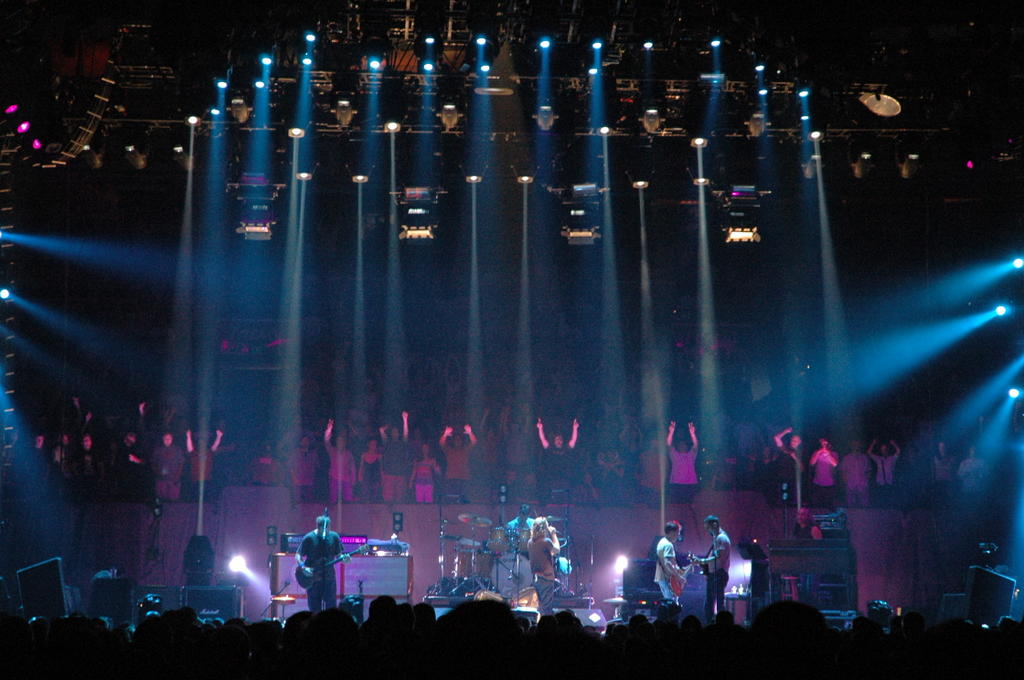
Why do I keep going to Pearl Jam concerts? Because when Eddie Vedder walks out with the opening band and rips into a dead-on cover of Bruce Springsteen’s “The Promised Land” (including a note-for-note perfect harmonica solo), you know it’s gonna be one heck of a night.
Pearl Jam was at the Wachovia Center in Philadelphia Monday night for the finale of its brief 2005 North American tour. No new album (yet), no overt political agenda (thank goodness); these guys just love playing live and wanted to get out and stretch their legs a little. Well, a lot.
On Monday night, the band continued to stake its claim as the most adventurous live act in the world. The way Pearl Jam goes about its concerts (Eddie writing up a new setlist out of his head in the moments leading up to the show), every night is special because nobody sees the same set twice. And then there are those occasions—and nobody can predict exactly when or where they’ll come—when the band somehow kicks it up yet another notch. Dates such as 7.11.95, 9.11.98, 11.6.00, and 7.11.03 (to name just a few) need no explanation in the diehard fan community; they are shows where something so extraordinary happened, the numbers alone hold significance.
Add 10.3.05 to that list.
The length and breadth of the show alone was stunning. Three hours, 34 songs, including a set Ed said was comprised of “songs we don’t play that often” (hello, dream come true). He started everything off on a high note by absolutely nailing “The Promised Land” (one of my favorite Springsteen songs) with openers Sleater-Kinney as his backing band. S-K went on to play an excellent set, including this shocking finale: they brought out EVERY MEMBER OF PEARL JAM to play a cover of Danzig’s “Mother,” with Ed videotaping the whole thing before jumping on Matt Cameron’s drum set (which I don’t even think was miced) to help finish the thing off. It’s always a good sign when you already feel like you’ve gotten your money’s worth and the band hasn’t even “officially” hit the stage.
The surreal experience continued with PJ’s set, as they opened with “Wash,” an all-time favorite that I had yet to hear in person. They’ve pulled it out every once in a while during tours past, but it’s usually rough around the edges. Not this time—they’ve obviously been practicing.
From there it was one of the most breakneck opening sets I can remember (in person or otherwise). By the time they kicked into “Brain of J” in the third slot, Mike McCready was already literally running around the gear on his side of the stage—again, always a good sign. Mike continues his evolution as a showman and one of the great guitar heroes of all time; he was on fire all night long, jumping on and off amps, playing behind his head, waving his arms in the air to pump up the crowd (like we needed any encouragement). Other than a few quick comments from Ed about how much the band loves playing Philadelphia, the first hour went by in a blink with a blistering 12 rockers in a row to open the night. They took a collective breath with “Betterman” (the opening singalong now one of my favorite PJ concert moments) and “Nothingman,” then tore into “Once,” “Bleed for Me” (a new song, so I’m guessing on the title here; it actually wasn’t that great, but I’m not going to worry right now about whether the new album will be any good or not), and “Blood” to cap off the main missive.
A longer-than-normal encore break meant something great was on the way; the more time Pearl Jam takes to come up with an encore set, the better the sets usually are. This one was no exception, as the band came back out with the ultra-rare “Around the Bend,” a beautiful acoustic song that closes 1996’s “No Code.” Follow that with Neil Young’s “Harvest Moon,” a new addition to PJ’s cover catalog, and we’re off to a great start. And then, WHAMMO! “Hard to Imagine,” a legendary b-side that, until this tour, has made far too few sets. But wait: WHAMMO, WHAMMO! “Crown of Thorns,” the amazing Mother Love Bone song that Ed told us is reserved only “for special occasions.” This is something so unthinkable, it didn’t even rest on my “wish list” (sorry, pun not intended). OK, I can go home now.
Yet that amazing double-dip leads into “Crazy Mary,” which held its own special point in the evening. Just as Ed finished the “L-O-I-T-E-R-I-N-G” line, a loud burst of distortion blasted out of the speakers, bringing the band to an abrupt halt. Ed seemed genuinely spooked and said he didn’t want to finish the song (much to the crowd’s chagrin). But Stone Gossard apparently convinced Ed to press on, so they pick up right where they left off and finish with a stunning solo duet from Mike and keyboardist Boom Gasper, while Ed wandered around the front of the stage sharing his wine bottle with fans up front.
“Alive” closed the first encore, a song that has undergone a major reshaping over the years. One of the band’s biggest radio hits, it had become cliché by the end of the 1990s. And then nine people died while Pearl Jam was onstage at a 2000 European festival, and “Alive” went away; really, how could Ed stand in front of another crowd and scream, “I’m still Alive!”?
The band retired “Alive” until the final show of the 2000 tour, the aforementioned 11.6.00 concert in Seattle, seemingly at peace with the tragedy that struck earlier that year. Since then, the pathos behind “Alive” has changed. Originally, the song was cynical; now, the band plays it with such a sense of hope that the song has returned as a highlight of any show.
With such a dream-come-true encore and running time already at two hours, the concert really could have ended right there. But PJ wasn’t done by a long shot, finishing the show with an amazing eight-song finale. “Last Kiss” led off with the band all gathered behind Matt’s drum kit playing to the behind-the-stage crowd—a nice little “thank you” to those who were just glad to be in the building.
It seemed the band was actually ready to call it quits a few songs later (boy, I’m glossing over “In My Tree,” “Do the Evolution” and “Sonic Reducer”? Yes, this show must have been legendary) with “Rockin’ in the Free World,” but Ed asked the crowd, “Do you want one or two?” Uh, do you really have to ask? So they rip into “Leaving Here” first, then turn the house lights up for the trademark extended jam of “Free World.” Ed was running all over the stage at this point, throwing tambourine after tambourine into the crowd and dancing with S-K’s Corin Tucker. Two songs became three, though, as Ed walked to the mic once again and told us, “Mike wants to say good-bye,” and of course it’s “Yellow Ledbetter” to finish the evening.
Here’s the scary thing: nights like Monday’s show in Philly are actually becoming more, not less, common in Pearl Jam’s concert resume. Typically bands start to wear down as the years roll by and age starts to add up. Not PJ. As these Gen-Xers all hit their 40s, they seem to only get better, with more “special” nights than ever as they continue to challenge their own history and break their own rules. They’ve gone from averaging 90 minutes to 2 hours to now 2 ½ hours per show; main sets that used to be 15 or 16 songs are now 18; encores that used to be two or three songs apiece are now stretching into five and six (or eight!).
Pearl Jam have become so good at their craft, “show” may even be a misnomer at this point. Last night was more like rock and roll catharsis, a truly communal experience between artist and audience. It’s a vibe they are able to deliver because they are so willing to take chances and create a new experience each and every time they take a stage. As Pearl Jam and Sleater-Kinney linked arms to take a group bow at the end of the night, I got the sense they really and truly enjoyed themselves as much as we did, and the rock and roll cliché of “respecting the fans” really does apply in this case. It’s that authenticity that continues to compel me to see them again and again.
I’m done trying to compare one Pearl Jam show to another, because it’s pointless. This band gives its all and gets it done time and time again—they never disappoint. As I said to my brother as we dropped back into our seats, physically exhausted and emotionally drained: “Unbelievable.”
Pearl Jam
10.3.05
Wachovia Center, Philadelphia
Pre-set:
The Promised Land (Ed w/Sleater-Kinney)
Mother (Pearl Jam w/Sleater-Kinney)
Main Set:
Wash
Hail Hail
Brain of J
Spin the Black Circle
Given to Fly
Sad
Alone
Even Flow
Green Disease
Faithfull
Whipping
Not for You
Leatherman
Betterman
Nothingman
Once
Bleed for Me (new, unreleased song)
Blood
First Encore:
Around the Bend
Harvest Moon (w/Sleater-Kinney)
Hard to Imagine
Crown of Thorns
Crazy Mary
Alive
Second Encore:
Last Kiss
In My Tree
Do the Evolution
Sonic Reducer
Little Sister
Leaving Here (w/Sleater-Kinney)
Rockin’ in the Free World (w/Sleater-Kinney)
Yellow Ledbetter
Saturday, October 01, 2005
A Rush of Blood to the Head: Coldplay at Nissan Pavilion, 9.30.05
I had absolutely no expectations for this show—after all, I bought my first Coldplay CD only three months ago. It’s not like I can quote each song chapter and verse.
We had cheap seats on the lawn (thanks to the band dropping prices as a benefit for Live8), and I wasn’t even in a hurry to get to the venue and run to the front. I just wanted to take it easy and enjoy the show as it unfolded.
Well, despite my relative apathy, Coldplay managed to win me over.
Playing live is the make-or-break moment for any band. Putting out a record is nice, but if you can’t take that music out on the road and play it right in front of me, I won’t have much use for you. But playing before a packed field (lead singer Chris Martin seemed a little overwhelmed by what must have been a near-capacity crowd), Coldplay took possession of the scene for 95 solid minutes of entertainment.
I was surprised to find goosebumps pop up when the band actually hit the stage (after nearly an hour after openers Rilo Kiley—that’s way too long of a wait) and ripped into “Square One,” the uptempo rocker that also leads off Coldplay’s latest album, “X&Y.” The band has a rather intricate light show that more often than not makes the band itself almost invisible; it’s a nice way of taking the spotlight off the men themselves and put the focus on the music.
After the opener, Coldplay unveiled a power trio of “Politik,” “Yellow” and “Speed of Sound,” keeping the zealous crowd up. This band may never have imagined it would be playing such a large venue, but these three songs alone proved the group has that certain “big” vibe necessary to capture an audience of that size.
Unfortunately, Coldplay’s “wall of sound” style also requires a lot of help on stage. I’m pretty sure there was more coming out of the speakers than met the eye; at one point, Martin’s voice was warbling repetitiously toward the end of a song and he actually talked over the music—two Martin voices at the same time. At another spot he actually said, “Stop the tape.” Not a good thing. But, to be fair, it wouldn’t be the first time a band needed a little extra help to pull off its live show (U2 essentially had a pit crew during the ZooTV tour, adding little bells and whistles where necessary, while Green Day and Nirvana both have recruited extra musicians for the road that technically aren’t “in the band”). There’s no doubt Coldplay is actually playing live, but with all the added techno-wizardry incorporated into the show, that doesn’t leave much room for spontaneity—they play essentially the same exact show every night.
So if a concert is going to be this carefully orchestrated, it at least better be good, and this one certainly was. Even though 95 minutes seems a little on the short side for a band with already such a deep catalog of hits, Coldplay seemed to give its full attention to each number—the band didn’t just blow through any of its offerings, making the overall show feel longer than it actually was. There was also an excellent ebb and flow to the whole thing—building and lessening intensity gradually from song to song with no jarring transitions.
Martin proved to be an excellent frontman in concert. It’s hard to capture a large audience sitting at a piano, but somehow he managed it. And when not playing the keys, he spent much of his time twirling about the stage, at one point running up an aisle of the pavilion to the soundboard to finish “In My Place.” (On a side note, I was also pleasantly surprised that Martin’s nasal voice held up well live; I was worried he wouldn’t be able to consistently hit notes that require such precision in the studio, but I noticed no glaring errors the entire night.) One of my favorite portions of the show, however, was his intro to “Everything’s Not Lost,” a quiet piece that he said didn’t go over too well the last time Coldplay played in D.C.—at the 2000 HFStival. Martin mentioned how nobody at that show wanted to particularly hear his band play—they were more excited about headliners Limp Bizkit, apparently. It seems strange, he said, to five years later have everybody cheering for it. It was a witty little barb that I appreciated—sort of a thank you to those who appreciate his music and, at the same time, a screw you to any of the posers that happened to be at that HFStival five years ago and now all of the sudden “love” Coldplay. Martin even improvised an entire first verse to the song about this experience, including a shot at Limp Bizkit. Pretty cool.
A great version of “The Scientist” then led into a mini-acoustic set of three songs, including a nice cover of Johnny Cash’s “Ring of Fire.” Coldplay started to lose people a little during this stretch, I think, but, once again, the band had a plan. After three quiet numbers, they ripped into what is certainly the showcase of the evening: “Clocks.” Sure, maybe it’s cliché, but this is my favorite Coldplay song and it did not disappoint in person (the light show is mesmerizing). This led into “Talk,” one of the best songs off “X&Y,” to close the main set on a manic high. During the climax off this song, Martin asked everyone to get their cameras ready and then told them to “shoot” at the same time the band’s lights went crazy with strobes; sure it’s a little forced, but it came off to a nice effect.
Martin opened the encore with the quietly beautiful “Swallowed by the Sea” before kicking into two more stone-cold faves, “In My Place” and “Fix You,” to finish the show, the latter building to an epic close that fittingly sent the crowd out on a high.
There’s something about Coldplay that doesn’t quite reach me—a few too many chinks in the armor that I know will prevent this band from cracking my top five (this was the last show of the U.S. tour and yet no surprises?). But last night, they simply got it done. There’s a certain gravitas to their music that allows the band to spread its wings across such a huge venue and not be overwhelmed, and that’s saying something. In a seemingly rare instance these days, at least this band actually lived up to the hype.
Coldplay
9.30.05
Nissan Pavilion, Bristow Virginia
Setlist:
Square One
Politik
Yellow
Speed of Sound
God Put a Smile on Your Face
Trouble
White Shadows
Everything’s Not Lost
The Scientist
Til Kingdom Come
Ring of Fire
Green Eyes
Clocks
Talk
Encore:
Swallowed in the Sea
In My Place
Fix You
We had cheap seats on the lawn (thanks to the band dropping prices as a benefit for Live8), and I wasn’t even in a hurry to get to the venue and run to the front. I just wanted to take it easy and enjoy the show as it unfolded.
Well, despite my relative apathy, Coldplay managed to win me over.
Playing live is the make-or-break moment for any band. Putting out a record is nice, but if you can’t take that music out on the road and play it right in front of me, I won’t have much use for you. But playing before a packed field (lead singer Chris Martin seemed a little overwhelmed by what must have been a near-capacity crowd), Coldplay took possession of the scene for 95 solid minutes of entertainment.
I was surprised to find goosebumps pop up when the band actually hit the stage (after nearly an hour after openers Rilo Kiley—that’s way too long of a wait) and ripped into “Square One,” the uptempo rocker that also leads off Coldplay’s latest album, “X&Y.” The band has a rather intricate light show that more often than not makes the band itself almost invisible; it’s a nice way of taking the spotlight off the men themselves and put the focus on the music.
After the opener, Coldplay unveiled a power trio of “Politik,” “Yellow” and “Speed of Sound,” keeping the zealous crowd up. This band may never have imagined it would be playing such a large venue, but these three songs alone proved the group has that certain “big” vibe necessary to capture an audience of that size.
Unfortunately, Coldplay’s “wall of sound” style also requires a lot of help on stage. I’m pretty sure there was more coming out of the speakers than met the eye; at one point, Martin’s voice was warbling repetitiously toward the end of a song and he actually talked over the music—two Martin voices at the same time. At another spot he actually said, “Stop the tape.” Not a good thing. But, to be fair, it wouldn’t be the first time a band needed a little extra help to pull off its live show (U2 essentially had a pit crew during the ZooTV tour, adding little bells and whistles where necessary, while Green Day and Nirvana both have recruited extra musicians for the road that technically aren’t “in the band”). There’s no doubt Coldplay is actually playing live, but with all the added techno-wizardry incorporated into the show, that doesn’t leave much room for spontaneity—they play essentially the same exact show every night.
So if a concert is going to be this carefully orchestrated, it at least better be good, and this one certainly was. Even though 95 minutes seems a little on the short side for a band with already such a deep catalog of hits, Coldplay seemed to give its full attention to each number—the band didn’t just blow through any of its offerings, making the overall show feel longer than it actually was. There was also an excellent ebb and flow to the whole thing—building and lessening intensity gradually from song to song with no jarring transitions.
Martin proved to be an excellent frontman in concert. It’s hard to capture a large audience sitting at a piano, but somehow he managed it. And when not playing the keys, he spent much of his time twirling about the stage, at one point running up an aisle of the pavilion to the soundboard to finish “In My Place.” (On a side note, I was also pleasantly surprised that Martin’s nasal voice held up well live; I was worried he wouldn’t be able to consistently hit notes that require such precision in the studio, but I noticed no glaring errors the entire night.) One of my favorite portions of the show, however, was his intro to “Everything’s Not Lost,” a quiet piece that he said didn’t go over too well the last time Coldplay played in D.C.—at the 2000 HFStival. Martin mentioned how nobody at that show wanted to particularly hear his band play—they were more excited about headliners Limp Bizkit, apparently. It seems strange, he said, to five years later have everybody cheering for it. It was a witty little barb that I appreciated—sort of a thank you to those who appreciate his music and, at the same time, a screw you to any of the posers that happened to be at that HFStival five years ago and now all of the sudden “love” Coldplay. Martin even improvised an entire first verse to the song about this experience, including a shot at Limp Bizkit. Pretty cool.
A great version of “The Scientist” then led into a mini-acoustic set of three songs, including a nice cover of Johnny Cash’s “Ring of Fire.” Coldplay started to lose people a little during this stretch, I think, but, once again, the band had a plan. After three quiet numbers, they ripped into what is certainly the showcase of the evening: “Clocks.” Sure, maybe it’s cliché, but this is my favorite Coldplay song and it did not disappoint in person (the light show is mesmerizing). This led into “Talk,” one of the best songs off “X&Y,” to close the main set on a manic high. During the climax off this song, Martin asked everyone to get their cameras ready and then told them to “shoot” at the same time the band’s lights went crazy with strobes; sure it’s a little forced, but it came off to a nice effect.
Martin opened the encore with the quietly beautiful “Swallowed by the Sea” before kicking into two more stone-cold faves, “In My Place” and “Fix You,” to finish the show, the latter building to an epic close that fittingly sent the crowd out on a high.
There’s something about Coldplay that doesn’t quite reach me—a few too many chinks in the armor that I know will prevent this band from cracking my top five (this was the last show of the U.S. tour and yet no surprises?). But last night, they simply got it done. There’s a certain gravitas to their music that allows the band to spread its wings across such a huge venue and not be overwhelmed, and that’s saying something. In a seemingly rare instance these days, at least this band actually lived up to the hype.
Coldplay
9.30.05
Nissan Pavilion, Bristow Virginia
Setlist:
Square One
Politik
Yellow
Speed of Sound
God Put a Smile on Your Face
Trouble
White Shadows
Everything’s Not Lost
The Scientist
Til Kingdom Come
Ring of Fire
Green Eyes
Clocks
Talk
Encore:
Swallowed in the Sea
In My Place
Fix You
Wednesday, September 28, 2005
The Biggest ‘Lost’ Surprise Yet
It had to happen sometime, but I never, never expected it to happen this soon.
Wow, did tonight’s episode of “Lost” suck or what? This was, without a shadow of a doubt, the worst of this very Emmy-worthy show’s 26 episodes.
No show is perfect, mind you, especially any series on broadcast TV that has to come up with 24 hours of television a season. It’s impossible to keep a high level of quality each and every time out when you don’t have the HBO luxury of half as many shows produced in, what, twice the time or more (hello 18 month layoff for “The Sopranos”). Frankly, it’s amazing what the producers behind “Lost” were able to accomplish last year, with not a blemish to their record.
In broadcast TV, though, the lull usually hits somewhere in the teens—you know, after the initial rush of creativity that launches a season, but before the final ramp-up to the season finale. Somewhere around February, writers will be scrambling around in the dark scrounging for any sort of way to fill 42 minutes of air time.
But after such a blistering start in 2004-05, I’m a little worried that “Lost” misfired so quickly in its sophomore campaign—they had an entire summer to work on this! Really, tonight’s show wouldn’t even qualify as “well, it was bad by ‘Lost’ standards but it was still pretty good compared to all the other junk on TV.” No, ladies and gentlemen, this one just tanked.
First off, it focused heavily on Michael, played by the series’ weakest regular actor, Harold Perrineau. After making us wait an entire episode to find out what happened to Michael’s raft and son after the former was attacked in last year’s season finale, we really didn’t learn anything more tonight. Michael and Sawyer spent nearly the entire episode floating around on bamboo being harassed (and not very convincingly) by what we were led to believe was a shark. The squabbling scenes between Michael and Sawyer (Josh Holloway) were so poorly written, even Holloway’s innate spark couldn’t save them.
Back on the island, the action in The Hatch moved not an inch. At the end of tonight’s episode, we’re right back where we started, only now we know the little, itsy-bitsy details of what happened in the time between Kate’s capture and Jack’s arrival. Unfortunately, there wasn’t much to it; why we were forced to sit through an entire episode for what seemingly could have been shortened to one or two scenes, I’ll never know. The only little nugget we got for our time was Desmond’s disbelief that healthy people were out on the island—apparently he was led to believe the world was coming to an end … or something like that.
Even the “Lost” trademark flashback was lackluster this time around, with a rather formulaic, no intensity look back at how Michael decided to let his son Walt go way back when, which of course is supposed to make us realize how painful it is for him to lose him again now to The Others. I kinda assumed that from last season’s Michael/Walt episode. I really didn’t need any more help, thank you.
And now the whole ill-conceived raft storyline is over after it barely got off the island. Everybody’s back “home” and The Others are bearing down on Michael, Sawyer and Jin, while Desmond still has a gun to Locke’s head back in The Hatch. Wow, that actually took them an hour?
Look, I’m not about to jump raft and give up on “Lost.” If there’s anything I’ve learned about the show’s co-creator J.J. Abrams, it’s that he seems to always have a plan and it all works out in the end. (Take last season’s “Alias” run, for example, which seemed off its game to start but finished with a big, big bang in a spectacular return to form. More on that show to come, I’m sure (crossing his fingers that the fifth (and probably last) season doesn’t destroy the entire series).)
But if there are a few more episodes like this before Christmas … well, let's not jump to any conclusions just yet.
Wow, did tonight’s episode of “Lost” suck or what? This was, without a shadow of a doubt, the worst of this very Emmy-worthy show’s 26 episodes.
No show is perfect, mind you, especially any series on broadcast TV that has to come up with 24 hours of television a season. It’s impossible to keep a high level of quality each and every time out when you don’t have the HBO luxury of half as many shows produced in, what, twice the time or more (hello 18 month layoff for “The Sopranos”). Frankly, it’s amazing what the producers behind “Lost” were able to accomplish last year, with not a blemish to their record.
In broadcast TV, though, the lull usually hits somewhere in the teens—you know, after the initial rush of creativity that launches a season, but before the final ramp-up to the season finale. Somewhere around February, writers will be scrambling around in the dark scrounging for any sort of way to fill 42 minutes of air time.
But after such a blistering start in 2004-05, I’m a little worried that “Lost” misfired so quickly in its sophomore campaign—they had an entire summer to work on this! Really, tonight’s show wouldn’t even qualify as “well, it was bad by ‘Lost’ standards but it was still pretty good compared to all the other junk on TV.” No, ladies and gentlemen, this one just tanked.
First off, it focused heavily on Michael, played by the series’ weakest regular actor, Harold Perrineau. After making us wait an entire episode to find out what happened to Michael’s raft and son after the former was attacked in last year’s season finale, we really didn’t learn anything more tonight. Michael and Sawyer spent nearly the entire episode floating around on bamboo being harassed (and not very convincingly) by what we were led to believe was a shark. The squabbling scenes between Michael and Sawyer (Josh Holloway) were so poorly written, even Holloway’s innate spark couldn’t save them.
Back on the island, the action in The Hatch moved not an inch. At the end of tonight’s episode, we’re right back where we started, only now we know the little, itsy-bitsy details of what happened in the time between Kate’s capture and Jack’s arrival. Unfortunately, there wasn’t much to it; why we were forced to sit through an entire episode for what seemingly could have been shortened to one or two scenes, I’ll never know. The only little nugget we got for our time was Desmond’s disbelief that healthy people were out on the island—apparently he was led to believe the world was coming to an end … or something like that.
Even the “Lost” trademark flashback was lackluster this time around, with a rather formulaic, no intensity look back at how Michael decided to let his son Walt go way back when, which of course is supposed to make us realize how painful it is for him to lose him again now to The Others. I kinda assumed that from last season’s Michael/Walt episode. I really didn’t need any more help, thank you.
And now the whole ill-conceived raft storyline is over after it barely got off the island. Everybody’s back “home” and The Others are bearing down on Michael, Sawyer and Jin, while Desmond still has a gun to Locke’s head back in The Hatch. Wow, that actually took them an hour?
Look, I’m not about to jump raft and give up on “Lost.” If there’s anything I’ve learned about the show’s co-creator J.J. Abrams, it’s that he seems to always have a plan and it all works out in the end. (Take last season’s “Alias” run, for example, which seemed off its game to start but finished with a big, big bang in a spectacular return to form. More on that show to come, I’m sure (crossing his fingers that the fifth (and probably last) season doesn’t destroy the entire series).)
But if there are a few more episodes like this before Christmas … well, let's not jump to any conclusions just yet.
Tuesday, September 20, 2005
How 'Bout Them Cowboys!
As a Redskins fan, last night was a long, long, long time comin’.
I was 16 the last time Washington beat the Cowboys in Dallas. That’s literally a lifetime ago. Since 1995, I’ve gotten a driver’s license, graduated from high school, graduated from college, got married, and worked for three different publications in three different states.
That’s a long time to wait for one victory.
Last night’s 14-13 Redskin win over the hated, despicable, filthy, no good stinkin’ Cowgirls was nothing short of a miracle. I’m not deluded into believing it was anything other than divine intervention. And I’m OK with that, because miracles have been in short supply around here for, oh, the past decade.
For those who either couldn’t stay up late enough (or early enough, in most cases), or simply gave up hope, let me recap the game: The Redskins’ offense, led by 35-year-old Mark Brunell, was inept for the first 55 minutes of the game. The aforementioned No. 8 spent almost as much time on the ground under a pile of Cowboys as he did throwing the ball, and when he managed to get a pass off, it was most likely a five-yarder or an incompletion followed by a punt. Until late in the fourth quarter, Washington averaged less than four yards per play; that, ladies in gentlemen, is pathetic. Thankfully, the Redskins feature one of the best defenses in the league, which managed to give up a measly 13 points on the road in an overheated stadium full of revved-up rednecks in silver and blue (Cowboy legends Troy Aikman, Emmitt Smith and Michael Irvin were added to the “ring of fame” last night at Texas Stadium, making the night’s outcome all that much sweeter).
So when the Skins got the ball back (again) with about five minutes to play and down two scores, I said, “If they don’t score a touchdown on this drive, I’m turning it off and going to bed.” You have to understand I’m the type of ascetic fan that typically watches every last second of every last game, just in case.
Well, last night was one of those cases.
The drive started out in typical Redskin style, i.e. backward instead of forward. After he was thrown to the ground like a bag of dirt, Brunell faced third-and-27 from deep in his own territory, surely an untenable situation and prelude to a loss. As Brunell dropped back to pass, the receivers were covered (again), so he stepped through the pocket and began running—shuffling, really—down the field; he gave a limp-leg move and all of the sudden, the Redskins had fourth-and-short instead of fourth-and-a-mile. A quick pass in the flat to James Thrash and they’re back in business.
Or so I thought. Ineptitude tried to rear its ugly head once again, as penalties and busted plays led to another fourth down, this time from the Dallas 39 and 15 yards needed for a new set of downs. This is it, I said, game over. And yet, I was wrong yet again, as Brunell floated a rainbow pass over the outstretched arms of Dallas safety Roy Williams—a Redskin nemesis if there ever was one—and into the waiting arms of new wideout Santana Moss, who fell down in the end zone for Washington’s first touchdown of the 2005 season.
Suddenly, it’s a ballgame, and I’m trying not to wake the neighbors in celebration.
So the Skins defense holds again—aided by more intervention from above in the form of a holding penalty that reversed a clock-killing Cowboy first down—giving Brunell and the boys have the ball back with a full three minutes on the clock, an eternity in the National Football League, even for the Redskins.
Turns out Brunell only needed about 30 seconds. In what is certainly the best ball I’ve ever seen No. 8 throw, he fires—yes, fires—a gorgeous strike to Moss, who is again streaking past Cowboy defenders, this time for a 70-yard touchdown that left me screaming (neighbors be damned) at 12:30 a.m. on Tuesday, Sept. 20, 2005, a time and date that will surely go down in both Redskin and Cowboy lore. Because the Skins’ defense held yet again and Washington players doused Joe Gibbs with water like he had just won the Super Bowl.
This game may not have meant as much to Gibbs as his three previous championships, but he said afterward, and I would agree, it was one of the top regular season games of his career, pre- or post-9/11. It was his first victory over Dallas coach Bill Parcells in nine tries, the Redskins’ first win in Dallas in 10 tries, and the first time Parcells has ever blown a fourth-quarter 13-point lead in 78 tries (yes, 78, that’s not a typo).
Yeah, it’s just two games, but better to be 2-0 than 0-2 (which they could and maybe should be).
Yeah, they shouldn’t have won this one, but the Cowboys have stolen so many games during the past decade, the Redskins were due.
And, yeah, the offense has only scored 23 points in two games, but I believe when this season is over, we’re going to look back at these last 14 as the turning point of the year. You could tell after the game that the players—especially the offense—had a big weight taken off their shoulders.
It was interesting to hear Clinton Portis say after the game that Moss had to convince Gibbs to let the speedy receiver go deep. I think Gibbs has been in shell shock and suffering from self doubt since returning to this franchise, and maybe it takes something like this for him to finally stop coaching scared and start coaching to win some games.
I’m not about to lose my head and say Washington can win the NFC East, because it won’t. I’m not going to say this group is going to win 11 or 12 games, because they can’t.
But with two down already, nine victories now looks like a genuine possibility, whereas one quarter of football ago it was more like a Dexter Manley pipe dream.
When the 2005 schedule was released, everybody in Washington (including me) griped about getting a Week 3 bye; now, I think nothing could have worked out better, because the players can carry this momentum with them into practice for the next two weeks as they prepare to host a playoff contender in the Seattle Seahawks on Oct. 2. Brunell needs all the time he can get to acclimate himself to this new group of receivers, receivers who now trust him to get the job done in crunch time, and, more importantly, deliver the ball with touch and speed. (And not to break my own arm patting myself on the back, but if you look at the post directly below this one, I can say I believe I had this one.)
Sports are such a crazy business. Just look how the fates and hopes of so many people can change, almost instantaneously, in the span of two nice-looking throws from a quarterback in the twilight of his career. The next 15 weeks certainly will be filled with anguish and anxiety, but for the first time since Coach Joe announced in January 2004 that he was returning to the city that loves him, the people of this city have hope that the team we love has a chance to do something special.
Who knows?
I was 16 the last time Washington beat the Cowboys in Dallas. That’s literally a lifetime ago. Since 1995, I’ve gotten a driver’s license, graduated from high school, graduated from college, got married, and worked for three different publications in three different states.
That’s a long time to wait for one victory.
Last night’s 14-13 Redskin win over the hated, despicable, filthy, no good stinkin’ Cowgirls was nothing short of a miracle. I’m not deluded into believing it was anything other than divine intervention. And I’m OK with that, because miracles have been in short supply around here for, oh, the past decade.
For those who either couldn’t stay up late enough (or early enough, in most cases), or simply gave up hope, let me recap the game: The Redskins’ offense, led by 35-year-old Mark Brunell, was inept for the first 55 minutes of the game. The aforementioned No. 8 spent almost as much time on the ground under a pile of Cowboys as he did throwing the ball, and when he managed to get a pass off, it was most likely a five-yarder or an incompletion followed by a punt. Until late in the fourth quarter, Washington averaged less than four yards per play; that, ladies in gentlemen, is pathetic. Thankfully, the Redskins feature one of the best defenses in the league, which managed to give up a measly 13 points on the road in an overheated stadium full of revved-up rednecks in silver and blue (Cowboy legends Troy Aikman, Emmitt Smith and Michael Irvin were added to the “ring of fame” last night at Texas Stadium, making the night’s outcome all that much sweeter).
So when the Skins got the ball back (again) with about five minutes to play and down two scores, I said, “If they don’t score a touchdown on this drive, I’m turning it off and going to bed.” You have to understand I’m the type of ascetic fan that typically watches every last second of every last game, just in case.
Well, last night was one of those cases.
The drive started out in typical Redskin style, i.e. backward instead of forward. After he was thrown to the ground like a bag of dirt, Brunell faced third-and-27 from deep in his own territory, surely an untenable situation and prelude to a loss. As Brunell dropped back to pass, the receivers were covered (again), so he stepped through the pocket and began running—shuffling, really—down the field; he gave a limp-leg move and all of the sudden, the Redskins had fourth-and-short instead of fourth-and-a-mile. A quick pass in the flat to James Thrash and they’re back in business.
Or so I thought. Ineptitude tried to rear its ugly head once again, as penalties and busted plays led to another fourth down, this time from the Dallas 39 and 15 yards needed for a new set of downs. This is it, I said, game over. And yet, I was wrong yet again, as Brunell floated a rainbow pass over the outstretched arms of Dallas safety Roy Williams—a Redskin nemesis if there ever was one—and into the waiting arms of new wideout Santana Moss, who fell down in the end zone for Washington’s first touchdown of the 2005 season.
Suddenly, it’s a ballgame, and I’m trying not to wake the neighbors in celebration.
So the Skins defense holds again—aided by more intervention from above in the form of a holding penalty that reversed a clock-killing Cowboy first down—giving Brunell and the boys have the ball back with a full three minutes on the clock, an eternity in the National Football League, even for the Redskins.
Turns out Brunell only needed about 30 seconds. In what is certainly the best ball I’ve ever seen No. 8 throw, he fires—yes, fires—a gorgeous strike to Moss, who is again streaking past Cowboy defenders, this time for a 70-yard touchdown that left me screaming (neighbors be damned) at 12:30 a.m. on Tuesday, Sept. 20, 2005, a time and date that will surely go down in both Redskin and Cowboy lore. Because the Skins’ defense held yet again and Washington players doused Joe Gibbs with water like he had just won the Super Bowl.
This game may not have meant as much to Gibbs as his three previous championships, but he said afterward, and I would agree, it was one of the top regular season games of his career, pre- or post-9/11. It was his first victory over Dallas coach Bill Parcells in nine tries, the Redskins’ first win in Dallas in 10 tries, and the first time Parcells has ever blown a fourth-quarter 13-point lead in 78 tries (yes, 78, that’s not a typo).
Yeah, it’s just two games, but better to be 2-0 than 0-2 (which they could and maybe should be).
Yeah, they shouldn’t have won this one, but the Cowboys have stolen so many games during the past decade, the Redskins were due.
And, yeah, the offense has only scored 23 points in two games, but I believe when this season is over, we’re going to look back at these last 14 as the turning point of the year. You could tell after the game that the players—especially the offense—had a big weight taken off their shoulders.
It was interesting to hear Clinton Portis say after the game that Moss had to convince Gibbs to let the speedy receiver go deep. I think Gibbs has been in shell shock and suffering from self doubt since returning to this franchise, and maybe it takes something like this for him to finally stop coaching scared and start coaching to win some games.
I’m not about to lose my head and say Washington can win the NFC East, because it won’t. I’m not going to say this group is going to win 11 or 12 games, because they can’t.
But with two down already, nine victories now looks like a genuine possibility, whereas one quarter of football ago it was more like a Dexter Manley pipe dream.
When the 2005 schedule was released, everybody in Washington (including me) griped about getting a Week 3 bye; now, I think nothing could have worked out better, because the players can carry this momentum with them into practice for the next two weeks as they prepare to host a playoff contender in the Seattle Seahawks on Oct. 2. Brunell needs all the time he can get to acclimate himself to this new group of receivers, receivers who now trust him to get the job done in crunch time, and, more importantly, deliver the ball with touch and speed. (And not to break my own arm patting myself on the back, but if you look at the post directly below this one, I can say I believe I had this one.)
Sports are such a crazy business. Just look how the fates and hopes of so many people can change, almost instantaneously, in the span of two nice-looking throws from a quarterback in the twilight of his career. The next 15 weeks certainly will be filled with anguish and anxiety, but for the first time since Coach Joe announced in January 2004 that he was returning to the city that loves him, the people of this city have hope that the team we love has a chance to do something special.
Who knows?
Rating the Stars
Geek. Nerd. Dork. You have too much time on your hands.
You may think one or all of these things after examining my favorite albums of all time, and I’m OK with that.
Let me explain how I came up with my list.
Apple’s iTunes allows you to rate songs in your playlists from one to five stars. As you should have already figured out just by the nature of this site, I’m a sucker for ratings and reviews, so I naturally started to rate some of my favorites while I listened to them. As I’m also basically a completist, rating a few songs started a snowball rolling, and I kept going and going until a good chunk of songs from my favorite artists were filled out. I then added up the ratings and divided by the number of songs on an album (interludes and other such oddities excluded to avoid skewing lower than deserved) to come up with an overall record value.
Here’s how I defined the stars:
• 1 star—Song skipped basically every time it comes up
• 2 stars—Skipped regularly, but not mandatory
• 3 stars—Not skipped when it comes up, but not usually sought after, either
• 4 stars—I go looking for this song
• 5 stars—A must-listen every time the CD is in
As with placing a value on anything artistic, this is not ironclad science. The rankings for albums of a single band are dead on, but because I only compared each song to other songs by that artist, looking at albums from multiple bands doesn’t always accurately reflect my overall tastes. For instance, there’s no way if I was stranded on a deserted island I would take my top-rated Dave Matthews Band album (“Under the Table and Dreaming” at 3.92) over a middle U2 album (say, “The Unforgettable Fire” at 3.52). Likewise, “Led Zeppelin IV” is my top-rated record, but U2’s “Achtung Baby” actually means more to me. Also, there are albums dragged down by a couple of clunkers that I would still take over an album that has a higher score based on consistent quality (like I would ever choose “Led Zeppelin I” over “Physical Graffiti”!). Like I said, this isn’t organic chemistry here, but I do think it’s an interesting conversation starter if nothing else. You should give it a go—it’s kinda fun, and a lot more interesting than solitaire.
Anyway, here’s the list (to be updated periodically as I buy new CDs and take time to rate those and others).
Led Zeppelin, “Led Zeppelin IV” (4.625)
U2, “Achtung Baby” (4.45)
Bruce Springsteen, “Darkness on the Edge of Town” (4.40)
Bruce Springsteen, “Born to Run” (4.375)
Pearl Jam, “Yield” (4.33)
Pink Floyd, “Dark Side of the Moon” (4.33)
PJ Harvey, “Stories from the City, Stories from the Sea” (4.25)
Bruce Springsteen, “Born in the U.S.A.” (4.25)
Dashboard Confessional, “A Mark, A Mission, A Brand, A Scar” (4.21)
The White Stripes, “Elephant” (4.21)
Pink Floyd, “Wish You Were Here” (4.20)
U2, “The Joshua Tree” (4.18)
Alkaline Trio, “From Here to Infirmary” (4.17)
Pearl Jam, “No Code” (4.17)
Rage Against the Machine, “Renegades” (4.12)
U2, “How to Dismantle an Atomic Bomb” (4.09)
Dashboard Confessional, “The Swiss Army Romance” (4.00)
Nirvana, “Nevermind” (4.00)
Pearl Jam, “Vitalogy” (4.00)
Saves the Day, “Stay What You Are” (4.00)
Soundtrack, “Singles” (4.00)
Bruce Springsteen, “Nebraska” (4.00)
U2, “Zooropa” (4.00)
Wilco, “Summer Teeth” (3.94)
Dave Matthews Band, “Under the Table and Dreaming” (3.92)
Coldplay, “A Rush of Blood to the Head” (3.91)
Dashboard Confessional, “The Places You Have Come to Fear the Most” (3.90)
Led Zeppelin, “Led Zeppelin II” (3.89)
The White Stripes, “De Stijl” (3.85)
U2, “All That You Can’t Leave Behind” (3.82)
Wilco, “Yankee Hotel Foxtrot” (3.82)
PJ Harvey, “To Bring You My Love” (3.80)
Led Zeppelin, “Led Zeppelin I” (3.78)
Fall Out Boy, “From Under the Cork Tree” (3.77)
Dave Matthews Band, “Crash” (3.75)
Nirvana, “In Utero” (3.75)
Led Zeppelin, “Physical Graffiti” (3.73)
PJ Harvey, “Dry” (3.73)
Stone Temple Pilots, “Tiny Music” (3.73)
Stone Temple Pilots, “Purple” (3.72)
Led Zeppelin, “Led Zeppelin III” (3.70)
Pearl Jam, “Binaural” (3.69)
Wilco, “Being There” (3.68)
Led Zeppelin, “Houses of the Holy” (3.625)
Bruce Springsteen, “The Rising” (3.60)
Bruce Springsteen, “Tunnel of Love” (3.58)
U2, “Pop” (3.58)
U2, “The Unforgettable Fire” (3.56)
The White Stripes, “White Blood Cells” (3.56)
Dave Matthews Band, “Busted Stuff” (3.55)
Bruce Springsteen, “The River” (3.55)
Dave Matthews Band, “Remember Two Things” (3.50)
PJ Harvey, “Rid of Me” (3.50)
Pearl Jam, “Vs.” (3.50)
Bruce Springsteen, “Devils and Dust” (3.50)
U2, “War” (3.50)
The White Stripes, “Get Behind Me Satan” (3.46)
Wilco, “A.M.” (3.46)
Bruce Springsteen, “Lucky Town” (3.40)
U2, “Boy” (3.36)
Bruce Springsteen, “Greetings from Asbury Park, N.J.” (3.33)
U2, “Rattle and Hum” (3.33)
Pearl Jam, “Riot Act” (3.29)
Dave Matthews Band, “Before These Crowded Streets” (3.27)
Led Zeppelin, “Presence” (3.14)
PJ Harvey, “Is This Desire?” (3.08)
Led Zeppelin, “Coda” (3.00)
Bruce Springsteen, “The Wild, the Innocent, and the E Street Shuffle” (3.00)
Bruce Springsteen, “Human Touch” (2.86)
U2, “October” (2.73)
Led Zeppelin, “In Through the Out Door” (2.71)
You may think one or all of these things after examining my favorite albums of all time, and I’m OK with that.
Let me explain how I came up with my list.
Apple’s iTunes allows you to rate songs in your playlists from one to five stars. As you should have already figured out just by the nature of this site, I’m a sucker for ratings and reviews, so I naturally started to rate some of my favorites while I listened to them. As I’m also basically a completist, rating a few songs started a snowball rolling, and I kept going and going until a good chunk of songs from my favorite artists were filled out. I then added up the ratings and divided by the number of songs on an album (interludes and other such oddities excluded to avoid skewing lower than deserved) to come up with an overall record value.
Here’s how I defined the stars:
• 1 star—Song skipped basically every time it comes up
• 2 stars—Skipped regularly, but not mandatory
• 3 stars—Not skipped when it comes up, but not usually sought after, either
• 4 stars—I go looking for this song
• 5 stars—A must-listen every time the CD is in
As with placing a value on anything artistic, this is not ironclad science. The rankings for albums of a single band are dead on, but because I only compared each song to other songs by that artist, looking at albums from multiple bands doesn’t always accurately reflect my overall tastes. For instance, there’s no way if I was stranded on a deserted island I would take my top-rated Dave Matthews Band album (“Under the Table and Dreaming” at 3.92) over a middle U2 album (say, “The Unforgettable Fire” at 3.52). Likewise, “Led Zeppelin IV” is my top-rated record, but U2’s “Achtung Baby” actually means more to me. Also, there are albums dragged down by a couple of clunkers that I would still take over an album that has a higher score based on consistent quality (like I would ever choose “Led Zeppelin I” over “Physical Graffiti”!). Like I said, this isn’t organic chemistry here, but I do think it’s an interesting conversation starter if nothing else. You should give it a go—it’s kinda fun, and a lot more interesting than solitaire.
Anyway, here’s the list (to be updated periodically as I buy new CDs and take time to rate those and others).
Led Zeppelin, “Led Zeppelin IV” (4.625)
U2, “Achtung Baby” (4.45)
Bruce Springsteen, “Darkness on the Edge of Town” (4.40)
Bruce Springsteen, “Born to Run” (4.375)
Pearl Jam, “Yield” (4.33)
Pink Floyd, “Dark Side of the Moon” (4.33)
PJ Harvey, “Stories from the City, Stories from the Sea” (4.25)
Bruce Springsteen, “Born in the U.S.A.” (4.25)
Dashboard Confessional, “A Mark, A Mission, A Brand, A Scar” (4.21)
The White Stripes, “Elephant” (4.21)
Pink Floyd, “Wish You Were Here” (4.20)
U2, “The Joshua Tree” (4.18)
Alkaline Trio, “From Here to Infirmary” (4.17)
Pearl Jam, “No Code” (4.17)
Rage Against the Machine, “Renegades” (4.12)
U2, “How to Dismantle an Atomic Bomb” (4.09)
Dashboard Confessional, “The Swiss Army Romance” (4.00)
Nirvana, “Nevermind” (4.00)
Pearl Jam, “Vitalogy” (4.00)
Saves the Day, “Stay What You Are” (4.00)
Soundtrack, “Singles” (4.00)
Bruce Springsteen, “Nebraska” (4.00)
U2, “Zooropa” (4.00)
Wilco, “Summer Teeth” (3.94)
Dave Matthews Band, “Under the Table and Dreaming” (3.92)
Coldplay, “A Rush of Blood to the Head” (3.91)
Dashboard Confessional, “The Places You Have Come to Fear the Most” (3.90)
Led Zeppelin, “Led Zeppelin II” (3.89)
The White Stripes, “De Stijl” (3.85)
U2, “All That You Can’t Leave Behind” (3.82)
Wilco, “Yankee Hotel Foxtrot” (3.82)
PJ Harvey, “To Bring You My Love” (3.80)
Led Zeppelin, “Led Zeppelin I” (3.78)
Fall Out Boy, “From Under the Cork Tree” (3.77)
Dave Matthews Band, “Crash” (3.75)
Nirvana, “In Utero” (3.75)
Led Zeppelin, “Physical Graffiti” (3.73)
PJ Harvey, “Dry” (3.73)
Stone Temple Pilots, “Tiny Music” (3.73)
Stone Temple Pilots, “Purple” (3.72)
Led Zeppelin, “Led Zeppelin III” (3.70)
Pearl Jam, “Binaural” (3.69)
Wilco, “Being There” (3.68)
Led Zeppelin, “Houses of the Holy” (3.625)
Bruce Springsteen, “The Rising” (3.60)
Bruce Springsteen, “Tunnel of Love” (3.58)
U2, “Pop” (3.58)
U2, “The Unforgettable Fire” (3.56)
The White Stripes, “White Blood Cells” (3.56)
Dave Matthews Band, “Busted Stuff” (3.55)
Bruce Springsteen, “The River” (3.55)
Dave Matthews Band, “Remember Two Things” (3.50)
PJ Harvey, “Rid of Me” (3.50)
Pearl Jam, “Vs.” (3.50)
Bruce Springsteen, “Devils and Dust” (3.50)
U2, “War” (3.50)
The White Stripes, “Get Behind Me Satan” (3.46)
Wilco, “A.M.” (3.46)
Bruce Springsteen, “Lucky Town” (3.40)
U2, “Boy” (3.36)
Bruce Springsteen, “Greetings from Asbury Park, N.J.” (3.33)
U2, “Rattle and Hum” (3.33)
Pearl Jam, “Riot Act” (3.29)
Dave Matthews Band, “Before These Crowded Streets” (3.27)
Led Zeppelin, “Presence” (3.14)
PJ Harvey, “Is This Desire?” (3.08)
Led Zeppelin, “Coda” (3.00)
Bruce Springsteen, “The Wild, the Innocent, and the E Street Shuffle” (3.00)
Bruce Springsteen, “Human Touch” (2.86)
U2, “October” (2.73)
Led Zeppelin, “In Through the Out Door” (2.71)
Subscribe to:
Posts (Atom)

 Posts
Posts


