Richard Cypher, speaking in Terry Goodkind’s “Naked Empire”:
Compromising with murderers … grants them moral equivalence where none can rightfully exist. Moral equivalence says that you are no better than they; therefore, their belief—that they should be able to torture, rape, or murder you—is just as morally valid as your view—that you have the right to live free of their violence. Moral compromise rejects the concept of right and wrong. It says that everyone is equal, all desires are equally valid, all action is equally valid, so everyone should compromise to get along.
Where could you compromise with those who torture, rape, and murder people? In the number of days a week you will be tortured? In the number of men to be allowed to rape your loved ones? In how many of your family are to be murdered?
No moral equivalence exists in that situation, nor can it exist, so there can be no compromise, only suicide.
To even suggest compromise can exist with such men is to sanction murder.
If only we could find a Richard Cypher in this world.
Then again, someone who comes along these days making this much sense may just be the Antichrist.
Sunday, March 25, 2007


Snow Patrol w/Silversun Pickups, 3.23.07
It’s nice to see notoriety is sitting well with Snow Patrol.
After nearly a decade under the radar (in the U.S., anyway), the Irish quintet seems rather unfazed with its newfound success stemming from last year’s breakout hit “Chasing Cars.” Frontman Gary Lightbody was pleasantly down to earth Friday night at American University in D.C., making self-deprecating jokes and charming small talk in between songs during an excellent 90-minute set.
The handling of “Cars” was particularly impressive. Lightbody acknowledged the song’s import to the band, as it “may be the reason many of you are here tonight—and that’s fine, we’re glad to have you.” SP put the song in perfect position at seventh on a 17-song night; they didn’t use it right up front as a cheap way to grab people’s attention, but didn’t let it hang around unplayed for too long, either, dangling it in front of those in the audience who only knew that one song.
Even for the latter, they would have to be deaf and dumb not to come away from the show with a better appreciation for this band. Queue the setlist (found below, thanks to a poster on their UK message board—I wasn’t taking notes for a change) on your iPod and you’ll find an absolute powerhouse lineup, with winner after winner after winner. It’s not often I go to a show and get every song I wanted to hear, but Friday night was one of those rare times. From “Run” to “Somewhere a Clock Is Ticking” to “Shut Your Eyes” to the awesome closer “Hands Open,” the band was tight and forceful all night, and the sound was perfectly mixed.
Of the many highlights, certainly one of the best was D.C. native Valerie, who did an admirable job of filling in for Martha Wainwright on the duet “Set the Fire to the Third Bar.” Lightbody pulls a woman from the audience every night to sing with him, and he seemed genuinely impressed with Friday night’s lucky fan—and with good reason, because she basically nailed it.
The stage design was impressive without overpowering the music. In fact, it seems the band picked up a little something from U2 while opening for their fellow Irishmen, as the Patrol had a miniature version of U2’s light curtain that allowed images to be displayed on it.
Snow Patrol is playing larger venues these days thanks to “Cars,” but they didn’t seem uncomfortable or out of character in the least. In fact, you’d think mid-sized college gymnasiums would be a bad place for a show (AU’s Bender Arena holds about 5,000 people). But on the contrary, I’ve seen three concerts in the past year and a half in these size venues, and they’ve all felt and sounded great. There’s something about a college campus that lends itself to good concerts—and it’s not just because a bunch of kids are there, because Snow Patrol’s audience ranges from those younger and older than me. It was just a good vibe all night.
Of course, it helps when the opening band commands the stage and arrest everyone’s attention so effortlessly.
Even though I put Silversun Pickups’ “Rusted Wheel” on my “Songs of 2006” list, I should have written about them in more depth by now because this L.A. quartet is one of my favorite bands of the moment.
Lightbody dubbed the group’s debut album, 2006's “Carnavas,” a “masterpiece” from the stage Friday night. That may be overstating a bit, but it is tremendous. I’m not going to rush to compare the Pickups to anything, because they offer a singular sound—gritty and harsh, yet soaring and beautiful all at the same time, especially when lead singer/guitarist Brian Aubert hits his upper register.
The band was spectacular Friday night, steadied by terrific bass work from Nikki Monninger; rarely have I seen an opening band—especially the first of three groups on a bill—win over a crowd so quickly. But that’s the nature and appeal of the Pickups, with their loopy melodies that go from mellow to thrashing in the blink of an eye. They played one of the best six-song sets you’ll ever see Friday night—too bad they had to make way for the mediocre OK Go. They’re not bad, really, and the crowd seemed to dig them, but I’m just not into the whole jokey vibe they put off. Still, after the performances from Snow Patrol and Silversun Pickups, it’s not like I came away disappointed.
Snow Patrol
Bender Arena, American University
Washington, D.C.
3.23.07
Running time: 90 minutes
Spitting Games
It’s Beginning to Get to Me
Chocolate
Headlights on Dark Roads
How to Be Dead
Grazed Knees
Chasing Cars
Shut Your Eyes
Set the Fire to the Third Bar
Somewhere a Clock Is Ticking
Make This Go on Forever
Ways and Means
Run
You’re All I Have
Encore:
The Finish Line
Open Your Eyes
Hands Open
Silversun Pickups
Running time: 30 minutes
Well Thought Out Twinkles
Rusted Wheel
Dream at Tempo 119
Little Lover’s So Polite
Kissing Families
Lazy Eye
After nearly a decade under the radar (in the U.S., anyway), the Irish quintet seems rather unfazed with its newfound success stemming from last year’s breakout hit “Chasing Cars.” Frontman Gary Lightbody was pleasantly down to earth Friday night at American University in D.C., making self-deprecating jokes and charming small talk in between songs during an excellent 90-minute set.
The handling of “Cars” was particularly impressive. Lightbody acknowledged the song’s import to the band, as it “may be the reason many of you are here tonight—and that’s fine, we’re glad to have you.” SP put the song in perfect position at seventh on a 17-song night; they didn’t use it right up front as a cheap way to grab people’s attention, but didn’t let it hang around unplayed for too long, either, dangling it in front of those in the audience who only knew that one song.
Even for the latter, they would have to be deaf and dumb not to come away from the show with a better appreciation for this band. Queue the setlist (found below, thanks to a poster on their UK message board—I wasn’t taking notes for a change) on your iPod and you’ll find an absolute powerhouse lineup, with winner after winner after winner. It’s not often I go to a show and get every song I wanted to hear, but Friday night was one of those rare times. From “Run” to “Somewhere a Clock Is Ticking” to “Shut Your Eyes” to the awesome closer “Hands Open,” the band was tight and forceful all night, and the sound was perfectly mixed.
Of the many highlights, certainly one of the best was D.C. native Valerie, who did an admirable job of filling in for Martha Wainwright on the duet “Set the Fire to the Third Bar.” Lightbody pulls a woman from the audience every night to sing with him, and he seemed genuinely impressed with Friday night’s lucky fan—and with good reason, because she basically nailed it.
The stage design was impressive without overpowering the music. In fact, it seems the band picked up a little something from U2 while opening for their fellow Irishmen, as the Patrol had a miniature version of U2’s light curtain that allowed images to be displayed on it.
Snow Patrol is playing larger venues these days thanks to “Cars,” but they didn’t seem uncomfortable or out of character in the least. In fact, you’d think mid-sized college gymnasiums would be a bad place for a show (AU’s Bender Arena holds about 5,000 people). But on the contrary, I’ve seen three concerts in the past year and a half in these size venues, and they’ve all felt and sounded great. There’s something about a college campus that lends itself to good concerts—and it’s not just because a bunch of kids are there, because Snow Patrol’s audience ranges from those younger and older than me. It was just a good vibe all night.
Of course, it helps when the opening band commands the stage and arrest everyone’s attention so effortlessly.
Even though I put Silversun Pickups’ “Rusted Wheel” on my “Songs of 2006” list, I should have written about them in more depth by now because this L.A. quartet is one of my favorite bands of the moment.
Lightbody dubbed the group’s debut album, 2006's “Carnavas,” a “masterpiece” from the stage Friday night. That may be overstating a bit, but it is tremendous. I’m not going to rush to compare the Pickups to anything, because they offer a singular sound—gritty and harsh, yet soaring and beautiful all at the same time, especially when lead singer/guitarist Brian Aubert hits his upper register.
The band was spectacular Friday night, steadied by terrific bass work from Nikki Monninger; rarely have I seen an opening band—especially the first of three groups on a bill—win over a crowd so quickly. But that’s the nature and appeal of the Pickups, with their loopy melodies that go from mellow to thrashing in the blink of an eye. They played one of the best six-song sets you’ll ever see Friday night—too bad they had to make way for the mediocre OK Go. They’re not bad, really, and the crowd seemed to dig them, but I’m just not into the whole jokey vibe they put off. Still, after the performances from Snow Patrol and Silversun Pickups, it’s not like I came away disappointed.
Snow Patrol
Bender Arena, American University
Washington, D.C.
3.23.07
Running time: 90 minutes
Spitting Games
It’s Beginning to Get to Me
Chocolate
Headlights on Dark Roads
How to Be Dead
Grazed Knees
Chasing Cars
Shut Your Eyes
Set the Fire to the Third Bar
Somewhere a Clock Is Ticking
Make This Go on Forever
Ways and Means
Run
You’re All I Have
Encore:
The Finish Line
Open Your Eyes
Hands Open
Silversun Pickups
Running time: 30 minutes
Well Thought Out Twinkles
Rusted Wheel
Dream at Tempo 119
Little Lover’s So Polite
Kissing Families
Lazy Eye
Sunday, March 11, 2007
‘24’ Veers Off Course on Day 6

***WARNING: THIS POST IS RIFE WITH SPOILERS FROM PROBABLY EVERY SEASON OF “24”***
It’s my theory the writers and producers of “24” break the season down into six four-episode chunks, saving some of the biggest and best cliffhangers for the installments that fall on the “fours”—eps 4, 8, 12, 16, 20, and, of course, 24.
Episode 12, historically, is particularly significant. The halfway point of the day often features resolutions to major plotlines and spins the show off in a new direction. On Day 1, Jack rescued Teri and Kim from their kidnappers; on Day 3, the Salazar brothers died while Nina and the virus escaped amid a massive firefight; on Day 4, Michelle came back to CTU; and on Day 5—hello!—Edgar died.
After a brilliant start, Day 6 has been wandering and rather listless—by “24” standards—since the nuclear bomb exploded in Valencia at the end of … wait for it … Episode 4. Let me preface the rest of this by saying this show is still as good or better than anything else on TV, but the bar has been set so high—especially coming off Day 5, arguably the best of the series—that any slip feels significant.
That being said, Day 6 is shaping up to be the “worst” of the show’s seasons. For the past two months, I’ve been telling myself to trust the process, but when Episode 12 comes and goes with rather little impact, there’s trouble. My major complaint is the deaths of so many key characters in the past two seasons. With Tony, Michelle, Edgar, David Palmer, and, now, Curtis all gone, we’re left with essentially no one to root for other than Jack and Chloe. There just simply aren’t enough characters outside of the Big Guy that we even know, much less care about. The intrigue at CTU and inside the presidency has always been just as compelling as whatever trouble Jack’s into, but this year both of those areas are sorely lacking. And to make things even worse, the beloved Chloe has done absolutely NOTHING in 12 episodes, other than harangue her ex-husband/current boyfriend Morris.
In a recent Entertainment Weekly cover story, Executive Producer/Head Writer Howard Gordon admitted the “24” team has had trouble coming up with this season’s “big idea,” and it’s painfully obvious. The year started out with promise, focusing on Jack’s fallibility and struggle to recover from his unimaginable 18 months under Chinese torture. But that thread has faded to the background, leaving us with “24’s” increasingly familiar plotlines and tricks. It seems like after the bomb blew up, the writers looked at each other and said: “Now what?” They tried a more political approach, which fell flat. They tried a more familial approach, and that, too, fell rather flat (James Cromwell was cool as Jack’s dad, but the whole thing wasn’t as good as the sum of its parts). And, what’s more, the villains in this season are probably the least compelling of the entire series—where has Fayed been since torturing poor Morris several weeks ago? Gredenko is cartoonish in his stereotypicability (yes, I just invented that word).
That’s not to say the show isn’t still entertaining, because it is. Last week’s episode was intense, with Jack breaking into a foreign consulate (again!) and the fallout from the attempted presidential assassination attempt. But, wow, using Wayne Palmer as the new president—probably the worst decision in the history of this show—D.B. Woodside just isn’t up to the task, especially following up Gregory Itzin’s Emmy-winning performance last season. The trouble with most of the episodes this season is after the initial rush is over, the creeping feeling of been-there-done-that sets in.
There’s still time to salvage Day 6, of course. Rick Schroder joins the cast this week, which hopefully will give us a new CTU wingman to like. Itzin’s return to the series as disgraced President Logan is exciting, too, especially since this week Jean Smart also reprises her role as Logan’s manic (and now presumably estranged) wife.
I’m certainly not going to give up on “24”—not even close. The writers have learned from their past mistakes (Teri’s amnesia during Day 1, Kim and the mountain lion during Day 2, etc.), so I’m hopeful for a return to greatness. My suggestion for next year: Rein in the threat a bit. We don’t need nuclear bombs and mass casualties every season (matter of fact, the relative calm in California after a nuclear explosion continues to be a major problem with this season). I’d like to see the show’s producers hearken back to Day 1 and handle something a bit more down-to-earth—and personal.
Until then, I can only hope they remember what made their show great in the first place—it’s never been about the bombs, but the bombshells dropped on a weekly basis.
Saturday, March 10, 2007
Music Reviews: New albums from Arcade Fire, Brand New, Fall Out Boy, and PJ Harvey
Arcade Fire, “Neon Bible”
First things first: “Keep the Car Running,” the second track off Arcade Fire’s “Neon Bible,” is the early frontrunner for song of the year. This Celtic-tinged anthem is stunning; it would be worth the full price of the CD all by itself.
I highlight “Keep the Car Running” because it’s a bit of an anomaly on “Neon Bible,” as one of probably only three or four tracks that sound good independently (the escapist “No Cars Go” would be another, but more on that later). Like the ideal “High Fidelity” mix tape, “Neon Bible” is perfectly paced; the song sequencing pushes and pulls, ebbs and flows in just the right ways. Picking it apart on an iPod would certainly degrade the overall experience.
While Arcade Fire’s debut album, 2004’s “Funeral,” focused on personal pain, “Neon Bible” is directed outward. It features songs that are political without (thankfully) being overtly partisan, as lead singer/songwriter Win Butler taps into humanity’s seemingly global sense of desperation—“an ocean of violence/A world of empty streets,” as he describes it on the sublime “Ocean of Noise.” During “Intervention” he intones: “I can taste the fear/Lift me up and take me out of here.”
The lyrics throughout are dark, a tone set by the opening dirge of “Black Mirror.” Butler is at his best on the markedly Springsteen-ian “(Antichrist Television Blues),” which tells the nuanced story of a man so afraid of what can happen to average working Joes (i.e. they die just going to work when planes crash into their office buildings), he pushes his young daughter to maximize her God-given talent and become a star, “American Idol”-style. The five-minute epic is an inner monologue, as the father tries to escape the system through his daughter, yet knows the entire time he’s treading on shaky ground; eventually he concludes: “O tell me, Lord, am I the Antichrist?”
At times Butler’s lyrical work on “Neon Bible” comes across as overbearing when read straight off a page. His words are balanced, however, by soaring, deep, soulful, surprising, and, more often than not, exhilarating music. The strings from “Funeral” are complemented this time around by a full horn section, harp, gospel choir, and church organ. The tension built through the album finally explodes in Track 10, the aforementioned “No Cars Go,” a full-throttle quest for hope reminiscent of “War”-era U2.
With only a couple missteps (“Black Wave/Bad Vibrations” and the overly self-absorbed closer, “My Body Is a Cage”), Arcade Fire’s new release demands multiple careful listens (try it on a good pair of headphones). It’s an enthralling follow-up that proves all the hype and acclaim surrounding “Funeral” was no fluke. Grade: A-
Brand New, “The Devil and God Are Raging Inside Me”
After their pitch-perfect pop/punk debut, 2001’s “Your Favorite Weapon,” Brand New probably could have become, well, Fall Out Boy. Instead, founder Jesse Lacey went the other way, eschewing the easy and obvious for more esoteric—dare I say “mature”—material on 2003’s highly acclaimed “Deja Entendu.”
The Long Island band’s third album, “The Devil and God Are Raging Inside Me” (released last November), completes a trilogy of growth for Brand New, the natural conclusion to the work they’ve been doing for the better part of a decade. Building upon the whisper-to-a-scream mode from “Entendu,” Lacey & Co. (most notably guitarist Vin Accardi) stretch in all the right ways. Brawny highlights include the epic opener “Sowing Season,” the slow burn of “You Won’t Know,” and the full-tilt assault of “The Archers Bows Have Broken.”
Amidst all this bravado of raging guitars, hammering drums, and roaring vocals, the ironic highlight and centerpiece of the album is found in the searching, plaintive beauty of “Jesus,” the album’s third track. Set to a hypnotic metronome of a guitar riff, Lacey offers an open prayer to a Savior he’s not sure he believes in—and if he does, Lacey’s not sure he’s deserving, which, of course, is the point of God’s grace. Anyway, the work here encapsulates the essence of the album. Here’s a whiff:
I know you’re coming in the night like a thief
But I’ve had some time, O Lord, to hone my lying technique
I know you think that I’m someone you can trust
But I’m scared I’ll get scared and I swear I’ll try to nail you back up
So do you think that we could work out a sign
So I’ll know it’s you and that it’s over so I won’t even try
I know you’re coming for the people like me
But we all got wood and nails
And we turn out hate in factories
The only glaring problem with “Devil and God” is “Limousine (MS rebridge)”. Not only is this song an unwieldy eight minutes long, its placement at Track 5 bogs everything down at a crucial point. I’m also not thrilled with the unnecessary interlude between “Luca” and “Archers,” or the rather limp acoustic closer, “Handcuffs.”
Overall, though, this is an otherwise fine effort from a band seemingly always on the move. It’s hard to believe the same group of guys made both this record and “Your Favorite Weapon,” but that only enhances the entire catalog. An ambitious concept album about a crisis of faith, “The Devil and God Are Raging Inside Me” concludes a fascinating journey. Grade: A-
Fall Out Boy, “Infinity on High”
Perhaps the pressure of being mainstream standard bearers for pop/punk weighs a little too heavily on Fall Out Boy. Because “Infinity on High,” the Chicago quartet’s follow-up to 2005’s excellent breakthrough “From Under the Cork Tree,” comes off as a tepid, labored, forced attempt at trying not to be pigeonholed.
Look no further than lead single “It’s Not A Scene, It’s an Arms Race,” with its faux industrial beat and a chorus that will get stuck in your head for all the wrong reasons, not the least of which is the excessive and unnecessary repetition of “God damn” (ooh, you’re so hardcore Pete Wentz!). This disjointed mess “anchors” a Side One that is surprising only in its lack of energy. “Infinity” doesn’t really get going until Track 10, “The Carpal Tunnel of Love,” but by then it’s too little, too late.
This effort may be disappointing, but it’s not entirely surprising. After all, the band’s past two albums were outstanding, and with a couple of hits they went from relative obscurity to having Jay-Z cameo on their new record. There’s nothing wrong with expanding horizons, but it needs to be an organic change (see Brand New, above); there are hideous stretch marks all over this record. Here’s hoping “Infinity” is just a sign of growing pains. Grade: C-
PJ Harvey, “The Peel Sessions 1991-2004”
It’s not often a live album is considered essential (come on, how many “Live at Leeds” are there out there), but such is the case with PJ Harvey’s “The Peel Sessions 1991-2004,” released last October. Harvey was a close friend of Peel, the legendary BBC broadcaster (who died in 2004), and this fabulous collection of live appearances on his show is a fitting tribute to their relationship.
The songs span Harvey’s entire career, starting with the power-packed trio of “Oh My Lover,” “Victory,” and “Sheela-Na-Gig,” from her debut album, “Dry.” With performances chosen specifically by Harvey, the album also features a nice collection of b-sides. The most striking is “This Wicked Tongue,” a tenacious rocker that was criminally only released on the initial UK pressing of Harvey’s 2000 classic “Stories From the City, Stories From the Sea.” Other rarities include the brutal “Naked Cousin,” which hails from the recording sessions for 1995’s “To Bring You My Love” (another classic, by the way); “That Was My Veil,” from Harvey’s 1996 collaboration with John Parish; and two covers, Willie Dixon’s “Wang Dang Doodle” and Rainer Ptacek’s “Losing Ground,” previously available only on singles.
My only complaint is Harvey’s choice of “Beautiful Feeling” as the sole cut from “Stories,” but that’s a rather minor objection for what is, in total, a stellar set. Grade: A
First things first: “Keep the Car Running,” the second track off Arcade Fire’s “Neon Bible,” is the early frontrunner for song of the year. This Celtic-tinged anthem is stunning; it would be worth the full price of the CD all by itself.
I highlight “Keep the Car Running” because it’s a bit of an anomaly on “Neon Bible,” as one of probably only three or four tracks that sound good independently (the escapist “No Cars Go” would be another, but more on that later). Like the ideal “High Fidelity” mix tape, “Neon Bible” is perfectly paced; the song sequencing pushes and pulls, ebbs and flows in just the right ways. Picking it apart on an iPod would certainly degrade the overall experience.
While Arcade Fire’s debut album, 2004’s “Funeral,” focused on personal pain, “Neon Bible” is directed outward. It features songs that are political without (thankfully) being overtly partisan, as lead singer/songwriter Win Butler taps into humanity’s seemingly global sense of desperation—“an ocean of violence/A world of empty streets,” as he describes it on the sublime “Ocean of Noise.” During “Intervention” he intones: “I can taste the fear/Lift me up and take me out of here.”
The lyrics throughout are dark, a tone set by the opening dirge of “Black Mirror.” Butler is at his best on the markedly Springsteen-ian “(Antichrist Television Blues),” which tells the nuanced story of a man so afraid of what can happen to average working Joes (i.e. they die just going to work when planes crash into their office buildings), he pushes his young daughter to maximize her God-given talent and become a star, “American Idol”-style. The five-minute epic is an inner monologue, as the father tries to escape the system through his daughter, yet knows the entire time he’s treading on shaky ground; eventually he concludes: “O tell me, Lord, am I the Antichrist?”
At times Butler’s lyrical work on “Neon Bible” comes across as overbearing when read straight off a page. His words are balanced, however, by soaring, deep, soulful, surprising, and, more often than not, exhilarating music. The strings from “Funeral” are complemented this time around by a full horn section, harp, gospel choir, and church organ. The tension built through the album finally explodes in Track 10, the aforementioned “No Cars Go,” a full-throttle quest for hope reminiscent of “War”-era U2.
With only a couple missteps (“Black Wave/Bad Vibrations” and the overly self-absorbed closer, “My Body Is a Cage”), Arcade Fire’s new release demands multiple careful listens (try it on a good pair of headphones). It’s an enthralling follow-up that proves all the hype and acclaim surrounding “Funeral” was no fluke. Grade: A-
Brand New, “The Devil and God Are Raging Inside Me”
After their pitch-perfect pop/punk debut, 2001’s “Your Favorite Weapon,” Brand New probably could have become, well, Fall Out Boy. Instead, founder Jesse Lacey went the other way, eschewing the easy and obvious for more esoteric—dare I say “mature”—material on 2003’s highly acclaimed “Deja Entendu.”
The Long Island band’s third album, “The Devil and God Are Raging Inside Me” (released last November), completes a trilogy of growth for Brand New, the natural conclusion to the work they’ve been doing for the better part of a decade. Building upon the whisper-to-a-scream mode from “Entendu,” Lacey & Co. (most notably guitarist Vin Accardi) stretch in all the right ways. Brawny highlights include the epic opener “Sowing Season,” the slow burn of “You Won’t Know,” and the full-tilt assault of “The Archers Bows Have Broken.”
Amidst all this bravado of raging guitars, hammering drums, and roaring vocals, the ironic highlight and centerpiece of the album is found in the searching, plaintive beauty of “Jesus,” the album’s third track. Set to a hypnotic metronome of a guitar riff, Lacey offers an open prayer to a Savior he’s not sure he believes in—and if he does, Lacey’s not sure he’s deserving, which, of course, is the point of God’s grace. Anyway, the work here encapsulates the essence of the album. Here’s a whiff:
I know you’re coming in the night like a thief
But I’ve had some time, O Lord, to hone my lying technique
I know you think that I’m someone you can trust
But I’m scared I’ll get scared and I swear I’ll try to nail you back up
So do you think that we could work out a sign
So I’ll know it’s you and that it’s over so I won’t even try
I know you’re coming for the people like me
But we all got wood and nails
And we turn out hate in factories
The only glaring problem with “Devil and God” is “Limousine (MS rebridge)”. Not only is this song an unwieldy eight minutes long, its placement at Track 5 bogs everything down at a crucial point. I’m also not thrilled with the unnecessary interlude between “Luca” and “Archers,” or the rather limp acoustic closer, “Handcuffs.”
Overall, though, this is an otherwise fine effort from a band seemingly always on the move. It’s hard to believe the same group of guys made both this record and “Your Favorite Weapon,” but that only enhances the entire catalog. An ambitious concept album about a crisis of faith, “The Devil and God Are Raging Inside Me” concludes a fascinating journey. Grade: A-
Fall Out Boy, “Infinity on High”
Perhaps the pressure of being mainstream standard bearers for pop/punk weighs a little too heavily on Fall Out Boy. Because “Infinity on High,” the Chicago quartet’s follow-up to 2005’s excellent breakthrough “From Under the Cork Tree,” comes off as a tepid, labored, forced attempt at trying not to be pigeonholed.
Look no further than lead single “It’s Not A Scene, It’s an Arms Race,” with its faux industrial beat and a chorus that will get stuck in your head for all the wrong reasons, not the least of which is the excessive and unnecessary repetition of “God damn” (ooh, you’re so hardcore Pete Wentz!). This disjointed mess “anchors” a Side One that is surprising only in its lack of energy. “Infinity” doesn’t really get going until Track 10, “The Carpal Tunnel of Love,” but by then it’s too little, too late.
This effort may be disappointing, but it’s not entirely surprising. After all, the band’s past two albums were outstanding, and with a couple of hits they went from relative obscurity to having Jay-Z cameo on their new record. There’s nothing wrong with expanding horizons, but it needs to be an organic change (see Brand New, above); there are hideous stretch marks all over this record. Here’s hoping “Infinity” is just a sign of growing pains. Grade: C-
PJ Harvey, “The Peel Sessions 1991-2004”
It’s not often a live album is considered essential (come on, how many “Live at Leeds” are there out there), but such is the case with PJ Harvey’s “The Peel Sessions 1991-2004,” released last October. Harvey was a close friend of Peel, the legendary BBC broadcaster (who died in 2004), and this fabulous collection of live appearances on his show is a fitting tribute to their relationship.
The songs span Harvey’s entire career, starting with the power-packed trio of “Oh My Lover,” “Victory,” and “Sheela-Na-Gig,” from her debut album, “Dry.” With performances chosen specifically by Harvey, the album also features a nice collection of b-sides. The most striking is “This Wicked Tongue,” a tenacious rocker that was criminally only released on the initial UK pressing of Harvey’s 2000 classic “Stories From the City, Stories From the Sea.” Other rarities include the brutal “Naked Cousin,” which hails from the recording sessions for 1995’s “To Bring You My Love” (another classic, by the way); “That Was My Veil,” from Harvey’s 1996 collaboration with John Parish; and two covers, Willie Dixon’s “Wang Dang Doodle” and Rainer Ptacek’s “Losing Ground,” previously available only on singles.
My only complaint is Harvey’s choice of “Beautiful Feeling” as the sole cut from “Stories,” but that’s a rather minor objection for what is, in total, a stellar set. Grade: A
Thursday, January 11, 2007
24 Reasons to Love ‘24’
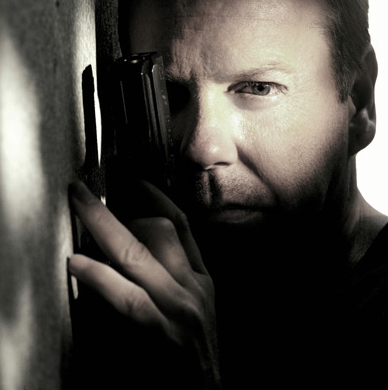
1. The clock. Real-time action over the course of an entire television season is one of the more amazing innovations in the history of modern entertainment. One of the best truisms I’ve heard about “24” is the producer who said the show’s central figure isn’t Counter Terrorist Unit Special Agent Jack Bauer—it’s the clock.
2. The “clock sound” is louder on the way into a commercial break than coming back from commercial.
3. Kiefer Sutherland. The guy was born to play Jack Bauer. He sets the tone for the entire show; he’s the foundation, and the standard-bearer. Sutherland’s at his best not when running or shooting at full tilt or screaming at someone (as you might think), but in moments of quiet, deadly fury.
4. Jack often serves as judge, jury, and executioner.
5. Jack Bauer jokes are hysterical.
6. The casting, overall, is superb—and it better be, because new people are coming in all the time. No character is safe, which not only adds a heightened sense of drama to every season, but keeps once-beloved personalities from going stale.
7. When characters die, they are briefly mourned and often missed, but the show moves on. No over-sentimentality allowed (thank goodness).
8. Then again, there’s just the right amount of emotion simmering right at the surface—especially for Jack—and you have to have seen every episode of every season to get the full impact.
9. The episode-ending cliffhangers are consistently the best I’ve ever seen, even better than the doozies on “Alias.”
10. The plot MOVES. Just when you think everything’s going to be resolved, a whole new Pandora’s box comes barreling down on top of you in midstream.
11. The villains, on balance, are well-developed, three-dimensional characters, with clear (if sometimes conflicted and objectionable) motivations for their actions.
12. Mary Lynn Rajskub’s facial expressions while playing systems analyst and all-around techno-guru Chloe O’Brian are priceless.
13. The show uses hyper-real scenarios to demonstrate real truths. There may not be a superhero like Jack on our side, but “24” reminds us people are sacrificing their lives for this country all the time—and I’m thankful and glad to have them out there.
14. Inner-office and inter-agency politics at CTU have national security implications. (Another example of reality in the hyper-real scenario.)
15. With all this craziness going on, you’d think the dialogue would be perpetually cheesy and/or stilted. By and large, it’s not.
16. Good guys drive Fords, bad guys drive Chevys.
17. The show is essentially apolitical, from a Democrat vs. Republican standpoint.
18. The writers aren’t afraid to use torture as an interrogation method.
19. The doors inside CTU make cool whooshing sounds.
20. The CTU telephone ringer is distinctive and never seems to annoy me, even after 120 episodes.
21. Real U.S. military personnel used at least one episode’s action scenes as a training mission.
22. Watching four (or eight) episodes in a row on DVD is great fun—and better than just about any movie you’re going to find (until the “24” movie hits theaters, of course).
23. “24” seems to only be getting better. I didn’t think anything could top Season 4, yet Season 5 managed to do it, without question. We’ll see if that trend continues when …
24. The curtain goes up on Season 6 Sunday at 8 p.m. with a two-night, four-hour extravaganza!
The Art of Monk
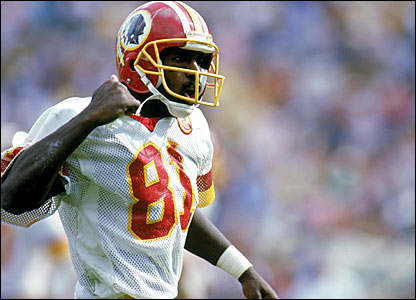
Former Washington Redskins wide receiver Art Monk—who just happens to be my favorite football player of all time—is once again on the ballot for this year's Pro Football Hall of Fame class. Instead of going into my long rant about why he should ALREADY be in, I'll defer to this guy, whose 20-minute video montage of Monk's career is everything and anything that needs be said.
See, this is why I can't throw out all my Redskins stuff.
Tuesday, January 09, 2007
(The Voice of) My Generation
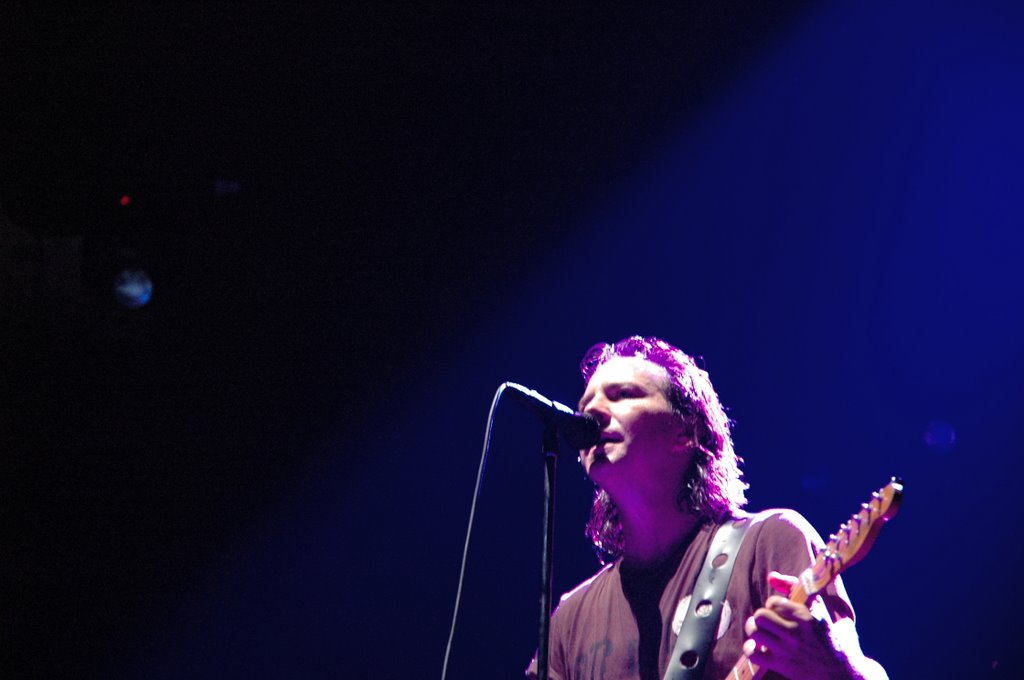
Eddie Vedder can sing anything.
Case in point: His new cover of The Who’s “Love, Reign O’er Me.” The song appears in an upcoming Adam Sandler film, “Reign Over Me” (co-starring Don Cheadle), that looks like it could be a welcome return to “Punch-Drunk Love” territory for the typically juvenile actor.
Anyway, Eddie recorded an outstanding version of “Reign” for the soundtrack, and it debuted in full earlier this week on a Seattle radio station; you can hear a recording made from that airing (albeit recorded over the Internet) here.
Eddie is quite particular about the songs he chooses to cover—both on official recorded versions and those that pop up during live sets. They almost always mean something special to him, and his passion clearly fuels the performances. It’s a remarkable thing, really, because his rugged, unmistakable baritone can seemingly fit into any song he chooses.
When I call Eddie the voice of my generation, I don’t mean in some literal, artsy sense—I mean his actual vocal performance (his lyrics, actually, can be hit or miss—more hits than misses, but still …). It was his voice, and his intensity, that originally drew me to Pearl Jam, and it’s the reason I’ve stuck around all these years (with all due credit to the most underrated guitarist of my generation, Mr. Mike McCready).
So this latest in a long line of excellent cover choices got me thinking about my favorite Vedder covers; he’s exposed me to some great music. Note: This list is focused on EV covers, not PJ covers. Thus no “Rockin’ in the Free World” or “Baba O’Riley” or the like, because those are more full-band experiences than strictly Ed songs. These are the 15 favorite covers I most strongly identify with his incredible voice. Note No. 2: This list is comprised only of the covers I’ve heard either via bootleg or in person; Pearl Jam have covered a few hundred songs in their career, and by no means have I heard them all.
1. “Throw Your Arms Around Me,” Hunters and Collectors (as performed 8.18.2000 in Indianapolis)—Just a simple little song, but its infectious melody—played solo on guitar—fits Ed’s voice perfectly. According to pearljam.com, he’s only performed it 12 times and only once during the entire 2000 tour—thankfully, I was lucky enough to be out on the lawn that night. Oddly, this is one of the few songs I haven’t gone back and checked out the original source material. Have to do something about that …
2. “One Step Up,” Bruce Springsteen (as performed on a pre-PJ EV demo)—I had always liked this song from “Tunnel of Love,” but hearing this stunning karaoke-style rendition put it over the top. I didn’t know anything about it when I downloaded several years ago, and that first listen blew me away.
3. “Save It for Later,” The English Beat—No “Betterman” feels quite complete without this tag. Too many great versions over the years to choose from, though that night in Indy featured a stirring rendition (what a show that was!). Thanks, Ed, for introducing me to The English Beat.
4. “I Am A Patriot,” Little Steven Van Zandt—This was my No. 1 choice for years, as it’s a beautiful song sung to perfection by Ed, and a political song I could actually identify with. But the stretch of lines that ends with “I ain’t no Democrat, and I ain’t no Republican” doesn’t ring true anymore after Ed’s shameless shilling for a moron like John Kerry during the Vote for Change Tour in 2004. Still an awesome cover, though.
5. “It’s OK,” Dead Moon (as performed 8.3.2000 in Virginia Beach and 8.24.2000 in Jones Beach, N.Y.)—“Betterman” may not feel quite right without “Save It for Later,” but there IS no “Daughter” without a tag, and this is my favorite of the many, many great ones over the years. “It’s OK” became a song of catharsis in 2000 after nine fans died at the Roskilde festival in Germany earlier that summer. I honestly thought the band would break up (so did they, for a while), but it’s moments like this that kept them going. The Jones Beach version was included on the “Touring Band 2000” DVD, and it’s a must-see goosebump moment. (Looking forward to the similar THREE-DISC 2006 version due in a few months!)
6. “I Believe in Miracles,” Ramones (as performed with Zeke on the Ramones tribute CD)—You want passion? I give you EV covering the Ramones. This song absolutely blasts off that album and dominates every other entry included. Ed’s performance was so awesome, he actually has two Ramones covers on the CD; the other, “Daytime Dilemma (Dangers of Love),” is good, but “Miracles” is spectacular.
7. “The Promised Land,” Bruce Springsteen (as performed with Sleater-Kinney on 10.3.2005 in Philly)—An absolute, total, shocking surprise of a pre-set opener. And it was basically PERFECT, right down to the harmonica solo (although Ed did have a little trouble with a few of the high notes). You can read more about it here.
8. “Naked Eye,” The Who (as performed solo 2.24.1994 in NYC)—Ed takes the stage for a guest appearance as part of Roger Daltrey’s 50th birthday bash and makes an indelible impression on the Who faithful in the crowd that night—and on me, listening to it years later. As best I can recall, Ed’s unbelievable version of “Naked Eye” gave me the final push I needed to start really listening to The Who—you know, beyond that “best of” sort of way. He played seven songs over the course of that two-night affair, and they are all stellar.
9. “I Won’t Back Down,” Tom Petty (as performed solo during the 1994 tour)—The notion of bootlegs on the Internet was in its infancy while I was in college. This cover (I still don’t know which version) was one of the first songs I downloaded; I was so thrilled with it, I burned it onto a CD ASAP and ran over to a friend’s dorm room—a huge Petty fan—to play it for her, and she was floored by it, too. Just one of those nice PJ-related musical memories I’ll never forget. You know what sucks, though? I think I’ve lost that CD …
10. “Let My Love Open the Door,” Pete Townshend—Ed’s performed this song, my favorite of Townshend’s solo work, multiple times—solo, with the band, and with Pete. It’s basically great each time, any way he does it.
11. “Masters of War,” Bob Dylan (as performed 10.16.1992 in NYC)—Ed absolutely eats this song alive. This version was played with Mike during a Dylan tribute at MSG but has been in regular rotation since 2003 for obvious reasons.
12. “Timeless Melody,” The La’s (as performed 6.14.2000 in the Czech Republic)—Thanks, Ed, for introducing me to The La’s.
13. “Modern Girl,” Sleater-Kinney (as performed 10.3.2005 in Philly)—Great little tag at the end of “Not for You.” Thanks, Ed, for introducing me to Sleater-Kinney.
14. “Growin’ Up,” Bruce Springsteen (as performed 7.14.2003 in Holmdel, N.J.)—I basically bought this bootleg just for this song, and it turned out to be a train wreck. Still, a gallant, endearing try.
15. “Love, Reign O’er Me,” The Who (as performed on the “Reign Over Me” soundtrack)—I’ll have to wait until I hear an official version, but something tells me this song will be moving up the list rapidly—and soon.
Everybody Sees It But Them: The Sickness of Joe Gibbs and Mark Brunell
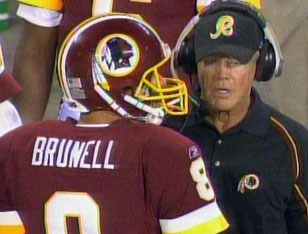
Politicians often issue announcements they’d like to hide “out with the trash,” releasing information late in a news cycle so it won’t make the weekday morning papers.
Congratulations, Joe Gibbs: You’ve now sunk to the level of a politician.
On Monday, Washington Redskins Quarterback Mark Brunell had major shoulder surgery on his THROWING ARM. The surgery took place, of course, after Gibbs finished his slate of year-end pressers so no one will have access to him for comment on the situation.
The ramifications of this news are stunning, depressing, and far-reaching. If I hadn’t invested more than two decades of emotion and fandom in this now-pathetic franchise, I would throw out every scrap of Redskin memorabilia I own. Today.
Even a half-blind man like me could see Brunell couldn’t throw the ball from here to there this season. If I could see it, my wife could see it, my brothers could see it, my parents could see it, the moron twins on SportsTalk 980 could see it, then it stands to reason every single defensive coordinator in the NFL could see it, too. Thus opposing defenses packed the line of scrimmage against the Redskins, knowing Brunell couldn't threaten them deep—whether the play was a run or another awful short pass, either way it was going to be right in front of all 11 defenders—and promptly stopped.
Some morons in Washington wonder if backup Ladell Betts should be the starting running back next season over Clinton Portis. Well, is it any wonder Betts' monster rushing attack began at the same time Brunell was benched and second-year QB Jason Campbell—who possesses a laser-rocket arm, as Peyton Manning would say—was moved into the lineup? As soon as defenders had to start worrying about passes traveling more than 10 yards through the air—what a shock!—the Skins' excellent offensive line was able to open up some running lanes again. If Betts gained 1,000 yards this season, a healthy Portis would have run for 1,600-plus with Campbell as a backfield mate. Perhaps the Skins could have won more than five games and actually made the playoffs in the pathetic NFC.
What makes me the most sick, though, is Gibbs' loyalty-to-a-fault for Brunell. With this news about Brunell’s obvious season-long injury, it's become a full-on sickness between these two guys. And what's worse, they're both Christians! Brunell should have had the moral integrity to bench himself if he was so hurt he was hampering the team, and Gibbs should have had the moral integrity to own up to his mistake.
Instead, Gibbs subtly passed the blame off on to new offensive coordinator Al Saunders, claiming the team got away from "Redskins football," meaning power running. Well what, exactly, was Saunders supposed to do with Brunell as his dilapidated triggerman? Saunders' offense relies on a QB willing to take hits and deliver the ball deep; Brunell can do neither. So Saunders had to start coming up with what Rick "Doc" Walker dubbed the "poodle offense" to try and cover for Brunell's obvious liabilities. By the end of the year, with a real QB in Campbell under center, the offense was clicking pretty well—both running and passing.
So however you look at it, Brunell and Gibbs cost the Redskins multiple victories for reasons unknown and inexplicable to anyone other than those two men. Their relationship has been an albatross around the team's neck for the past three seasons. From the very beginning of this second tenure in Washington, Gibbs hasn't felt like the same person this city has worshipped for nearly three decades. His first move was bringing in Brunell, and he's been covering up for that horrendous mistake ever since due to what I can only assume is abject vanity. In the same offseason, he then traded away Champ Bailey (the best cover-corner in the league) and a second-round pick for Portis; I love Lil' Clinton, but the team could obviously use Bailey right now more than Portis.
Gibbs has spent the past three seasons defending these awful moves, all the while championing second-rate players. He’s acted like Grandpa Joe, the kindly old guy who never says a bad word about anybody and just wants everybody to love him. Well, that doesn't cut it "up here," as Gibbs is fond of saying.
My only hope is this: When the reality of the worst season in Gibbs’ career finally settles in over the next weeks and months, perhaps that will reawaken the hard-nosed man of integrity I knew from my childhood. Perhaps he’s finally through worrying about expectations so he can finally get back to fulfilling them.
If so, Gibbs is off to a very, very bad start. This latest Brunell indignity foisted upon Redskins fans was an inexcusable act of cowardice perpetrated by a coach previously thought incapable of such a thing.
Saturday, January 06, 2007
In Search of Truth: The Works of Terry Goodkind

I’d like to introduce you to two people I’ve come to know and love over the past six months. Their names are Richard Cypher and Kahlan Amnell—and, yes, technically they don’t exist.
Richard and Kahlan are the main characters in author Terry Goodkind’s 11-novel Sword of Truth saga. I’ve just finished Book 6, “Faith of the Fallen,” one of the best pieces of modern fiction I have ever read.
You can find Goodkind’s novels in any bookstore; they typically occupy an entire shelf in the sci-fi/fantasy section. But that distinction is nominal. When I first heard Goodkind’s disclaimer about his work—he does not intentionally engage in the “world building” typically associated with the genre—I dismissed the notion as nearly insufferable pomposity.
After finishing “Faith of the Fallen” and its predecessor/companion novel, “Soul of the Fire,” I believe his statement without question.
Goodkind is a devotee of writer/philosopher Ayn Rand, founder of the objectivist movement, which, in part, celebrates the best qualities of individuals—namely truth, reason, and love—while eschewing a “collectivist” mentality found in an ideology such as socialism (or liberalism). Goodkind is not naïve; he knows no human being is perfect. But Richard and Kahlan are the summation and embodiment of his hopes for the potential of humanity. He simply uses the trappings of traditional fantasy—magic, swords and sorcery, horses and castles—to showcase his characters’ ideals, and the points he is making about modern society.
He writes Richard and Kahlan in vivid, intimate, oftentimes agonizing detail. No stones in their personalities or thoughts are left unturned (conversations can last 50 pages or more); they are two of the most fully realized characters I’ve ever encountered, and their hopes, fears, desires, flaws, and loves are laid bare before us. Goodkind describes it as capturing us in their souls.
It will sound trite to those unfamiliar with Goodkind’s work (or those simply too cynical to allow his novels to affect their own souls), but his writing is so visceral, Richard and Kahlan feel like real people to me. I think about them when not reading their stories. And when I am reading, I react physically to their successes and failures, their bliss and pain (and there is violent, graphic pain); my stomach tightens, sweat blossoms in my pores, my throat clenches, tears come to my eyes. There have been times when I’ve wanted to throw the book across the room and scream; other times, I smile as wide as I ever have. Goodkind says he experiences the same while writing. The emotions of the scenes are paramount to him, as they are his tools for conveying his ideas.
These books are not perfect from a technical perspective. The first entry in the series, 1995’s “Wizard’s First Rule,” was also Goodkind’s first novel. In the 15 years or so since he began this project, he has honed his craft and freely admits his desire to go back and improve that initial manuscript. But the purpose—and its intended impact on the reader—shines clearly from the outset. And it is simply this:
Richard inspires me to be a better writer, a better husband, a better man, a better human being. Kahlan, too, while also reminding me how blessed I am to be married to a wonderful green-eyed woman and experience real, true love on a daily basis.
I could go on at length about what the Sword of Truth novels have come to mean to me, but that would require divulging details about the books that could spoil the experience for others. By that reasoning, this may be the only time I write about them, I don’t know.
I can assure you this, though: If you like fantasy, you will find a home in Goodkind’s work. If you don’t like fantasy, you may enjoy them all the more. He is a rare author, indeed.
Friday, January 05, 2007
The Billion-Dollar Dozen: Summer 2007
Geesh. I knew I had forgotten a few would-be blockbusters for summer 2007, but how did I miss the next “Ocean’s” and Pixar movies, not to mention Bruce Willis’ “Die Hard” reprise and the surefire abomination that will be “Rush Hour 3”? Just proves my point, though: This year may be the worst of all time for pre-release hype. It’s going to be unbearable.
So, since it almost feels like summer outside anyway, might as well predict how the blockbuster season will go down now:
$350 million-plus
1. “Pirates of the Caribbean: At World’s End” (May 25)
2. “Shrek the Third” (May 18)
3. “Spider-Man 3” (May 4)
Even though the second installments of both the “Pirates” and “Shrek” franchises topped $400 million domestically, these three films might cannibalize each other this May—a trend I see coming for the entire summer, actually. The biggest question of the year will be answered quickly with these monsters: Will all of America really go to the movies en masse three times in one month?
$250-$300 million
4. “Harry Potter and the Order of the Phoenix” (July 13)
5. “Ratatouille” (June 29)
What is that funny-looking name on the last line, you ask? It’s the cumbersome title for the next Disney/Pixar effort, helmed by Brad Bird (the genius behind my fave of the Pixar stable, “The Incredibles”). Harry is a guaranteed hit, and Pixar hasn’t missed yet.
$150-$200 million
6. “The Bourne Ultimatum” (Aug. 3)
7. “Live Free or Die Hard” (July 4)
8. “Rush Hour 3” (Aug. 10)
Paul Greengrass returns for his second straight Bourne flick, which is awesome news, and the trailer for “Die Hard 4,” a film that seemed ridiculous when I first heard about it, looks decent. As for “Rush Hour,” the last installment made an obscene $226 million, but I’m factoring in blockbuster fatigue.
$100-$150 million
9. “Ocean’s 13” (June 8)
10. “The Simpsons Movie” (July 27)
11. “Transformers” (July 4)
12. “Fantastic Four: Rise of the Silver Surfer” (June 15)
This final group should all open huge but will probably flame out quickly. Those opening-weekend hauls should be enough to hit triple digits by the time all is said and done, although it wouldn’t surprise me if “Oceans” is the only one to actually cross that plateau.
Other movies to keep an eye on that I have absolutely no idea how they’ll place (also, keep in mind there isn’t a romantic comedy on this entire entry—one is bound to pop up and make some decent money):
• “Bratz” (Aug. 17)
• “Delta Farce” (May 11)
• “Evan Almighty” (June 22)
• “The Invasion” (Aug. 17)
• “Hostel: Part II” (June 8)
• “Nancy Drew” (June 15)
So, since it almost feels like summer outside anyway, might as well predict how the blockbuster season will go down now:
$350 million-plus
1. “Pirates of the Caribbean: At World’s End” (May 25)
2. “Shrek the Third” (May 18)
3. “Spider-Man 3” (May 4)
Even though the second installments of both the “Pirates” and “Shrek” franchises topped $400 million domestically, these three films might cannibalize each other this May—a trend I see coming for the entire summer, actually. The biggest question of the year will be answered quickly with these monsters: Will all of America really go to the movies en masse three times in one month?
$250-$300 million
4. “Harry Potter and the Order of the Phoenix” (July 13)
5. “Ratatouille” (June 29)
What is that funny-looking name on the last line, you ask? It’s the cumbersome title for the next Disney/Pixar effort, helmed by Brad Bird (the genius behind my fave of the Pixar stable, “The Incredibles”). Harry is a guaranteed hit, and Pixar hasn’t missed yet.
$150-$200 million
6. “The Bourne Ultimatum” (Aug. 3)
7. “Live Free or Die Hard” (July 4)
8. “Rush Hour 3” (Aug. 10)
Paul Greengrass returns for his second straight Bourne flick, which is awesome news, and the trailer for “Die Hard 4,” a film that seemed ridiculous when I first heard about it, looks decent. As for “Rush Hour,” the last installment made an obscene $226 million, but I’m factoring in blockbuster fatigue.
$100-$150 million
9. “Ocean’s 13” (June 8)
10. “The Simpsons Movie” (July 27)
11. “Transformers” (July 4)
12. “Fantastic Four: Rise of the Silver Surfer” (June 15)
This final group should all open huge but will probably flame out quickly. Those opening-weekend hauls should be enough to hit triple digits by the time all is said and done, although it wouldn’t surprise me if “Oceans” is the only one to actually cross that plateau.
Other movies to keep an eye on that I have absolutely no idea how they’ll place (also, keep in mind there isn’t a romantic comedy on this entire entry—one is bound to pop up and make some decent money):
• “Bratz” (Aug. 17)
• “Delta Farce” (May 11)
• “Evan Almighty” (June 22)
• “The Invasion” (Aug. 17)
• “Hostel: Part II” (June 8)
• “Nancy Drew” (June 15)
Tuesday, January 02, 2007
Best of 2006—Blurred Edition
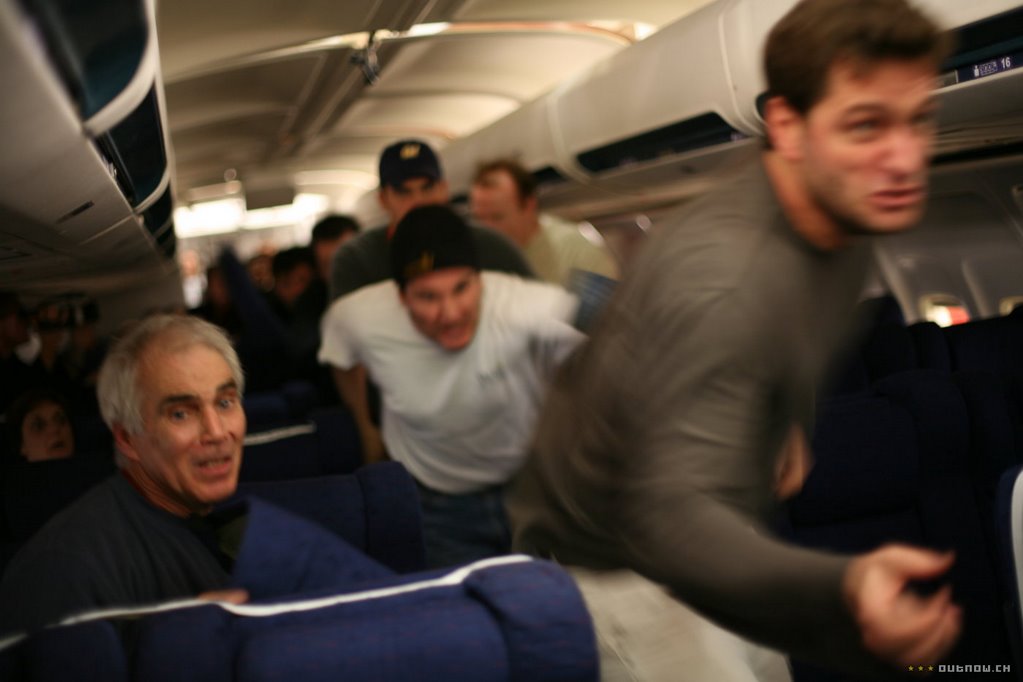
For the second year in a row, I can’t come up with 10 movies that would require compiling a “Best of” year-end list. In fact, I don’t think I even saw 10 movies in the theater this year. And glancing at the bevy of top-movie lists this past month, seems I didn’t miss much. “The Queen”? “Flags of Our Fathers”/”Letters from Iwo Jima”? “Little Miss Sunshine”? No thanks. The only consistently high-rated films I wanted to see but missed were “Borat” and “Dreamgirls.”
The simple fact is, there really are more reasons to stay in than ever. Television in 2006 didn’t just catch up to the film industry, the “boob tube” surpassed traditional Hollywood moviemaking. Sure there’s more reality schlock than ever, but TV is also taking more risks and greenlighting more ambitious projects than ever before, too—in my lifetime, anyway.
Taking a cue from HBO, the network that started this resurgence nearly a decade ago with “The Sopranos,” broadcast execs finally got wise and divided serialized shows (my flavor of choice) into mini-seasons, so viewers get major story arcs in big chunks, rather than having to sift through weeks of reruns for one new morsel. Thus shows like “Heroes” and “Lost” become more satisfying because their deep stories are played out in power-packed intervals.
Of course, all that said and still the most significant and powerful piece of filmmaking I saw in 2006 was, in fact, a movie. Since the lines between traditional cinema and traditional television continue to blur, I’ve blended my “Best of 2006” into one master list. Here goes …
1. “United 93”—This was quite simply one of the best movies I’ve ever seen. Screw Scorsese, writer/director Paul Greengrass deserves every award-season accolade for actually completing a seemingly impossible mission of translating the still-open wound of Sept. 11 into a piece of work that not only keeps you pinned back in your seat, but honors those brave passengers at the same time. I don’t know that I’ll ever watch this movie again, but it’s burned into my memory. For more viewing, I highly recommend Greengrass’ “Bloody Sunday,” which is similar in its documentary-style production. You can also check out my review from April here.
2. “Deadwood”—In any other year—meaning one that didn’t offer “United 93”—this superb Western would have topped the list. “Deadwood” is, yes, my favorite television show of all time—although simply labeling it a “television show” doesn’t seem to quite encapsulate all it has to offer, and at the same time reinforces my thesis about quality TV in general. A terrific cast, impeccable acting, true Shakespearean writing, classic Western themes, shocking violence that nevertheless didn’t feel excessive, and, unlike “The Sopranos,” characters you can actually love and root for. I’ve never seen its equal and can’t imagine I will ever again. You can read my June preview/review here.
3. “24”—The best adrenaline rush on screen—big or small—this year. I caught up with the herd in 2006, watching seasons 2-5 on DVD, and am definitely now a Jack Bauer devotee. Season 5 is my favorite of the bunch; I rank the others this way (best to least best): 4, 2, 1, 3. More on this topic soon (I hope, if I have the time/energy) as Season 6 blasts into existence in less than two weeks.
4. “Superman Returns”—I know most critics either panned or were generally indifferent to Bryan Singer’s take on the Man of Steel, but I absolutely loved it. Maybe it just caught me at a particularly good time, but this film gave me chills throughout, and I can’t wait for the next one. For more, check out my review from July here.
5. “PTI”—The little show I like to call “Pardon the Interruption” may only draw a few hundred thousand viewers a day, but it’s consistently the funniest half-hour on TV. Even with co-host Michael Wilbon morphing into an utter talking head and fellow host Tony Kornheiser spending most of the fall on split-screen for “Monday Night Football,” these two knuckleheads are the two most influential sports commentators in the business. And they make me laugh every single day.
6. “Entourage”—Season 3 may have had some rough spots (oh, that horrible two-episode “Dom” arc), but the first two eps of the year were two of the funniest pieces of television work I’ve ever seen. In fact, Jeremy Piven’s Ari Gold smashing his assistant’s little “power figure” statue may be my favorite comedic scene of all time.
7. “The Nine”—Wow, forget what I said about those TV execs, because there’s no way this show should have been pulled from the schedule already. I hope they do at least let this season run its course, because this show started hot and never cooled. John Billingsley’s kooky suicidal-turned-optimistic Egan Foote received well-deserved acclaim, but Tim Daly (remember the straight-laced pilot from “Wings”?) was just as good as a gambling-addicted cop, maybe even better.
8. “Lost”—I basically gave up on this show (more on that in a minute) but came back for the Season 3 premiere and got hooked all over again. By focusing on the power trio of Jack, Kate, and Sawyer, “Lost” returned to its strengths this fall and turned in a couple of its best installments. And let’s not forget a fabulous turn by he-with-the-wicked-eyes Michael Emerson as super-baddie (or is he?) Ben/Henry, plus sterling newcomer Elizabeth Mitchell as Jack’s captor/love interest, Juliet. Here’s hoping for more of the same when the show begins its 16-episode spring season in February.
9. “Heroes”—Although a little too self-aware at times of its “mythology,” credit NBC for taking a risk on this stellar action/drama. Like “24,” superb acting from multiple cast members helps ground a hyper-real show in a sense of human reality. There wasn’t quite enough payoff for that so-cool “Save the Cheerleader. Save the World” promo, so I’m a little reticent about the new “list” thing—again, a little too self-aware. But I’m definitely a fan.
10. “Whiskey on a Sunday”—This flawless rock doc told me everything I’d ever want to know about Flogging Molly, one of my favorite bands. It not only gives a great oral history of the group, but provides deep insights into several songs—most notably the heart-wrenching story of frontman Dave King playing an homage to his father, “The Likes of You Again,” for his mother for the first time. And the bonus CD was awesome, too.
Honorable Mentions
• “Cars”—The latest Pixar effort probably belongs on the above list, but it was just missing that intangible little extra something found in classics like “The Incredibles” and “Toy Story.” Solid, to be sure, but the first half-hour or so kinda dragged. Still, there were some absolutely glorious images and laugh-out-loud moments.
• “The Departed”—I really, really, really liked this movie—right up until the last five minutes. That ending left a bad taste in my mouth. Until then, though, it was certainly one of the best gangster movies I’ve seen in a while. Kudos to Leo and Marky Mark—two actors I typically avoid—for spectacular performances. And as a Matt Damon fan, he didn’t disappoint, either.
• “The Prestige”—If I had made a top 10 list of just movies, this would have been on it somewhere.
• “Smallville”—The 100th episode was amazing, but Season 6 has drifted a bit. Nice touch in the last ep, though, using AFI’s “Prelude 12/21” as the outro music.
• “V for Vendetta”—Another movie that had a lot going for it until the bitter end. I just can’t get too excited about a film that’s going to preach at me about how I need to “understand” Islamic terrorists. Still, great performances by Hugo Weaving and Natalie Portman.
Biggest Disappointments
1. “The Sopranos”—I ranted back in May about the exaggerated Vito story arc, so I won’t rehash here. But it says something that I, a devoted “Sopranos” fan, can’t remember a single thing about the Season 6 finale.
2. “X-Men: The Last Stand”—I knew going in that Brett Ratner was no Bryan Singer, but there’s no way I could have predicted in my worst nightmares the abomination that is this movie. You can read my review here.
3. “Alias”—The series finale was actually pretty good, but just about everything else about Season 5 was mediocre at best. It didn’t help Jen had to go get knocked up by Affleck, but they should have just ended with the excellent Season 4 finale. How great would it have been if Syd had just looked at Vaughn in the car and said, “I’m pregnant”—and there’s your series! The writers did the best they could, I guess, with little input from J.J. Abrams and a midseason hiatus, but this was a far cry from the series’ Season 2 peak.
4. “Lost”—As I mentioned earlier, Season 2 was a major drop in quality from the first go-round. Primary characters such as Jack, Locke, and Sawyer all went in petty, alpha male, king-of-the-mountain directions that made me dislike them, which is a bad, bad thing. Once again, J.J. Abrams leaves a project and it goes to crap. Can we clone him or something?
5. “Pirates of the Caribbean: Dead Man’s Chest”—On first blush, I may have overrated this movie. I watched it on DVD over the holidays and it didn’t hold up very well—too dark, not enough genuine yuks. Of course, it may shift again depending on how well it ultimately sets up the third installment. And speaking of …
Bring Me That Horizon
It doesn’t take a genius to figure this out, but I’ll go on record now that this year may break ever box office record in the books based on summer alone. The month of May brings “Spider-Man 3,” “Shrek 3,” and “Pirates 3”; other surefire blockbusters include “Harry Potter 5,” “Bourne 3,” plus the long-awaited “Simpsons” and “Transformers” movies (the former looks hilarious, the latter looks, well, meh). And let’s not forget a revitalized “Teenage Mutant Ninja Turtles” film in March!
Those are just the titles I can remember off the top of my head—I’m sure there are a few more pending “blockbusters” waiting in the wings. The scary thing is, I’ll probably see most, if not all, of the aforementioned installments; I just wonder if all these “must-see” movies will end up cannibalizing one another.
Hopefully they’ll be good enough to at least give me a reason to sit in a movie theater again.
Wednesday, November 29, 2006
The Beatles, 'LOVE'
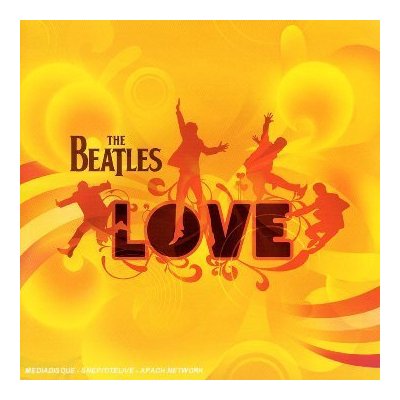
“LOVE,” the new “album” from The Beatles, is not only the most overhyped release of the year (and that’s saying something), but certainly one of the most disappointing, as well.
Released last week just in time for Black Friday, “LOVE” is the soundtrack to the new Cirque du Soleil show of the same name, which opened this summer at the Mirage in Vegas. George Martin (the “Fifth Beatle”) and his son, Giles, worked on this thing for years, apparently, and the result is billed as a “mash up” album. For those not familiar with that term, it means combining two old songs to create an entirely new one.
In this case, it’s false advertising.
The idea of mixing The Beatles’ all-too-familiar tracks in new and supposedly revolutionary ways was thrilling to me; the results, unfortunately, are barely interesting, because the Martins were apparently too scared to make truly risky and bold choices with a catalog revered like it’s the Word of God.
There’s only one true mash up on all of “LOVE”—the combination of “Within You Without You” and “Tomorrow Never Knows,” two songs not all that dissimilar in the first place. The rest of the album simply blends one song into another, if that.
Supposedly there are morsels of more than 180 Beatles tracks appearing in “LOVE’s” 78 minutes, but you’d have to be a Beatles freak to catch most of them. I own almost all of the original albums, and the majority of the songs on "LOVE" sound the same as they always have to these ears.
There are a few exceptions: When “Being for the Benefit of Mr. Kite” explodes into “I Want You,” it’s a sonic extravaganza that tantalizingly hints at what "LOVE" could and should have been. The Martins also effectively segue from “Drive My Car” to “The Word” to “What You’re Doing,” and Martin Sr.’s orchestral addition to “While My Guitar Gently Weeps” is a nice touch.
The overall impression, though, is underwhelming. It’s laughable that some reviewers even entertained the notion that “LOVE” could be considered an original Beatles album. This is not a reimagining, not a dramatic new vision of the band’s career. And it’s certainly nowhere near as exciting as Danger Mouse’s underground sensation “The Grey Album” from 2004, which magnificently and truly mashed The Beatles’ “White Album” with Jay-Z’s “Black Album.”
If nothing else, “LOVE” proves how amazing and ahead of their time the originals were, because those still sound more revolutionary than any of the bells and whistles added by the Martins. In theory this album sounded great; too bad the producers were afraid to do it right.
Grade: C+
Friday, November 24, 2006
The 26 of 2006
It’s truly a rare thing when a handful of albums from one calendar can crack my “Top Whatever of All Time” list. But 2006 was just such a year for music, and I was buying CDs like it was 1999.
New albums that spent more time in my life than any other this year were: AFI’s “Decemberunderground,” The Bouncing Souls’ “The Gold Record,” Johnny Cash’s “American V: A Hundred Highways,” Gnarls Barkley’s “St. Elsewhere,” Pearl Jam’s “Pearl Jam,” Bruce Springsteen’s “We Shall Overcome,” and the Yeah Yeah Yeahs’ “Show Your Bones.” And the great thing about that group is it features strong efforts from my old standbys and essentially new personal discoveries—I got the best of both worlds this year.
There was much, much more where those came from, though. I know it’s a little early for a traditional year-end best-of list, but I figured in honor of Black Friday I’d give everybody a holiday cheat sheet. An homage to one of my favorite new TV shows, I’m calling this list “The 26,” because I had to come up with a cutoff point somewhere. I highly recommend every single song and (almost) every single album on this list. Several records deserved multiple nominations, but I limited the entries to just one per band for obvious logistical reasons.
Song of the Year
• “Life Wasted,” Pearl Jam (from 2006’s “Pearl Jam”)—If you click the “Play Count” tab on my iPod, this song jumps straight to the top. I loved it the moment I first heard it when, weeks before the album came out, the band released it as a streaming video online. I was on the fence about the new record until I heard this song, and from then on it was all-out excitement. It opens and sets the tone for the album perfectly; it’s uplifting and contemplative without being cheesy; and it marked the band’s best album since 1998’s “Yield” and a throwback to “Vitalogy”-era intensity. There are several other cuts off this deep release that deserve to make the list (ah, “Come Back,” “Severed Hand,” “Unemployable,” and “Inside Job”), but “Life Wasted” encapsulates the entire record in just under four minutes.
The Other 25
• “Ain’t Talkin’,” Bob Dylan (from 2006’s “Modern Times”)—This beautiful, haunting epic is tucked away at the end of Dylan’s first studio album in five years. At nearly 9 minutes, you’d think it would drag, especially given its crawling tempo and near-whisper vocals. Um, no. It’s fantastic, to the very last second.
• “Air Said to Me,” Trey Anastasio (from 2005’s “Shine”)—An excellent rocker from his first post-Phish release. I only bought the record because he was opening for Tom Petty this summer. I bought this year’s effort, “Bar 17,” because “Air Said to Me” made me a fan. That Phish catalog is daunting, though …
• “Company in My Back,” Wilco (from 2004’s “A Ghost Is Born”)—The reason for this song’s inclusion is covered in my review of April’s Wilco show, so I won’t rehash. Simply put: It unlocked that album for me.
• “Don’t Wait,” Dashboard Confessional (from 2006’s “Dusk and Summer”)—If I had to make one cut from this list, “Don’t Wait” would be it. And not because of the song, which I’ve loved since hearing it live more than a year ago. No, Chris & Co. seem to be going in a bad direction these days. Here’s hoping the next record’s better.
• “For the Best,” Straylight Run (from 2004’s “Straylight Run”)—I don’t know if the members of this band (which formed after a defection from Taking Back Sunday) are Christians, but this gorgeous piano-driven song nevertheless touches on a spiritual battle I’ve been fighting for years: knowledge vs. faith.
• “Further On Up the Road,” Johnny Cash (from 2006’s “American V”)—It’s like Bruce Springsteen wrote this song for the Man in Black. I could have picked any one of five or six songs off arguably the best “American” series entry (ah, “Like the 309,” “I Came to Believe,” and “God’s Gonna Cut You Down”), but “Further On” seems to crystallize Cash’s defiant battle with death and loss in his last days. You are missed; I wish I knew you better when you were still here.
• “Gold Lion,” Yeah Yeah Yeahs (from 2006’s “Show Your Bones”)—WOW. That’s about all needs said about this album-opening tsunami. If you want more, check my collection of album reviews from June. Oh, and as I discovered this summer, “Show Your Bones” for some reason matches perfectly with William Gibson’s 2003 novel “Pattern Recognition.”
• “Hands Open,” Snow Patrol (from 2006’s “Eyes Open”)—An excellent early cut from a stellar album (even if it does namecheck Sufjan Stevens, I still love it). It’s funny how things can change over the course of time. When I first posted my review for this album, I gave it a B+; after multiple, multiple listens, I would definitely upgrade that decision now. This album has few missteps, and no glaring errors.
• “I Bet You Look Good on the Dancefloor,” Arctic Monkeys (from 2006’s “Whatever People Say I Am, That’s What I’m Not”)—This album came across the pond burdened with so much pre-release hype, it would be easy to dismiss—and probably was by many. But these British brats actually made a record that stands up to scrutiny. It’s not the Best Rock Album of All Time that some in the British tabs were slobbering early this year, but I defy you not to bounce your head and tap your foot to this batch of tunes.
• “I’m Shipping Up to Boston,” Dropkick Murphys (from 2005’s “The Warrior’s Code”)—I first heard the Irish punk of Flogging Molly and Dropkick Murphys at basically the same time. I liked Molly more (and still do), so the Murphys kinda got pushed to the background. Until, that is, I was sitting in a movie theater watching “The Departed” a couple months ago and this exhilarating Woodie Guthrie cover came BLASTING out of the surround-sound in all its glory. Thanks, Marty. The movie was good, this choice was golden.
• “Insistor,” Tapes ’n Tapes (from 2006’s “The Loon”)—Any new song that wouldn’t sound out of place on the “Pulp Fiction” soundtrack is good enough for me.
• “John Henry,” Bruce Springsteen and the Seeger Sessions Band (from 2006’s “We Shall Overcome”)—Again, an album that could occupy multiple slots on this list (ah, “Mrs. McGrath,” “O Mary Don’t You Weep,” and “Pay Me My Money Down”). I picked “John Henry” because it’s the powerhouse of the bunch and an absolute punch in the face live. Like “Life Wasted,” this song, too, was streamed online weeks before the release and really got my blood boiling for The Boss’ new venture. Kudos to Springsteen for having the guts to make such a departure and pulling it off so well.
• “Just a Thought,” Gnarls Barkley (from 2006’s “St. Elsewhere”)—Another album that absolutely, positively lives up to the overwhelming hype. The omnipresent “Crazy” would be the obvious choice here, but “Just a Thought,” singer/rapper Cee-Lo’s frank discussion of depression and suicide, is a monster track in the middle of this glorious concoction with DJ extraordinaire Danger Mouse.
• “Laura,” Flogging Molly (from 2006’s “Whiskey on a Sunday”)—This song’s been around for awhile but wasn’t released as an official studio recording until this summer’s bonus disc to the enlightening documentary DVD “Whiskey on a Sunday.” If you’re curious about this band, “Laura” works as both an introduction and a summary of their best work. This is probably my favorite Molly track now.
• “Not Everyone,” Nine Black Alps (from 2005’s “Everything Is”)—The Brits are on a roll, that’s for sure. Yeah, the Alps are very reminiscent of Nirvana, but it’s been more than a decade, already. At this point it’s gotta be considered more homage than straight-up copying, right? Whatever it is, this album rocks.
• “Penny On the Train Track,” Ben Kweller (from 2006’s “Ben Kweller”)—I covered this song in my review for RELEVANT, so it should be no surprise it makes an appearance here. This album only gets better the more times I listen to it.
• “Prelude 12/21,” AFI (from 2006’s “Decemberunderground”)—Yes, yet another album that could have demanded multiple entries (ah, “Miss Murder,” “Summer Shudder,” “Love Like Winter,” and “The Missing Frame”). I chose “Prelude” because, even though it’s not even really a complete song, it sets the tone for the entire record. The heavy drumbeat and ethereal background chorale of voices gets your heart thumping in preparation for the assault to come.
• “Rusted Wheel,” Silversun Pickups (from 2006’s “Carnavas”)—I actually bought this record only a few weeks ago based on strong word-of-mouth, so I haven’t had time to fully digest these trippy fuzz-rockers yet. “Rusted Wheel” is definitely the early standout, however. Theme parks use the term “placemaking” in their designs, meaning an area not to be missed, a singular location that draws people in. That term seems to apply to this song; it lives in its own space and place.
• “So Jersey”/”For All the Unheard,” The Bouncing Souls (from 2006’s “The Gold Record”)—These glorious songs are absolutely inseparable in my mind, so the Souls get the only multiple-entry on this list. I was shocked how much I loved this album, and blown away be these two tracks, in particular. For me, they’re two halves of one sentiment: In “So Jersey,” the band shares its gratitude for what music has done for them; in “Unheard,” they pay tribute to people out there just like them who, for whatever reason, weren’t able to realize their dreams and find release for their troubles through music.
• “Square One,” Tom Petty (from 2006’s “Highway Companion”)—Again, territory covered already in RELEVANT. A stunning return to glory. After all these years and all those hits, you’d think he’d be incapable of adding another classic to the repertoire. Think again.
• “Store Bought Bones,” The Raconteurs (from 2006’s “Broken Boy Soldiers”)—Jack White and Brendan Benson call down the hammer of the gods in this all-out rocker. Unveiled online well before the album release, “Bones” built up expectations for this side project that ultimately went unfulfilled. The record was really good, but it just wasn’t quite as momentous an occasion as I was expecting/hoping for. Still wish I had caught these guys on the road, though; word is they put on an awesome show.
• “The Train,” OutKast (from 2006’s “Idlewild”)—Big Boi, you’ve outdone yourself with this one. Funny enough, my favorite part is right before the last chorus when, in a quiet aside, Big Boi tells the backup singers, “I can take it from here, ladies. Y’all have done a good deed tonight.”
• “You Don’t Love Me,” Kooks (from 2006’s “Inside In/Inside Out”)—No need to reprint anything from RELEVANT. This album will always stick out to me because I heard about it while spending a week in England for work. I hadn’t heard of them before (because the album had just dropped in the UK about a month prior and had yet to hit the States), so I wandered around Staines one night looking for a CD shop and picked this album up, based on a local recommendation. Excellent advice.
• “Walk On (UK Single Version),” U2 (from 2001’s “Walk On” single)—I place this song at the end of the list (slightly out of order) because it works perfectly as a closer—as proved during the 2001 Elevation Tour. U2 is pissing me off right now, though, with this ridiculous “18 Singles” compilation that just hit the shelves this week. I understand it’s probably a record-label thing or a way to garner new fans or whatever, but at least let the diehards buy the two new songs individually off iTunes—no such luck. There’s no way I’m buying yet another version of “Where the Streets Have No Name” or “One.”
Anyway, the real reason I put this version of “Walk On” here is it helped me this year realize my favorite word in all of language is “hallelujah.” For those that haven’t heard it, this remixed version is far superior to the original album cut off 2000’s “All That You Can’t Leave Behind” because in the final minute the band breaks into a hallelujah chorus; it’s one of my favorite sections of any U2 song.
When used in the context of real praise and said/sung with conviction (as the band does here, brilliantly), I can’t think of a more beautiful word, a word that not only represents a powerful notion, but embodies its sentiment just in the way it’s uttered. It gives me gooseflesh.
New albums that spent more time in my life than any other this year were: AFI’s “Decemberunderground,” The Bouncing Souls’ “The Gold Record,” Johnny Cash’s “American V: A Hundred Highways,” Gnarls Barkley’s “St. Elsewhere,” Pearl Jam’s “Pearl Jam,” Bruce Springsteen’s “We Shall Overcome,” and the Yeah Yeah Yeahs’ “Show Your Bones.” And the great thing about that group is it features strong efforts from my old standbys and essentially new personal discoveries—I got the best of both worlds this year.
There was much, much more where those came from, though. I know it’s a little early for a traditional year-end best-of list, but I figured in honor of Black Friday I’d give everybody a holiday cheat sheet. An homage to one of my favorite new TV shows, I’m calling this list “The 26,” because I had to come up with a cutoff point somewhere. I highly recommend every single song and (almost) every single album on this list. Several records deserved multiple nominations, but I limited the entries to just one per band for obvious logistical reasons.
Song of the Year
• “Life Wasted,” Pearl Jam (from 2006’s “Pearl Jam”)—If you click the “Play Count” tab on my iPod, this song jumps straight to the top. I loved it the moment I first heard it when, weeks before the album came out, the band released it as a streaming video online. I was on the fence about the new record until I heard this song, and from then on it was all-out excitement. It opens and sets the tone for the album perfectly; it’s uplifting and contemplative without being cheesy; and it marked the band’s best album since 1998’s “Yield” and a throwback to “Vitalogy”-era intensity. There are several other cuts off this deep release that deserve to make the list (ah, “Come Back,” “Severed Hand,” “Unemployable,” and “Inside Job”), but “Life Wasted” encapsulates the entire record in just under four minutes.
The Other 25
• “Ain’t Talkin’,” Bob Dylan (from 2006’s “Modern Times”)—This beautiful, haunting epic is tucked away at the end of Dylan’s first studio album in five years. At nearly 9 minutes, you’d think it would drag, especially given its crawling tempo and near-whisper vocals. Um, no. It’s fantastic, to the very last second.
• “Air Said to Me,” Trey Anastasio (from 2005’s “Shine”)—An excellent rocker from his first post-Phish release. I only bought the record because he was opening for Tom Petty this summer. I bought this year’s effort, “Bar 17,” because “Air Said to Me” made me a fan. That Phish catalog is daunting, though …
• “Company in My Back,” Wilco (from 2004’s “A Ghost Is Born”)—The reason for this song’s inclusion is covered in my review of April’s Wilco show, so I won’t rehash. Simply put: It unlocked that album for me.
• “Don’t Wait,” Dashboard Confessional (from 2006’s “Dusk and Summer”)—If I had to make one cut from this list, “Don’t Wait” would be it. And not because of the song, which I’ve loved since hearing it live more than a year ago. No, Chris & Co. seem to be going in a bad direction these days. Here’s hoping the next record’s better.
• “For the Best,” Straylight Run (from 2004’s “Straylight Run”)—I don’t know if the members of this band (which formed after a defection from Taking Back Sunday) are Christians, but this gorgeous piano-driven song nevertheless touches on a spiritual battle I’ve been fighting for years: knowledge vs. faith.
• “Further On Up the Road,” Johnny Cash (from 2006’s “American V”)—It’s like Bruce Springsteen wrote this song for the Man in Black. I could have picked any one of five or six songs off arguably the best “American” series entry (ah, “Like the 309,” “I Came to Believe,” and “God’s Gonna Cut You Down”), but “Further On” seems to crystallize Cash’s defiant battle with death and loss in his last days. You are missed; I wish I knew you better when you were still here.
• “Gold Lion,” Yeah Yeah Yeahs (from 2006’s “Show Your Bones”)—WOW. That’s about all needs said about this album-opening tsunami. If you want more, check my collection of album reviews from June. Oh, and as I discovered this summer, “Show Your Bones” for some reason matches perfectly with William Gibson’s 2003 novel “Pattern Recognition.”
• “Hands Open,” Snow Patrol (from 2006’s “Eyes Open”)—An excellent early cut from a stellar album (even if it does namecheck Sufjan Stevens, I still love it). It’s funny how things can change over the course of time. When I first posted my review for this album, I gave it a B+; after multiple, multiple listens, I would definitely upgrade that decision now. This album has few missteps, and no glaring errors.
• “I Bet You Look Good on the Dancefloor,” Arctic Monkeys (from 2006’s “Whatever People Say I Am, That’s What I’m Not”)—This album came across the pond burdened with so much pre-release hype, it would be easy to dismiss—and probably was by many. But these British brats actually made a record that stands up to scrutiny. It’s not the Best Rock Album of All Time that some in the British tabs were slobbering early this year, but I defy you not to bounce your head and tap your foot to this batch of tunes.
• “I’m Shipping Up to Boston,” Dropkick Murphys (from 2005’s “The Warrior’s Code”)—I first heard the Irish punk of Flogging Molly and Dropkick Murphys at basically the same time. I liked Molly more (and still do), so the Murphys kinda got pushed to the background. Until, that is, I was sitting in a movie theater watching “The Departed” a couple months ago and this exhilarating Woodie Guthrie cover came BLASTING out of the surround-sound in all its glory. Thanks, Marty. The movie was good, this choice was golden.
• “Insistor,” Tapes ’n Tapes (from 2006’s “The Loon”)—Any new song that wouldn’t sound out of place on the “Pulp Fiction” soundtrack is good enough for me.
• “John Henry,” Bruce Springsteen and the Seeger Sessions Band (from 2006’s “We Shall Overcome”)—Again, an album that could occupy multiple slots on this list (ah, “Mrs. McGrath,” “O Mary Don’t You Weep,” and “Pay Me My Money Down”). I picked “John Henry” because it’s the powerhouse of the bunch and an absolute punch in the face live. Like “Life Wasted,” this song, too, was streamed online weeks before the release and really got my blood boiling for The Boss’ new venture. Kudos to Springsteen for having the guts to make such a departure and pulling it off so well.
• “Just a Thought,” Gnarls Barkley (from 2006’s “St. Elsewhere”)—Another album that absolutely, positively lives up to the overwhelming hype. The omnipresent “Crazy” would be the obvious choice here, but “Just a Thought,” singer/rapper Cee-Lo’s frank discussion of depression and suicide, is a monster track in the middle of this glorious concoction with DJ extraordinaire Danger Mouse.
• “Laura,” Flogging Molly (from 2006’s “Whiskey on a Sunday”)—This song’s been around for awhile but wasn’t released as an official studio recording until this summer’s bonus disc to the enlightening documentary DVD “Whiskey on a Sunday.” If you’re curious about this band, “Laura” works as both an introduction and a summary of their best work. This is probably my favorite Molly track now.
• “Not Everyone,” Nine Black Alps (from 2005’s “Everything Is”)—The Brits are on a roll, that’s for sure. Yeah, the Alps are very reminiscent of Nirvana, but it’s been more than a decade, already. At this point it’s gotta be considered more homage than straight-up copying, right? Whatever it is, this album rocks.
• “Penny On the Train Track,” Ben Kweller (from 2006’s “Ben Kweller”)—I covered this song in my review for RELEVANT, so it should be no surprise it makes an appearance here. This album only gets better the more times I listen to it.
• “Prelude 12/21,” AFI (from 2006’s “Decemberunderground”)—Yes, yet another album that could have demanded multiple entries (ah, “Miss Murder,” “Summer Shudder,” “Love Like Winter,” and “The Missing Frame”). I chose “Prelude” because, even though it’s not even really a complete song, it sets the tone for the entire record. The heavy drumbeat and ethereal background chorale of voices gets your heart thumping in preparation for the assault to come.
• “Rusted Wheel,” Silversun Pickups (from 2006’s “Carnavas”)—I actually bought this record only a few weeks ago based on strong word-of-mouth, so I haven’t had time to fully digest these trippy fuzz-rockers yet. “Rusted Wheel” is definitely the early standout, however. Theme parks use the term “placemaking” in their designs, meaning an area not to be missed, a singular location that draws people in. That term seems to apply to this song; it lives in its own space and place.
• “So Jersey”/”For All the Unheard,” The Bouncing Souls (from 2006’s “The Gold Record”)—These glorious songs are absolutely inseparable in my mind, so the Souls get the only multiple-entry on this list. I was shocked how much I loved this album, and blown away be these two tracks, in particular. For me, they’re two halves of one sentiment: In “So Jersey,” the band shares its gratitude for what music has done for them; in “Unheard,” they pay tribute to people out there just like them who, for whatever reason, weren’t able to realize their dreams and find release for their troubles through music.
• “Square One,” Tom Petty (from 2006’s “Highway Companion”)—Again, territory covered already in RELEVANT. A stunning return to glory. After all these years and all those hits, you’d think he’d be incapable of adding another classic to the repertoire. Think again.
• “Store Bought Bones,” The Raconteurs (from 2006’s “Broken Boy Soldiers”)—Jack White and Brendan Benson call down the hammer of the gods in this all-out rocker. Unveiled online well before the album release, “Bones” built up expectations for this side project that ultimately went unfulfilled. The record was really good, but it just wasn’t quite as momentous an occasion as I was expecting/hoping for. Still wish I had caught these guys on the road, though; word is they put on an awesome show.
• “The Train,” OutKast (from 2006’s “Idlewild”)—Big Boi, you’ve outdone yourself with this one. Funny enough, my favorite part is right before the last chorus when, in a quiet aside, Big Boi tells the backup singers, “I can take it from here, ladies. Y’all have done a good deed tonight.”
• “You Don’t Love Me,” Kooks (from 2006’s “Inside In/Inside Out”)—No need to reprint anything from RELEVANT. This album will always stick out to me because I heard about it while spending a week in England for work. I hadn’t heard of them before (because the album had just dropped in the UK about a month prior and had yet to hit the States), so I wandered around Staines one night looking for a CD shop and picked this album up, based on a local recommendation. Excellent advice.
• “Walk On (UK Single Version),” U2 (from 2001’s “Walk On” single)—I place this song at the end of the list (slightly out of order) because it works perfectly as a closer—as proved during the 2001 Elevation Tour. U2 is pissing me off right now, though, with this ridiculous “18 Singles” compilation that just hit the shelves this week. I understand it’s probably a record-label thing or a way to garner new fans or whatever, but at least let the diehards buy the two new songs individually off iTunes—no such luck. There’s no way I’m buying yet another version of “Where the Streets Have No Name” or “One.”
Anyway, the real reason I put this version of “Walk On” here is it helped me this year realize my favorite word in all of language is “hallelujah.” For those that haven’t heard it, this remixed version is far superior to the original album cut off 2000’s “All That You Can’t Leave Behind” because in the final minute the band breaks into a hallelujah chorus; it’s one of my favorite sections of any U2 song.
When used in the context of real praise and said/sung with conviction (as the band does here, brilliantly), I can’t think of a more beautiful word, a word that not only represents a powerful notion, but embodies its sentiment just in the way it’s uttered. It gives me gooseflesh.
Thursday, November 02, 2006
Kweller, Kooks, and The Killers
RELEVANT has posted my capsule reviews for the new Ben Kweller album (A-), the Kooks (B+), and The Killers (B). You can read them here.
Saturday, October 21, 2006
‘The Prestige’

Christopher Nolan is some wizard with a camera.
Consider the roll this 36-year-old British filmmaker is on: He breaks through in 2000 with “Memento,” a cult smash in which the entire story is told backward. He follows that with “Insomnia,” a taut crime thriller headlined by none other than Al Pacino. And then last year he resuscitates the Batman franchise with the flawed but promising “Batman Begins,” which not only puts him right on the A-list, but does the same for his Bruce Wayne, too, Christian Bale (the best of the Bruce bunch, by the way, and it’s not even close).
Now, after that detour into the mainstream, Nolan returns to his esoteric roots with “The Prestige,” an excellent mindbender of a movie about two rival magicians in late 19th century London. Bale is back with Nolan in what appears to be Hollywood’s brightest new actor/director dynamic duo (giving George Clooney and Steven Soderbergh all they can handle and more). The iron-jawed chameleon this time dives into Alfred Borden, an up-and-coming magician whose dedication to his craft knows no bounds. Playing opposite Bale to fabulous effect is Hugh Jackman as the troubled Rupert Angier, a slightly inferior illusionist whose upper-crust upbringing has given him a better flair for the dramatic. Thus the conflict is established early: Style vs. substance, and both want what the other has.
Jackman’s name may be atop the credits, but this movie belongs to Bale—and that’s no shame to everyone’s new favorite Aussie, who gives a fine performance and continues to prove there’s more to him than adamantium claws. But Bale is mesmerizing throughout—there isn’t a wasted movement or a single line where you don’t fully believe his performance.
Of course, it helps these guys are backed up by the likes of Michael Caine and Scarlett Johansson, no slouches themselves when it comes to pure magnetism. The venerable Caine plays Angier’s engineer, the man who creates the illusions while also serving as the film’s moral center. Johansson actually has a rather minor role as Angier’s assistant/love interest, but as usual lights up the screen whenever she’s on it.
Neither of the two magicians is necessarily likable, yet they’re fascinating to watch. Both sacrifice everything else in their lives for their art and wear that determination with a mixture of pride and martyrdom. The film is essentially a lengthy game of one-upmanship, albeit an extremely dangerous one, as each becomes obsessed with not only discovering how the other manages their latest tricks, but then foiling the other’s illusions in front of a paying audience.
Nolan is the true magician here, as he weaves scenes together by constantly moving back and forth along the story’s timeline to reveal various aspects of each man’s dementia. In essence, “The Prestige” really does become a two-hour magic trick as it draws from various genres—drama, crime, comedy, romance, and even a little sci-fi/fantasy—to keep us wondering just how he’s pulling it all off. Unfortunately, like his characters, Nolan gets too carried away; there are a few too many double-crosses (or triple- or quadruple-crosses, as the case may be) for the film’s own good. I could have used a little deeper character motivation for the two leads and more actual onscreen magic, but these are relatively minor quibbles for a movie that is sure to engender lively conversation during the car ride home.
On the whole, “The Prestige” is a thoroughly engrossing head-trip with more surprising twists and turns than M. Night Shyamalan’s produced in his entire career. Nolan is still searching for his truly great film, but the method is spot on—it can only be a matter of time.
Grade: A-
Tuesday, September 26, 2006
It's Just More of the Same (yawn) in 'Studio 60'
Aaron Sorkin must really, really hate Christianity. It seems to be an obsession, or maybe just an easy cure for writer’s block.
It’s no secret on which side of the political aisle Sorkin resides. This is the guy who wrote “The American President” and created “The West Wing,” both highlighting Democratic administrations—and both quality entertainment.
But in the very first episode of the latter, way back in 1999, the plot revolved around Josh Lyman (Bradley Whitford) trying to get himself out of a jam for insulting the “religious right.” He spent the entire episode thinking it would be his last day in The White House before good ol’ Jed Bartlet came hobbling in on a cane to save the day and send those right-wing fanatics out on their self-righteous ears (Jed didn’t use that word, of course).
Well, it’s a new millennium, a new show, and, unfortunately, the same old Aaron.
In the second episode of his over-hyped new series, “Studio 60 on the Sunset Strip,” those Christian “nut jobs” (I can’t remember if that’s the actual derogatory name applied in the show, but it was something along those lines) are back at it again, this time protesting a sketch dubbed “Crazy Christians” set to air on Sorkin’s fictional version of “Saturday Night Live.” Whitford is even back in on the action, this time playing the show’s executive producer who looks, talks, and thinks EXACTLY like Josh Lyman (big stretch, huh, Bradley? Of course, I guess it’s better than reprising your villainous role for “Billy Madison II”). Whitford’s “new” character oh-so-gallantly refuses to cave to the radical right—again.
It’s not hard to see where the impetus for these albeit stereotypical characterizations of Christians comes from—most of the time I think Jerry Falwell does more harm than good on the public stage. But how about a little originality? If Sorkin had half the guts he thinks he does, he’d have made the protesters Muslims and dubbed the skit “The Joys of Jihad.” Instead, he took the easy way out, because Christians have been mocked and exaggerated and generalized and marginalized for so long, his petty little quips in “Studio 60” don’t even register on the controversy Richter scale anymore.
The anti-Christian content didn’t irritate me that much, really, because it’s not a surprise. No, it bothered me on an artistic level. “Studio 60,” by and large, sucks (if such a judgment can be reached after one episode, and I think it can). It’s basically “The West Wing” set in a Hollywood studio instead of The White House. I know Sorkin has various “trademark” elements to his series—the fast walking and talking, the witty banter, etc.—but “Studio 60” is a lackluster retread, right down to using the same font on its opening credits as those found on “The West Wing.”
At least in that show I could stand the self-importance and the melodrama because it typically revolved around such matters as nuclear warheads or State of the Union addresses. Sorkin’s talents don’t carry the same weight when applied to drafting next week’s lame opening skit. I realize the people behind “SNL” are under a lot of pressure, but that doesn’t mean I really care. It’s still a sketch comedy show, and “Studio 60” treats the job like it’s curing cancer.
In fact, for all of “The West Wing” aped in his new series, Sorkin seems to have left out the most fascinating part: the process. I would be interested in a show that deals exclusively with what a writers’ war room is like on deadline of a major TV show—something Sorkin knows all too well with his frequent missed deadlines. In this week’s episode, we got precious little of that and way too much who-slept-with-who soap opera crapola.
Sorkin is one of the best at what he does, that’s for sure (click on the May 2004 folder at right for my glowing column on his work for “West Wing”). Despite all these flaws, I still laughed out loud several times during the hour. Whitford and Matthew Perry (who plays the show’s lead writer) are fantastic together.
But in just that one hour (which is more like 42 minutes factoring in commercials), Sorkin took at least a half-dozen shots at Christians and conservatives in general—oh, how, like befuddled and defrocked Dan Rather, Sorkin longs for the days when “real” journalists like those at The New York Times were the only voices in media, while the Drudge Report is slammed with off-handed smarmy comments (ironically, Drudge was just named the Walter Cronkite of his era—in a new book by a Washington Post political writer, no less).
I’ve said it before and here it is again: Enough of the politics, already. It’s been done to death. You’re a liberal and you hate conservatives and Christians and George W. Bush (and don’t think those three are necessarily one and the same). We all get it. Here we are now, entertain us (and yes, I know that line is completely out of context here, but I thought it somewhat appropriate since we just passed the album’s 15th anniversary—we’re all getting old).
Thank goodness “Heroes” looks like it could be awesome.
It’s no secret on which side of the political aisle Sorkin resides. This is the guy who wrote “The American President” and created “The West Wing,” both highlighting Democratic administrations—and both quality entertainment.
But in the very first episode of the latter, way back in 1999, the plot revolved around Josh Lyman (Bradley Whitford) trying to get himself out of a jam for insulting the “religious right.” He spent the entire episode thinking it would be his last day in The White House before good ol’ Jed Bartlet came hobbling in on a cane to save the day and send those right-wing fanatics out on their self-righteous ears (Jed didn’t use that word, of course).
Well, it’s a new millennium, a new show, and, unfortunately, the same old Aaron.
In the second episode of his over-hyped new series, “Studio 60 on the Sunset Strip,” those Christian “nut jobs” (I can’t remember if that’s the actual derogatory name applied in the show, but it was something along those lines) are back at it again, this time protesting a sketch dubbed “Crazy Christians” set to air on Sorkin’s fictional version of “Saturday Night Live.” Whitford is even back in on the action, this time playing the show’s executive producer who looks, talks, and thinks EXACTLY like Josh Lyman (big stretch, huh, Bradley? Of course, I guess it’s better than reprising your villainous role for “Billy Madison II”). Whitford’s “new” character oh-so-gallantly refuses to cave to the radical right—again.
It’s not hard to see where the impetus for these albeit stereotypical characterizations of Christians comes from—most of the time I think Jerry Falwell does more harm than good on the public stage. But how about a little originality? If Sorkin had half the guts he thinks he does, he’d have made the protesters Muslims and dubbed the skit “The Joys of Jihad.” Instead, he took the easy way out, because Christians have been mocked and exaggerated and generalized and marginalized for so long, his petty little quips in “Studio 60” don’t even register on the controversy Richter scale anymore.
The anti-Christian content didn’t irritate me that much, really, because it’s not a surprise. No, it bothered me on an artistic level. “Studio 60,” by and large, sucks (if such a judgment can be reached after one episode, and I think it can). It’s basically “The West Wing” set in a Hollywood studio instead of The White House. I know Sorkin has various “trademark” elements to his series—the fast walking and talking, the witty banter, etc.—but “Studio 60” is a lackluster retread, right down to using the same font on its opening credits as those found on “The West Wing.”
At least in that show I could stand the self-importance and the melodrama because it typically revolved around such matters as nuclear warheads or State of the Union addresses. Sorkin’s talents don’t carry the same weight when applied to drafting next week’s lame opening skit. I realize the people behind “SNL” are under a lot of pressure, but that doesn’t mean I really care. It’s still a sketch comedy show, and “Studio 60” treats the job like it’s curing cancer.
In fact, for all of “The West Wing” aped in his new series, Sorkin seems to have left out the most fascinating part: the process. I would be interested in a show that deals exclusively with what a writers’ war room is like on deadline of a major TV show—something Sorkin knows all too well with his frequent missed deadlines. In this week’s episode, we got precious little of that and way too much who-slept-with-who soap opera crapola.
Sorkin is one of the best at what he does, that’s for sure (click on the May 2004 folder at right for my glowing column on his work for “West Wing”). Despite all these flaws, I still laughed out loud several times during the hour. Whitford and Matthew Perry (who plays the show’s lead writer) are fantastic together.
But in just that one hour (which is more like 42 minutes factoring in commercials), Sorkin took at least a half-dozen shots at Christians and conservatives in general—oh, how, like befuddled and defrocked Dan Rather, Sorkin longs for the days when “real” journalists like those at The New York Times were the only voices in media, while the Drudge Report is slammed with off-handed smarmy comments (ironically, Drudge was just named the Walter Cronkite of his era—in a new book by a Washington Post political writer, no less).
I’ve said it before and here it is again: Enough of the politics, already. It’s been done to death. You’re a liberal and you hate conservatives and Christians and George W. Bush (and don’t think those three are necessarily one and the same). We all get it. Here we are now, entertain us (and yes, I know that line is completely out of context here, but I thought it somewhat appropriate since we just passed the album’s 15th anniversary—we’re all getting old).
Thank goodness “Heroes” looks like it could be awesome.
Friday, September 15, 2006
More Capsule Music Reviews
It seems music is either feast or famine for me these days. I feel a little uncomfortable giving out so many A’s this summer, but it really has been a fantastic season. Case in point: Here are three more albums in the “A” range, and two I probably won’t listen to anymore.
• “B’Day,” Beyoncé—Wow, happy b’day to us, because Beyonce’s second solo album is what I was hoping for three years ago on “Dangerously in Love.” That album featured the perfect opening trifecta of “Crazy in Love”/“Naughty Girl”/“Baby Boy” but drifted the rest of the way through too many listless Mariah-esque slow jams. “B’Day,” on the other hand, mashes the pedal down nearly all the way through its breezy 10 songs (plus two hidden tracks). Leaving Destiny’s Child way back in her rearview mirror, Ms. Knowles unleashes her inner Aretha throughout this set, peeling paint off the walls at the top of her lungs in shredders like “Ring the Alarm,” “Get Me Bodied,” and lead single “Déjà Vu,” the latter teaming her once again with beau Jay-Z. Speaking of, I was worried for him the first time through “B’Day,” because Beyoncé seems on a rampaging mission to decimate every lowdown man in her life (especially on “Irreplaceable”: “I could have another you in a minute/Matter of fact, he’ll be here in a minute”). And then I listened through past the end of “Resentment,” the final track on the album; in the beginning of the “hidden” section, B’ explains this album was spawned in the afterglow of her work in “Dreamgirls,” the Oscar-baiting movie in which she stars (it opens Christmas Day). She loved that character, Deena, so much she didn’t want to let her go and thus wrote a batch of songs from her perspective—saying all the things Deena should have said in the film but didn’t. Beyoncé then throws in “Listen,” apparently the pivotal song from the movie. This message puts a deeper level of context on an album whose lyrical content would otherwise seem run-of-the-mill. It’s a stellar sophomore effort that makes “Dangerously” sound tame and cements the fact that there’s way more to Beyoncé than simply being the pop diva of the moment. Grade: A-
• “Happy Hollow,” Cursive—Setting aside for a moment this is a concept album that attempts to rip Christianity to shreds in every song, I still can’t connect with it. Lead singer/songwriter Tim Kasher has an abrasive voice that just hits me the wrong way. Musically, “Happy Hollow” is quite interesting, but I just can’t get past that grating vocal (in that way, Cursive reminds me of Thursday and Say Anything). And even if I did like Kasher’s voice, there’s no way I’d listen to this album ever again. My beliefs are challenged on a continual basis by pop culture and I’ve made my peace with that. “Happy Hollow” goes beyond what I’m willing to put up with—there’s nothing I can personally find redeemable in these albeit quite literal lyrics. I can understand why this album is one of the best reviewed of the year, but I’m in no position to give anywhere close to an objective opinion. Grade: N/A
• “Modern Times,” Bob Dylan—I don’t know nearly enough to put Dylan’s new album in context as a career achievement—I leave that for the experts (although Rolling Stone handing out yet another five-star review seems excessive). What amazes me, the novice, is how after 40-plus years and 40-plus albums he somehow conjures up his magic for yet another sterling set. In a time when so many of Dylan’s contemporaries are dead, retired, or irrelevant, he remains at the top of his game (how cool is that iPod commercial?). It’s strange to think Dylan’s last album, “Love and Theft,” was released on Sept. 11, 2001, because that album is loose and full of joy, so at odds with that awful day. Like so many Americans, the past five years seem to have worn on Dylan; while “Modern Times” maintains the same sound of its predecessor, the tone is much different. It’s mellower, more contemplative. “Love and Theft” seemed to stretch out and fill the room, while “Modern Times” draws in on itself, sucking you in with it. Dylan and his band make room for plenty of old-school rockin’ and rollin’ on great cuts like “Thunder On The Mountain,” “Rollin’ and Tumblin’,” and “The Levee’s Gonna Break.” But it’s the quiet moments that really make this record. Like all 8 minutes and 48 seconds of “Ain’t Talkin’,” which doesn’t waste a heartbeat. Grade: A
***On a side note, anyone who still hasn’t purchased this CD, I recommend picking it up at Best Buy so you can have the exclusive booklet from that store which includes cover art and tracklists for every single Dylan album. It’s pretty sweet.***
• “Another Fine Day,” Golden Smog—I’m ashamed to admit I’m only well-versed in one piece of the three main bands that make up super-side project Golden Smog, featuring members of the Jayhawks, Soul Asylum, and Wilco. Nor do I own any of Smog’s previous recordings, which date back to 1992. But that may not be a bad thing, because I’m guessing there are a lot of people in my same situation, meaning there’s a little something for everybody on this excellent set. For the past couple months since its release, I’ve been trying to find a bad song on this record and there just isn’t one—the only flaw may be, at 15 tracks, it’s a bit overwhelming. To mention one highlight, though, is to leave out five others equally deserving (but, okay, “Beautiful Mind” and the Kinks cover “Strangers” are particularly awesome). The influences are wide-ranging: classic rock, roots rock, pop rock, folk, country, alt-country, it’s all here—and it all sounds really good. So good, in fact, you won’t believe this is “just a side project.” Grade: A-
• “Illinois,” Sufjan Stevens—This is not a review, per se, because “Illinois” was last year’s IT indie album. I just thought I’d mention I’ve been trying for all of 2006 to like this record and finally, just this week, gave up and deleted it from my iPod. It’s just too cute, too perfect, too … I don’t know … too cold, maybe? I can see why people go crazy for Sufjan—he fits perfectly into the post-“Garden State” soundtrack world in which we all live—but it didn’t do much for me (although I do enjoy “Jacksonville”). I guess this means I have to turn in my Christian I.D. card now.
• “B’Day,” Beyoncé—Wow, happy b’day to us, because Beyonce’s second solo album is what I was hoping for three years ago on “Dangerously in Love.” That album featured the perfect opening trifecta of “Crazy in Love”/“Naughty Girl”/“Baby Boy” but drifted the rest of the way through too many listless Mariah-esque slow jams. “B’Day,” on the other hand, mashes the pedal down nearly all the way through its breezy 10 songs (plus two hidden tracks). Leaving Destiny’s Child way back in her rearview mirror, Ms. Knowles unleashes her inner Aretha throughout this set, peeling paint off the walls at the top of her lungs in shredders like “Ring the Alarm,” “Get Me Bodied,” and lead single “Déjà Vu,” the latter teaming her once again with beau Jay-Z. Speaking of, I was worried for him the first time through “B’Day,” because Beyoncé seems on a rampaging mission to decimate every lowdown man in her life (especially on “Irreplaceable”: “I could have another you in a minute/Matter of fact, he’ll be here in a minute”). And then I listened through past the end of “Resentment,” the final track on the album; in the beginning of the “hidden” section, B’ explains this album was spawned in the afterglow of her work in “Dreamgirls,” the Oscar-baiting movie in which she stars (it opens Christmas Day). She loved that character, Deena, so much she didn’t want to let her go and thus wrote a batch of songs from her perspective—saying all the things Deena should have said in the film but didn’t. Beyoncé then throws in “Listen,” apparently the pivotal song from the movie. This message puts a deeper level of context on an album whose lyrical content would otherwise seem run-of-the-mill. It’s a stellar sophomore effort that makes “Dangerously” sound tame and cements the fact that there’s way more to Beyoncé than simply being the pop diva of the moment. Grade: A-
• “Happy Hollow,” Cursive—Setting aside for a moment this is a concept album that attempts to rip Christianity to shreds in every song, I still can’t connect with it. Lead singer/songwriter Tim Kasher has an abrasive voice that just hits me the wrong way. Musically, “Happy Hollow” is quite interesting, but I just can’t get past that grating vocal (in that way, Cursive reminds me of Thursday and Say Anything). And even if I did like Kasher’s voice, there’s no way I’d listen to this album ever again. My beliefs are challenged on a continual basis by pop culture and I’ve made my peace with that. “Happy Hollow” goes beyond what I’m willing to put up with—there’s nothing I can personally find redeemable in these albeit quite literal lyrics. I can understand why this album is one of the best reviewed of the year, but I’m in no position to give anywhere close to an objective opinion. Grade: N/A
• “Modern Times,” Bob Dylan—I don’t know nearly enough to put Dylan’s new album in context as a career achievement—I leave that for the experts (although Rolling Stone handing out yet another five-star review seems excessive). What amazes me, the novice, is how after 40-plus years and 40-plus albums he somehow conjures up his magic for yet another sterling set. In a time when so many of Dylan’s contemporaries are dead, retired, or irrelevant, he remains at the top of his game (how cool is that iPod commercial?). It’s strange to think Dylan’s last album, “Love and Theft,” was released on Sept. 11, 2001, because that album is loose and full of joy, so at odds with that awful day. Like so many Americans, the past five years seem to have worn on Dylan; while “Modern Times” maintains the same sound of its predecessor, the tone is much different. It’s mellower, more contemplative. “Love and Theft” seemed to stretch out and fill the room, while “Modern Times” draws in on itself, sucking you in with it. Dylan and his band make room for plenty of old-school rockin’ and rollin’ on great cuts like “Thunder On The Mountain,” “Rollin’ and Tumblin’,” and “The Levee’s Gonna Break.” But it’s the quiet moments that really make this record. Like all 8 minutes and 48 seconds of “Ain’t Talkin’,” which doesn’t waste a heartbeat. Grade: A
***On a side note, anyone who still hasn’t purchased this CD, I recommend picking it up at Best Buy so you can have the exclusive booklet from that store which includes cover art and tracklists for every single Dylan album. It’s pretty sweet.***
• “Another Fine Day,” Golden Smog—I’m ashamed to admit I’m only well-versed in one piece of the three main bands that make up super-side project Golden Smog, featuring members of the Jayhawks, Soul Asylum, and Wilco. Nor do I own any of Smog’s previous recordings, which date back to 1992. But that may not be a bad thing, because I’m guessing there are a lot of people in my same situation, meaning there’s a little something for everybody on this excellent set. For the past couple months since its release, I’ve been trying to find a bad song on this record and there just isn’t one—the only flaw may be, at 15 tracks, it’s a bit overwhelming. To mention one highlight, though, is to leave out five others equally deserving (but, okay, “Beautiful Mind” and the Kinks cover “Strangers” are particularly awesome). The influences are wide-ranging: classic rock, roots rock, pop rock, folk, country, alt-country, it’s all here—and it all sounds really good. So good, in fact, you won’t believe this is “just a side project.” Grade: A-
• “Illinois,” Sufjan Stevens—This is not a review, per se, because “Illinois” was last year’s IT indie album. I just thought I’d mention I’ve been trying for all of 2006 to like this record and finally, just this week, gave up and deleted it from my iPod. It’s just too cute, too perfect, too … I don’t know … too cold, maybe? I can see why people go crazy for Sufjan—he fits perfectly into the post-“Garden State” soundtrack world in which we all live—but it didn’t do much for me (although I do enjoy “Jacksonville”). I guess this means I have to turn in my Christian I.D. card now.
Saturday, September 09, 2006
OutKast, 'Idlewild'
My latest review is now online at Relevant. Grade: A- (Bonus points for the person who can spot the grammatical error in the first sentence—not my fault, by the way.)
Saturday, August 12, 2006
The Ghost of a Good Thing: Dashboard Confessional in D.C., 8.9.06
What in the world has gotten into Chris Carrabba?
This week his band, Dashboard Confessional, played Constitution Hall in D.C. and it was … just okay. That’s strange, considering I saw this very same band just nine months ago and it was, without a doubt, one of the best concerts of my life.
Of course, the latter was part of a college tour, and Dashboard played on a sparse stage set up at one end of a big ol’ gym in the Middle of Nowhere, Maryland, to about 750 to 1,000 people. (It was basically a perfect show—check out the November 2005 folder at right for more.)
In the intervening time, Carrabba released “Dusk and Summer,” his fourth and most arena-friendly album. And, apparently, he’s decided to overhaul his entire stage persona. Now, I’m certainly not one to criticize an artist for expanding or changing; to simply play the same old warhorses the same old way for years on end typically is a bad thing (unless you’re the ageless wonder Tom Petty). Carrabba’s 31 years old now, so I appreciate some of the more subtle changes he’s made for this tour, such as playing “The Good Fight” all-electric or mellowing out “The Swiss Army Romance” so it’s more mature and contemplative, as opposed to the heart-on-sleeve post-teenage angst way it was originally conceived.
But elsewhere, Carrabba’s decided to come out from behind the mic and guitar, parading around the stage trying to unleash his inner Robert Plant. He looks absolutely ridiculous (and uncomfortable, and unnatural) holding up his left hand, palm out, with his eyes closed and body bent at the waist. I realize Dashboard is playing to bigger crowds now than it ever has (they sold out large concert halls in D.C., Boston, and NYC this week), but Carrabba’s changed his style more drastically than could ever be considered innate. It’s way too campy; for the first time in four shows, it felt like Carrabba was disingenuous, posing for the crowd with total lack of any real emotion. Just because you’re playing to a bigger room doesn’t mean you have to act “bigger.” There’s only one Bono and, sorry Chris, you ain’t him.
I’m hoping this is just a phase, just a step in Carrabba’s figuring out how to age gracefully. As I wrote in my review for “Dusk and Summer,” he’s too old to be doing the same old thing. Consider his quote from a Boston Herald article this week:
“When you come from the DIY world that I come from, you realize that there’s a reason to embrace those values. But there’s also a reason to not let those things roll over your creative nature in a negative way. That was a liberating feeling to discover in making this record.”
In principle, I totally agree with him. Indie/punk “cred” is about as fickle a fanbase as you’ll ever find—one wrong move according to some unrealistic, unattainable, unwritten, inscrutable standard, and they label you a sellout and trash you on punknews.org. That’s not what I’m doing here. I have no problem with Dashboard’s rising popularity; what bothers me is seemingly changing who you are to meet that new audience. Because, man, I hope D/C is not following in the footsteps of DMB; one beloved band’s betrayal is enough.
It would be one thing if these stylistic alterations accompanied a better experience (hello, ZooTV). You want to add stage effects, backdrops, etc.? Fine. But Wednesday night’s show was middling at best, where the added “production value” too severely determined the course of the music. Plus, two opening bands meant the setlist was cropped down to 16 songs and less than an hour and a half. Dashboard’s playing the same set every single night and, as they wind down to the end of this tour, they look flat-out bored. Even their best songs—“Vindicated,” “Hands Down,” “Again I Go Unnoticed”—felt rote.
That’s not to say there weren’t some nice moments, though, and that I didn’t have a good time. “So Long, So Long” is a winner, and all the other new songs sounded good live, too (even though I can’t believe they’re not playing “Reason to Believe”). If I had never seen the band before, I probably would have been fine, especially with such great seats (second row!) that only cost $25. And maybe I just caught them on an off night. But when I know what Dashboard’s capable of, this show was, in general, a hollow disappointment.
Dashboard Confessional
Constitution Hall
Washington, D.C.
8.9.06
Heaven Here
Rooftops and Invitations
The Good Fight
The Swiss Army Romance
The Secret’s in the Telling
Again I Go Unnoticed
Ghost of a Good Thing
Gone, Gone, Gone (John Ralston on lead vocals)
Dusk and Summer
Remember to Breathe
Screaming Infidelities
So Long, So Long
Stolen
Don’t Wait
Encore:
Vindicated
Hands Down
Running time: 1 hour, 25 minutes
***And a note about opening acts Say Anything and Ben Lee***
Say Anything goes down as one of the worst openers I’ve ever seen. Musically, they’re tight and exciting, but frontman Max Bemis is horrendous. He set an awful tone leading up to Dashboard’s set. And what’s worse, Carrabba tagged one of Bemis’ lines into “Swiss Army,” then brought Bemis out onstage to sing part of “Remember to Breathe.” We would have been much better served with just the charming, funny Aussie Ben Lee and a longer set from Dashboard.
This week his band, Dashboard Confessional, played Constitution Hall in D.C. and it was … just okay. That’s strange, considering I saw this very same band just nine months ago and it was, without a doubt, one of the best concerts of my life.
Of course, the latter was part of a college tour, and Dashboard played on a sparse stage set up at one end of a big ol’ gym in the Middle of Nowhere, Maryland, to about 750 to 1,000 people. (It was basically a perfect show—check out the November 2005 folder at right for more.)
In the intervening time, Carrabba released “Dusk and Summer,” his fourth and most arena-friendly album. And, apparently, he’s decided to overhaul his entire stage persona. Now, I’m certainly not one to criticize an artist for expanding or changing; to simply play the same old warhorses the same old way for years on end typically is a bad thing (unless you’re the ageless wonder Tom Petty). Carrabba’s 31 years old now, so I appreciate some of the more subtle changes he’s made for this tour, such as playing “The Good Fight” all-electric or mellowing out “The Swiss Army Romance” so it’s more mature and contemplative, as opposed to the heart-on-sleeve post-teenage angst way it was originally conceived.
But elsewhere, Carrabba’s decided to come out from behind the mic and guitar, parading around the stage trying to unleash his inner Robert Plant. He looks absolutely ridiculous (and uncomfortable, and unnatural) holding up his left hand, palm out, with his eyes closed and body bent at the waist. I realize Dashboard is playing to bigger crowds now than it ever has (they sold out large concert halls in D.C., Boston, and NYC this week), but Carrabba’s changed his style more drastically than could ever be considered innate. It’s way too campy; for the first time in four shows, it felt like Carrabba was disingenuous, posing for the crowd with total lack of any real emotion. Just because you’re playing to a bigger room doesn’t mean you have to act “bigger.” There’s only one Bono and, sorry Chris, you ain’t him.
I’m hoping this is just a phase, just a step in Carrabba’s figuring out how to age gracefully. As I wrote in my review for “Dusk and Summer,” he’s too old to be doing the same old thing. Consider his quote from a Boston Herald article this week:
“When you come from the DIY world that I come from, you realize that there’s a reason to embrace those values. But there’s also a reason to not let those things roll over your creative nature in a negative way. That was a liberating feeling to discover in making this record.”
In principle, I totally agree with him. Indie/punk “cred” is about as fickle a fanbase as you’ll ever find—one wrong move according to some unrealistic, unattainable, unwritten, inscrutable standard, and they label you a sellout and trash you on punknews.org. That’s not what I’m doing here. I have no problem with Dashboard’s rising popularity; what bothers me is seemingly changing who you are to meet that new audience. Because, man, I hope D/C is not following in the footsteps of DMB; one beloved band’s betrayal is enough.
It would be one thing if these stylistic alterations accompanied a better experience (hello, ZooTV). You want to add stage effects, backdrops, etc.? Fine. But Wednesday night’s show was middling at best, where the added “production value” too severely determined the course of the music. Plus, two opening bands meant the setlist was cropped down to 16 songs and less than an hour and a half. Dashboard’s playing the same set every single night and, as they wind down to the end of this tour, they look flat-out bored. Even their best songs—“Vindicated,” “Hands Down,” “Again I Go Unnoticed”—felt rote.
That’s not to say there weren’t some nice moments, though, and that I didn’t have a good time. “So Long, So Long” is a winner, and all the other new songs sounded good live, too (even though I can’t believe they’re not playing “Reason to Believe”). If I had never seen the band before, I probably would have been fine, especially with such great seats (second row!) that only cost $25. And maybe I just caught them on an off night. But when I know what Dashboard’s capable of, this show was, in general, a hollow disappointment.
Dashboard Confessional
Constitution Hall
Washington, D.C.
8.9.06
Heaven Here
Rooftops and Invitations
The Good Fight
The Swiss Army Romance
The Secret’s in the Telling
Again I Go Unnoticed
Ghost of a Good Thing
Gone, Gone, Gone (John Ralston on lead vocals)
Dusk and Summer
Remember to Breathe
Screaming Infidelities
So Long, So Long
Stolen
Don’t Wait
Encore:
Vindicated
Hands Down
Running time: 1 hour, 25 minutes
***And a note about opening acts Say Anything and Ben Lee***
Say Anything goes down as one of the worst openers I’ve ever seen. Musically, they’re tight and exciting, but frontman Max Bemis is horrendous. He set an awful tone leading up to Dashboard’s set. And what’s worse, Carrabba tagged one of Bemis’ lines into “Swiss Army,” then brought Bemis out onstage to sing part of “Remember to Breathe.” We would have been much better served with just the charming, funny Aussie Ben Lee and a longer set from Dashboard.
Monday, August 07, 2006
Johnny Cash, "American V: A Hundred Highways"/Tom Petty, "Highway Companion"
My two latest music reviews are now online at www.relevantmagazine.com, under the headline "Highwaymen Revisited." Again, RELEVANT doesn't give grades, but I give Cash an A, Petty an A-. Both come highly recommended.
Subscribe to:
Posts (Atom)

 Posts
Posts


